TRANSMISSION // 2611.31115v1
Why a robot’s interface can matter as much as its AI
Source published
RUIBench tests how robot-control interfaces affect task success. In simulation and a smaller real-robot study, fewer decisions helped when agents retained useful feedback—but interface advantages shifted in the physical world.
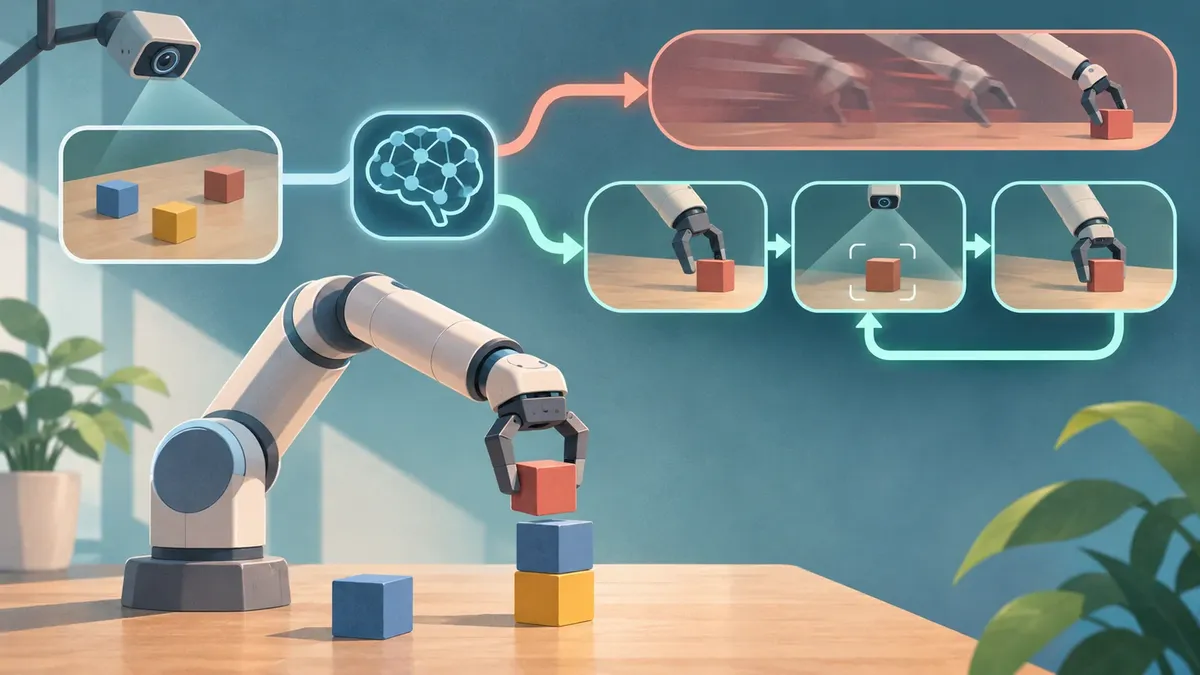
A robot may know what it should do and still fail at doing it. The way its AI sends commands—and gets information back—can shape how often it acts, whether it can correct mistakes, and whether it recognizes when a task is finished. RUIBench puts that interface design question under controlled test.
The question: what makes a good robot interface?
When an AI controls a robot, it needs a way to turn decisions into movement. It might issue tiny motion commands, point to a location in an image, request a predefined skill such as picking something up, or write a short program that strings actions together. These choices affect not only what the robot can do, but how often the AI must pause to make another decision and whether it can inspect the result along the way.
The authors of RUIBench ask how those choices affect task performance. Their central idea is that a capable model can be held back by an interface that demands too many decisions—or by one that lets actions run without enough feedback to catch errors.
How they tested it
The team built RUIBench, a collection of 30 manipulation tasks grouped into five suites: reasoning from prior knowledge, learning from examples, physical discovery, reacting to changing events, and precise manipulation during contact. Tasks include finding an egg under a pot, responding to a Simon Says-style game, and inserting a graphics card into a slot.
They also developed RUIKit, a framework for comparing robot-use interfaces (RUIs) while keeping the robot, perception tools, and evaluation setup consistent. The framework varies two things: the kind of action an AI can specify—such as a joint movement, a target pose, an image point, or a semantic skill—and how actions are organized. The AI can issue one action at a time or write a program that combines actions and can check observations between them. Together, these choices produce 13 interfaces, including one that lets the AI choose among them.
The team tested two frontier coding agents in simulation and fine-tuned a smaller 4-billion-parameter model for each fixed interface. A separate real-robot study involved two frontier agents, five tasks, and 650 episodes on a single robot arm. In simulation, success was judged from recorded physical outcomes—not the agent’s own claim. The real-robot episodes were assessed by a human operator.
Fewer decisions helped—but feedback mattered
In simulation, changing only the interface moved Claude Code’s success rate from 45.3% to 80.7%. The researchers report that this spread was larger than the average success-rate difference between the two frontier agents across interfaces. The result shows how strongly the interface could affect performance in this test setup; it does not mean one design will work best for every agent or task.
Programs helped when agents used them to combine actions and gather feedback. For Claude Code, program-based interfaces raised average simulated success from 64% to 75% and reduced the median number of model replies from 30 to 12. Codex gained much less: its programs typically wrapped a single action rather than composing a longer sequence. So the option to write programs was useful mainly when the agent could make effective use of it.
The paper’s takeaway is not simply “automate more.” A comparison among one-action-at-a-time control, action sequences without intermediate observations, and programs with observations and conditional steps found that combining actions reduced the number of decisions, while feedback within a program added further gains. The balance varied by task: some benefited from executing a known sequence, while discovery and time-sensitive tasks depended more on seeing what happened and adapting.
The smaller model also did better with some interfaces than others after fine-tuning on 300 trajectories per interface. Interfaces that described a target or operation—such as a pose, point, or skill—were easier for it to learn than several lower-level motion-command options. In this study, the best per-action interfaces for all three agents were Pose and Skill. This is evidence about the models and training setup tested, not a general ranking of robot interfaces.
Simulation did not settle the real-world question
Interface preferences changed on the physical robot. For Claude Code, programs outperformed per-action control in simulation but not in the real-robot study: success was 36% with programs and 42% with per-action execution. The authors point to physical uncertainty—such as sensor noise, calibration offsets, and slipping grasps—as a reason opportunities to inspect and correct actions may matter more in reality. This is a proposed explanation grounded in their observations, not proof that one factor caused the shift.
A second problem concerned knowing when to stop. Many failed simulated episodes ended with an agent claiming success: 82.1% for Claude Code and 70.9% for Codex. In a post-hoc analysis of tasks where failure could be judged from the final images, a fresh judge could often recognize failures the agents had seen but not acted on. Checks of individual actions, such as whether an object was grasped or placed, did not reliably establish that the whole task was complete. The authors argue that robots need verification at the task level as well as feedback on individual movements.
What remains uncertain
RUIBench is a benchmark, not a demonstration that these interfaces will improve robots in everyday use. Most experiments were in simulation; the real-robot comparison covered five tasks on one arm. The authors say broader physical testing is needed. Time-critical reactions and contact-heavy tasks also remained difficult across interfaces, suggesting that some corrections may need to happen faster or at finer physical resolution than the tested setups allow.
The findings come from a November 2026 arXiv preprint. A preprint is a public research manuscript and may not have undergone peer review. The results are therefore best read as evidence from a particular benchmark and experimental setup, not as a settled rule for all robots.
- robotics
- robot-use interfaces
- RUIBench
- embodied AI
- robot manipulation
- robot benchmarks
- physical feedback
Reviewed cross-references
These connections were reviewed by a model, not independently fact-checked by a human. Similarity does not imply agreement; consult the original papers and the evidence below.
Robot-coding agents need better failure diagnosis, not just more feedback
Supporting evidence: Both studies suggest that useful feedback depends on how agents can act on it: RUIBench reports that effective robot-use interfaces reduce unnecessary decisions while preserving essential feedback, while the controlled self-learning study finds feedback most effective when aligned with meaningful policy decisions. The studies use different tasks and methods, so this supports a bounded design principle rather than a direct performance comparison.
Model review: · openai-codex/gpt-6-luna
Evidence and provenance
Selected excerpts, not complete papers. PDF extraction can omit figures or damage equations, tables and reading order; sources may be preprints.
2611.31115v1 — Original paper
Excerpt reference:
static/papers/2611.31115v1.md:171-242
Basis: Paper text
Source SHA-256:bdc2fa80a91e68dd525fa49ca781241b98ef855cb54203a9c5ff1fbccc98b2bb2611.09030v1 — Original paper
Excerpt reference:
static/papers/2611.09030v1.md:89-124
Basis: Paper text
Source SHA-256:c6a0598cf7fcdf6b55fd5429102e358e9a23bc01e2396d1f023447d9652fb036
Why computer-savvy AI struggles with a real keyboard
Supporting evidence: Both papers identify a gap between intended actions and successful physical outcomes: RUIBench reports that interface effectiveness changes on a real robot and that agents can claim success despite failures; ROSWorld describes missed or incorrect physical inputs during computer tasks and evaluates outcomes independently. ROSWorld concerns keyboard-and-mouse operation in simulation, not RUIBench’s manipulation tasks, so the evidence supports the relevance of physical execution and outcome checking, not a shared measured effect.
Model review: · openai-codex/gpt-6-luna
Evidence and provenance
Selected excerpts, not complete papers. PDF extraction can omit figures or damage equations, tables and reading order; sources may be preprints.
2611.31115v1 — Original paper
Excerpt reference:
static/papers/2611.31115v1.md:171-242
Basis: Paper text
Source SHA-256:bdc2fa80a91e68dd525fa49ca781241b98ef855cb54203a9c5ff1fbccc98b2bb2611.27467v1 — Original paper
Excerpt reference:
static/papers/2611.27467v1.md:166-244
Basis: Paper text
Source SHA-256:0f329d71e06589f33e6805dd8279fe1102d6b9bc76724272b9ca3a26559712d6
Related reading
Automatically matched by shared topic keywords. These links do not imply that the sources agree or establish a consensus.
A Simulated World for Robots That Learn From Doing
Source published
Shared keywords: embodied ai, robot benchmarks
Robot Memory Fails When the World Keeps Moving
Source published
Shared keywords: embodied ai, robot benchmarks
Robots Need to Know Not Just What to Do, but When
Source published
Shared keywords: robot benchmarks, robot manipulation
Teaching a robot model to predict what its actions will change
Source published
Shared keywords: robot benchmarks, robot manipulation
When Reflections Challenge Robot Policies
Source published
Shared keywords: embodied ai, robot manipulation