TRANSMISSION // 2611.31090v1
Can language models choose which delivery routes to rethink?
Source published
A preprint tests language-model-generated rules on synthetic routing instances and specified solvers. Results vary: some comparisons favor a generated rule, while others show no advantage.
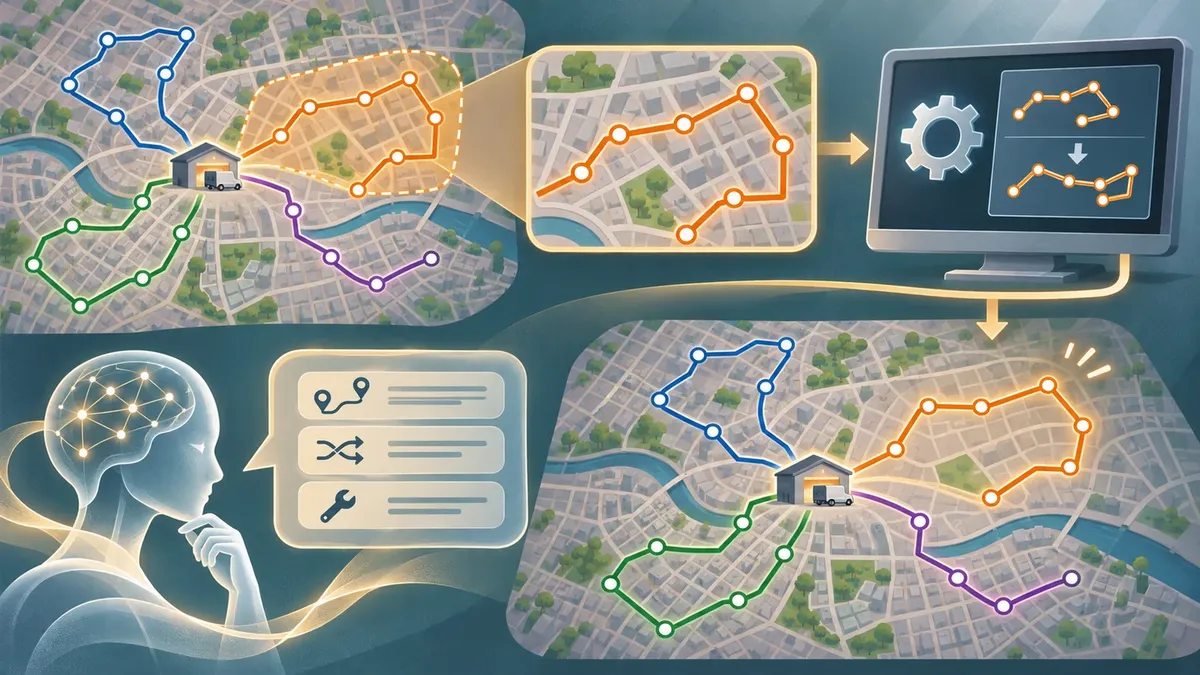
In vehicle routing, improving a plan can mean choosing a group of existing routes and asking a solver to reorganize the customers on them. This preprint tests whether a language model can propose and refine programs for making that choice—not whether it can plan an entire delivery system on its own.
Finding low-cost routes for many customers is computationally challenging because the number of possible combinations grows rapidly. One practical approach is to start with a feasible plan and improve it in pieces: select some routes, rework the customers assigned to them, and keep a feasible change if it lowers travel distance.
A new preprint asks whether a large language model (LLM) can design the rule for selecting those groups. The model does not plan every route itself. It proposes and refines computer programs, or heuristics, that select and rank groups for a separate optimization solver to repair.
Divide, repair, and keep improvements
The study focuses on the capacitated vehicle routing problem (CVRP). Every customer must be served once, routes begin and end at a depot, and each vehicle must stay within its carrying capacity. Starting from a feasible plan, the researchers repeatedly select a group of whole routes, called a delegation. A fixed solver reorganizes the customers on those routes while leaving the rest of the plan unchanged. A repair is accepted only if it is feasible, lowers total distance, and is completed within the time budget.
The researchers compared generated rules with three baselines from the earlier Learning to Delegate (L2D) approach: a hand-built centroid rule and two trained neural-network policies. Those neural policies rank groups formed by a fixed spatial rule; the new programs construct groups as well as rank them.
For discovery, the LLM proposed a hypothesis and a program, whose measured performance informed later proposals. Researchers screened proposals, shortlisted candidates, and chose one on a separate validation set. The selected program was then tested without source changes on held-out instances. Discovery and validation used 500-customer instances from one synthetic family, CVRP-S, with the Lin–Kernighan–Helsgaun (LKH) repair solver. Tests also covered a second generated family, CVRP-X, with 500, 1,000, or 2,000 customers, using LKH and hybrid genetic search (HGS).
The main measure was the percentage reduction in route cost from a shared starting plan. Methods were compared on the same instances and solver seeds, with specified routing time budgets. Adjusted intervals accounted for variability across instances and multiple comparisons.
Results depended on the test setting
On held-out CVRP-S instances, the primary generated program did not demonstrate an advantage over the three baselines. Its mean reduction was 0.07 to 0.17 percentage points lower than theirs, and all three adjusted intervals were below zero.
On CVRP-X with LKH, the primary program had greater mean reductions than both neural L2D policies at all three customer counts, with adjusted intervals above zero in all six comparisons. With HGS, the evidence was narrower: the program exceeded the L2D clustered/mixed policy at 1,000 and 2,000 customers, with adjusted intervals above zero. Other comparisons—including those against the centroid rule—did not establish a clear difference.
The authors also examined two programs that ranked second and third on the validation panel. In an exploratory analysis, both had higher observed mean reductions than the primary program in all seven test panels. These comparisons were made after the transfer results were inspected; they were not a new selection of the primary program. They show that these two candidates did better on these test panels, but do not establish how reliably validation rankings predict performance in general.
The programs use estimates of potential savings from moving or swapping customers between routes when constructing groups. Their code and design hypotheses are available for inspection, but the study does not evaluate interpretability as an outcome. Once a program has been selected, routing can proceed without further LLM calls; the conventional solver still performs the repairs.
Scope and uncertainty
The results provide evidence that programs proposed through this LLM-based search can outperform particular baselines on some generated test settings. They do not show uniform gains: the primary program was lower than the baselines on CVRP-S, and many HGS comparisons were inconclusive. The strongest HGS result was limited to comparisons against one neural policy at two tested sizes.
The experiments used synthetic instances, shared starting solutions and solver seeds, and specified time budgets. These controls make the comparisons more direct within the study, but they do not establish performance on operational delivery data or under other routing constraints. The authors also note that validation used only 500-customer CVRP-S instances with LKH; validation across more instance families, sizes, and repair solvers could better match selection to intended use. Longer whole-instance solver runs served as quality references, not certificates of optimality, and their different budgets do not support a direct matched-budget speed comparison.
This is a preprint, so its claims remain provisional pending independent scrutiny and further testing. It reports results for a particular heuristic-discovery process and set of benchmarks, not a guarantee that language-model-generated rules will improve real-world logistics.
- vehicle routing
- large language models
- optimization heuristics
- capacitated vehicle routing
- operations research
- preprint
Reviewed cross-references
These connections were reviewed by a model, not independently fact-checked by a human. Similarity does not imply agreement; consult the original papers and the evidence below.
Can simpler AI frameworks design better heuristics?
Shared method: Both studies iteratively use an LLM to generate and refine heuristic programs using evaluation feedback: Wang et al. do so for route-delegation selection, while Zhu et al. describe an agent-loop framework for heuristic design. Their tasks and evaluation setups differ, so this methodological overlap does not establish comparable performance.
Model review: · openai-codex/gpt-6-luna
Evidence and provenance
Selected excerpts, not complete papers. PDF extraction can omit figures or damage equations, tables and reading order; sources may be preprints.
2611.31090v1 — Original paper
Excerpt reference:
static/papers/2611.31090v1.md:339-459
Basis: Paper text
Source SHA-256:aae022e78daef4d6c753ca1bfb5631d7636c9c3797aeee89feae9448a3f7cec22609.37172v3 — Original paper
Excerpt reference:
static/papers/2609.37172v3.md:13-74
Basis: Paper text
Source SHA-256:08bd4643538abe70af8b59073d6dc93976557d8d65b1cdfbf86ad3b5b144c8d3
Related reading
Automatically matched by shared topic keywords. These links do not imply that the sources agree or establish a consensus.
Can AI solver skills transfer between optimization problems?
Source published
Shared keywords: large language models
How domain knowledge shapes an optimization search
Source published
Shared keywords: vehicle routing
When a quantum subproblem solver makes ADMM worse
Source published
Shared keywords: optimization heuristics
How Moral Concepts Are Organized Inside Language Models
Source published
Shared keywords: large language models
Why AI Can Get Civil Time Wrong
Source published
Shared keywords: large language models