TRANSMISSION // 2611.31088v1
How MAASAI coordinates astronomy analysis
Source published
MAASAI links language-model reasoning with astronomy tools and literature retrieval. Radio-image tests show promise, but results are task-specific and evaluation remains limited.
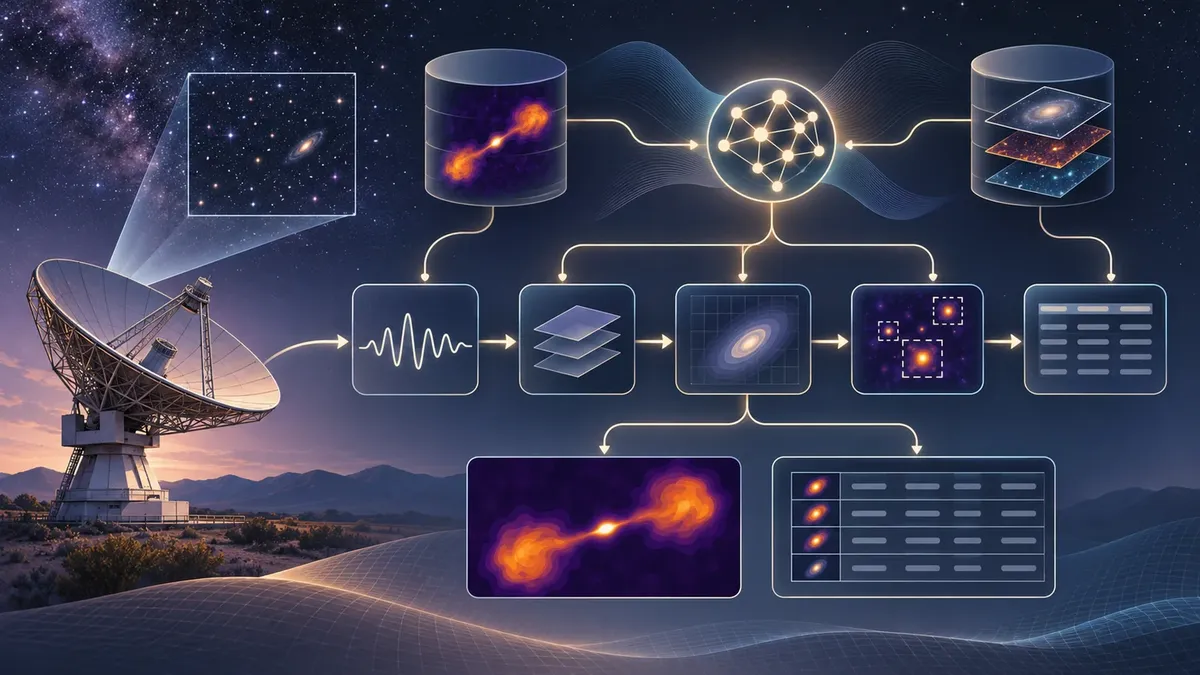
Can a software system help astronomers coordinate specialised tools, archives and data products? MAASAI is a multi-agent framework built to plan and run such workflows. Tests on selected radio-astronomy tasks report stronger scores than a GPT-5.5 baseline on several benchmarks, while leaving open how well the approach generalises.
Astronomical analyses can involve images, catalogues, archives and specialised software. MAASAI—short for Multi-agent Astronomy Assistant for Scientific Analysis and Inference—is designed to help coordinate these pieces through natural-language requests. The authors’ central question is how foundation models can be combined with established scientific capabilities to support multi-step data analysis.
MAASAI uses a graph-based workflow with agents for request preparation, planning, execution and response synthesis. Specialised workers handle different kinds of data and tasks, while a retrieval system can supply literature passages and astronomy software performs scientific operations. The framework tracks intermediate products and their provenance, offers optional human approval, and supports configurable model backends, including local open-weight models. It is a tool for orchestrating analyses, not a demonstration of fully automated scientific research.
How the system was tested
The evaluation focused mainly on radio astronomy. For its image benchmarks, the researchers ran MAASAI with a locally hosted Gemma4:31b model and compared it with GPT-5.5, using the same inputs and task instructions. One benchmark tested classification of extended and diffuse emission in 5,718 annotated images; another tested six radio-source morphology classes in 3,835 images.
A third benchmark combined image assessment, source detection and morphology classification. It used 450 ASKAP EMU Pilot Survey images with annotations added by the researchers to provide ground truth. The comparison was between complete systems: GPT-5.5’s internal source-detection procedure was not exposed, so the results do not compare MAASAI’s specialist tools with GPT-5.5 performing unaided visual reasoning.
The paper also presents workflow demonstrations involving source measurements, archive retrieval, source extraction, cross-matching and catalogue comparison. These illustrate coordination rather than providing formal benchmark evidence for every operation; the authors report, for example, that some requested archive products were unsupported or unavailable.
For literature-grounded reasoning, MAASAI answered 94 radio-astronomy questions using retrieved sources. GPT-5.5 acted as an automated judge, scoring answers on five criteria, including scientific correctness, literature support and treatment of uncertainty. Astronomers reviewed a subset: 59 answers received at least one expert assessment.
What the results show
On the extended-and-diffuse-emission benchmark, MAASAI’s macro-averaged F1 score was 0.72, compared with 0.53 for GPT-5.5. The result varied by class: GPT-5.5 scored higher on extended sources, which the authors identify as a relative weakness for MAASAI.
On the separate six-class morphology benchmark, MAASAI’s macro-averaged F1 was 0.88, versus 0.37 for GPT-5.5. In the composite benchmark, source-detection F1 was 70.2% for MAASAI and 60.7% for GPT-5.5. But the composite task exposed continuing difficulties: MAASAI often confused the less common EXTENDED-MULTISLAND category with EXTENDED sources, and some images labelled PECULIAR were classified as COMPLEX.
The workflow demonstrations show that MAASAI could coordinate several tools and return structured results with provenance. In one archive-assisted example, it completed source extraction and SIMBAD cross-matching, while GPT-5.5 could not access the relevant query service in its execution environment. These examples show what the framework did in specific settings, not that it will reliably complete every archive workflow.
Automated ratings of the literature answers were generally favourable, with completeness and literature support among the weaker criteria. Expert reviewers also gave positive average scores, but the pilot was limited and uneven: reviewer agreement was generally low or uncertain, and agreement between human and automated scores was weak. The assessments therefore do not establish a dependable measure of answer quality.
What remains uncertain
The benchmark comparisons assess MAASAI and GPT-5.5 as whole systems. They do not isolate how much of the difference comes from the model, tools or workflow design. Nor do results against this one baseline show that MAASAI will outperform general-purpose models across astronomy. The evaluation is primarily about radio astronomy; broader performance has not been systematically tested.
Multi-stage workflows require sequential model inferences, which can add latency; the authors report that execution can take several minutes with their local setup. Straightforward requests may follow a single-step plan, so this limitation does not apply equally to every task.
This work is an arXiv preprint, and the supplied record does not establish peer review. The paper says the software is intended for public release upon acceptance. Its findings are best read as evidence that a coordinated system can connect language-model reasoning with established astronomical tools on selected tasks—not as proof that it can independently produce reliable scientific conclusions.
- MAASAI
- radio astronomy
- astronomical data analysis
- AI agents
- scientific software
- large language models
Reviewed cross-references
These connections were reviewed by a model, not independently fact-checked by a human. Similarity does not imply agreement; consult the original papers and the evidence below.
Turning Factory Event Logs Into Simulations With AI
Shared method: Both preprints describe multi-agent systems that coordinate tool-assisted workflows: MAASAI uses graph-based orchestration for astronomical analysis, while GenAI4SimPy divides event-log-to-simulation generation into sequential phases coordinated by an orchestrator. This is a bounded architectural similarity, not evidence that their performance or validation is comparable; the excerpts are selective.
Model review: · openai-codex/gpt-6-luna
Evidence and provenance
Selected excerpts, not complete papers. PDF extraction can omit figures or damage equations, tables and reading order; sources may be preprints.
2611.31088v1 — Original paper
Excerpt reference:
static/papers/2611.31088v1.md:13-66
Basis: Paper text
Source SHA-256:d376cce8e85a7773d5c34139d5464c8fbef757ee9eb5dcdc8309ddc661982fea2611.27483v1 — Original paper
Excerpt reference:
static/papers/2611.27483v1.md:238-314
Basis: Paper text
Source SHA-256:7c70b1cd1f871aec2fc34a27b305f22ed20792b5cc708935be7a0b55fc2968af
Related reading
Automatically matched by shared topic keywords. These links do not imply that the sources agree or establish a consensus.
AI agents search for faster atom-simulation algorithms
Source published
Shared keywords: scientific software
A New Blueprint for AI-Assisted Materials Software
Source published
Shared keywords: large language models, scientific software
A Benchmark for AI Edits to Earth System Models
Source published
Shared keywords: scientific software
A project notebook for guiding MRI AI agents
Source published
Shared keywords: ai agents
Targeted AI repairs improve scientific code translation—but simple tests miss errors
Source published
Shared keywords: ai agents