TRANSMISSION // 2611.31063v1
How local mistakes travel through AI teams
Source published
REPA models how errors move between language-model agents, and tests whether local measurements can predict system-level effects and guide repairs.
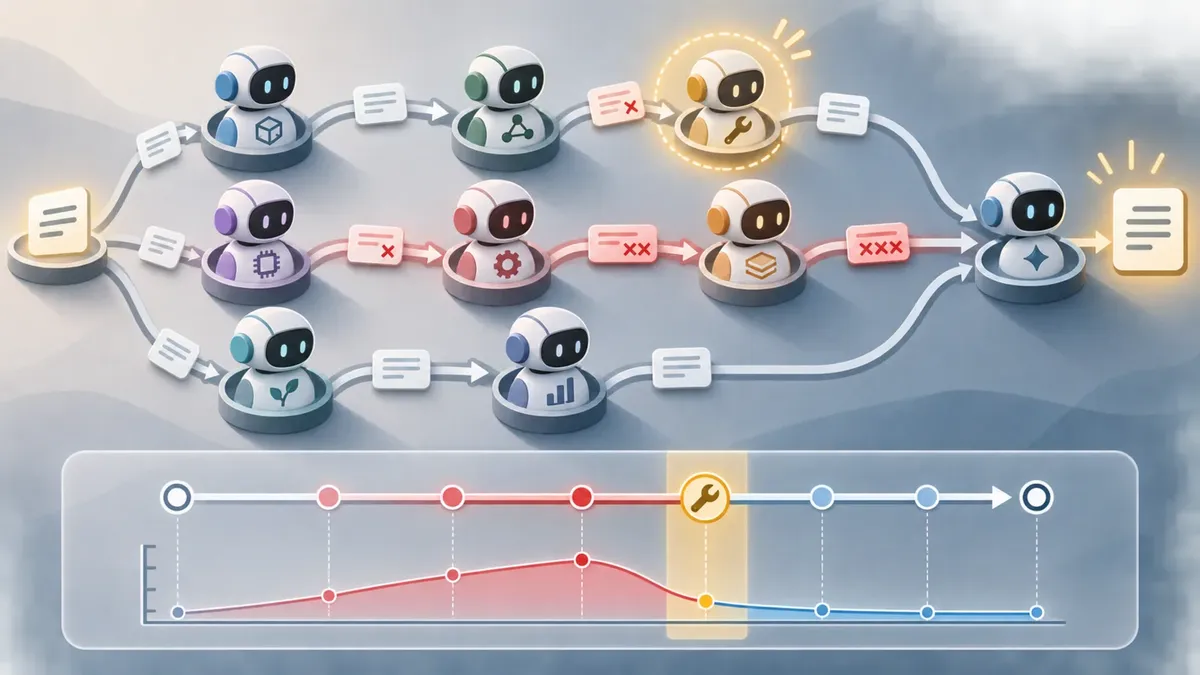
A wrong message from one AI agent can shape what other agents say next. A new preprint proposes a way to measure that chain—not just whether the final answer is right or wrong.
When several large language models work together, one agent’s mistake can become another’s starting point. But a correct final answer does not reveal whether the team corrected an earlier error, ignored it, or reached the right result another way. A wrong answer, meanwhile, does not show where the failure began.
In “From Local Errors to System Failures,” Wenlong Yu and colleagues introduce Response-Aware Error Propagation among Agents, or REPA. The method estimates how changes in an agent’s input relate to changes in its output, then combines those local estimates to predict how errors may appear at the end of a multi-agent workflow.
Measuring the links in the chain
The researchers compared paired runs of the same question: a reference run and a perturbed run, in which an error was introduced. An evaluator scored differences in agents’ inputs and outputs across error categories, including factual errors and hallucinations. REPA separately estimates how an agent’s input is assembled from the task and messages from other agents, and how the agent responds to that input.
The method combines these estimates along the workflow’s communication structure. In effect, it asks how a change introduced upstream might be transformed as it passes through downstream agents. Once the local response models are fitted, REPA predicts an endpoint response using the source discrepancy and workflow structure—not downstream messages or the final answer from the test run.
The evaluation covered three Qwen model configurations, six multi-agent workflows, and ten knowledge and reasoning settings in the ErrPropBench-10 benchmark. The main controlled error-injection and recovery studies used HotpotQA, a dataset of questions requiring reasoning across multiple documents. The broader benchmark included seven knowledge domains and three multi-hop question-answering settings.
What the study found
Across the three Qwen configurations, REPA’s mean condition-level Spearman correlation was 0.84, compared with 0.47 for direct regression, according to the abstract. Spearman correlation measures whether two sets of results tend to rank cases in the same order. Here, the comparison suggests REPA was better at ranking conditions by measured error propagation; it does not mean that its predictions were 84% accurate. The detailed results report correlations from 0.83 to 0.85 across the configurations, and lower prediction error than the tested regression alternatives.
The researchers also tested whether REPA could help choose where to intervene. In controlled experiments, they disabled agents’ task-processing functions and compared strategies for restoring one agent’s original prompt. REPA-guided selection brought answer accuracy closer to that of the healthy workflow than the other tested selection approaches.
In a separate retrieval-augmented generation (RAG) experiment, retrieved evidence was supplied to a selected agent. The abstract reports an average accuracy improvement of 19 percentage points over providing no retrieval, with 16% additional tokens. The detailed paper shows that benefits and token costs varied by model and comparison: REPA-RAG used fewer tokens than supplying evidence to every agent, but accuracy was not uniformly higher across models.
What the results do—and don’t—show
The findings support REPA as a way to study and predict error responses in the tested settings, not as a guarantee that an AI team will avoid failure. Its predictions depend on evaluator measurements, and the paper’s audit found that agreement varied by error category. The authors emphasize factual errors and hallucinations; some other channel judgments were less consistent. The audit also did not retrospectively validate the scoring protocol used for archived prediction results.
The prediction baselines were regression models, not direct experimental comparisons against every existing failure-diagnosis or recovery method. The authors note that broader domains, other model families, heterogeneous teams, and changing tool-using systems remain to be tested. Results from controlled benchmark questions may not transfer directly to real-world tasks.
This is an arXiv preprint, not evidence of peer review. Its findings are best read as a proposed measurement framework and an initial evaluation. The central idea reaches beyond REPA: understanding a team’s final answer may require tracing what each agent received and how it responded along the way.
- multi-agent systems
- large language models
- error propagation
- AI evaluation
- retrieval-augmented generation
- REPA
Reviewed cross-references
These connections were reviewed by a model, not independently fact-checked by a human. Similarity does not imply agreement; consult the original papers and the evidence below.
Failed AI agents often had evidence of their mistakes, a trace study finds
Supporting evidence: Both motivate tracing intermediate errors rather than relying only on final outcomes: REPA models how measured local responses relate to system-level propagation, while Wang et al. report that errors often enter before the decisive step and that contradictory evidence in failed trajectories often goes unused. This supports the bounded value of intermediate-state analysis, not REPA’s predictive accuracy: REPA uses controlled paired executions, whereas Wang et al. annotate 95 failed runs from two corpora, and their proposed controls were not tested as interventions.
Model review: · openai-codex/gpt-6-luna
Evidence and provenance
Selected excerpts, not complete papers. PDF extraction can omit figures or damage equations, tables and reading order; sources may be preprints.
2611.31063v1 — Original paper
Excerpt reference:
static/papers/2611.31063v1.md:39-88
Basis: Paper text
Source SHA-256:71ec9bac414ebed8a7ed529f5949a0e01680ba2a37fe3fc0f3f9b9b5187d3fe62611.13254v1 — Original paper
Excerpt reference:
static/papers/2611.13254v1.md:97-153
Basis: Paper text
Source SHA-256:447ab3951fa14949eaeaf42f4214658d67dc4a98e3d1e78563c7ad563df5f5f5
Related reading
Automatically matched by shared topic keywords. These links do not imply that the sources agree or establish a consensus.
Can One AI Agent Learn From a Whole Team?
Source published
Shared keywords: large language models, multi agent systems
When should a digital twin be trusted—and what should it change?
Source published
Shared keywords: error propagation, multi agent systems
Failed AI agents often had evidence of their mistakes, a trace study finds
Source published
Shared keywords: error propagation, multi agent systems
Can retrieving dog-care information help AI give better advice?
Source published
Shared keywords: ai evaluation, large language models, retrieval augmented generation
EvoML checks machine-learning workflows in stages and saves successful fixes
Source published
Shared keywords: multi agent systems