TRANSMISSION // 2611.31038v1
A smarter starting point for robot actions
Source published
Boltz-Flow changes the noise that a robot policy starts from, using task-conditioned energy scoring to seek action sequences that better match demonstrations. Tests report gains across simulation benchmarks and five real-world tasks, though the evidence has limits.
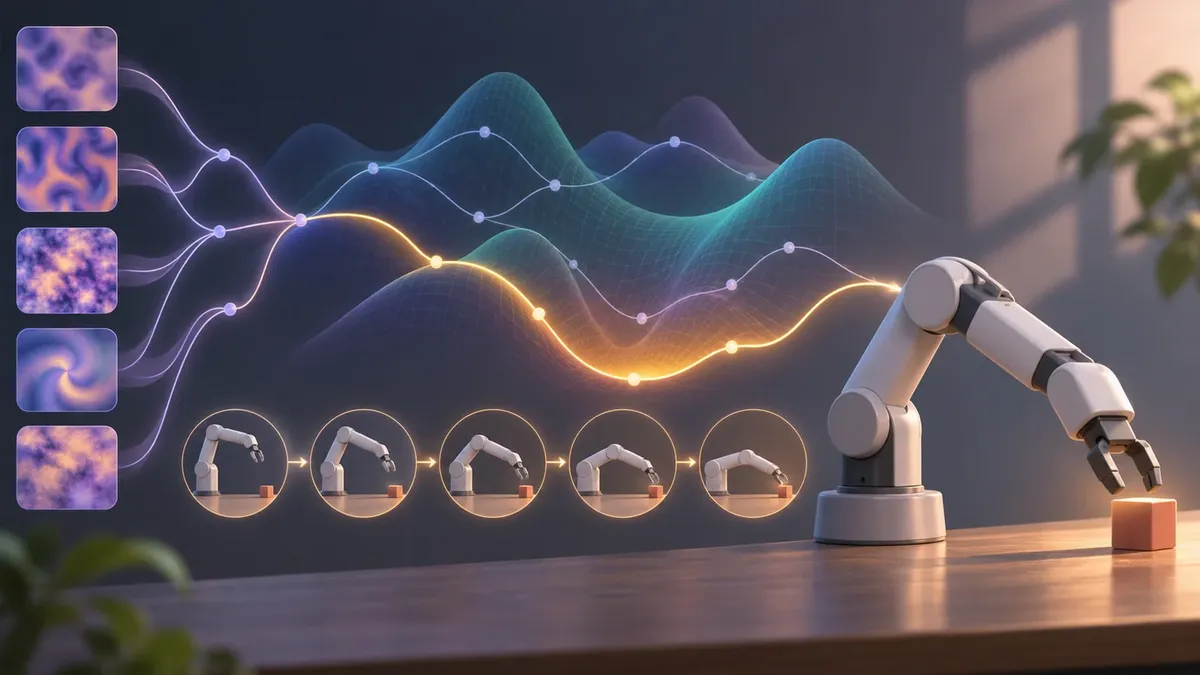
A robot policy can generate different actions from the same scene depending on the noise used to start its calculation. Boltz-Flow learns to choose that starting point based on the observation and instruction, while leaving the main action-generating model frozen in its core evaluation. The authors report improvements on several benchmarks, but the results come from a preprint and do not establish how well the method will work across robots and settings beyond those tested.
A robot asked to move an object may have several plausible ways to do it. In a flow-matching policy, the robot starts with noise and gradually transforms it into a sequence of actions. The question behind Boltz-Flow is whether choosing that starting noise more carefully can help the policy produce better movements.
Many such policies start from the same kind of Gaussian noise, regardless of the scene or instruction. Boltz-Flow’s authors argue that this starting point may not capture useful relationships across a sequence of movements—for instance, how arm position, orientation and gripper control need to work together. Their proposal is to make the starting noise depend on what the robot sees and what it has been asked to do.
Learning which starting points are useful
Boltz-Flow adds a conditional Boltzmann machine, an energy-based model that gives different scores to possible starting states. In everyday terms, it learns which starting points are more likely to lead the existing robot policy toward an action resembling a demonstration.
The system first represents candidate starting states as binary variables. The observation and instruction condition an energy landscape over those states: lower-energy states are preferred. An Ising optimization solver searches for promising configurations, which are then converted into continuous noise. The robot’s original flow-matching policy uses that noise to produce actions through its usual integration procedure. In the central frozen-policy setup, the policy itself is not changed; Boltz-Flow changes where its action-generation process begins.
Training uses offline demonstrations rather than new robot interactions. The researchers generate candidate starting states, run each through the frozen policy, and compare the resulting actions with demonstrated actions. A listwise learning objective trains the energy model to rank better candidates more favorably. The paper reports using a physical coherent Ising machine (CIM) for some training experiments; simulated annealing is also used as a solver, including for inference in several reported comparisons.
Reported results—and their scope
The main simulation tests use LIBERO, LIBERO-Plus and RoboTwin 2.0, with the π₀.₅ policy as the primary backbone. On LIBERO, the paper reports average success of 98.6% for Boltz-Flow, compared with 94.7% for its reproduced baseline. Adding noise-adapted fine-tuning—now updating the policy as well as adapting to the new starting source—raises the reported average to 99.1%. On LIBERO-Plus, which tests the same task set under controlled perturbations, Boltz-Flow reaches 85.9% overall versus 82.3% for the baseline. The paper also reports improvements on RoboTwin 2.0 in both its clean and randomized settings.
Those results do not mean Boltz-Flow leads every comparison. On LIBERO-Plus, the paper’s listed LEAP result is 87.5%, above Boltz-Flow’s 85.9%. The authors also test five real-world manipulation tasks, with 10 trials per task for each of two systems. Across those 50 trials per system, the reported success rate rises from 46% for the OpenPI baseline to 62% for Boltz-Flow. That is an encouraging result, but a small set of trials on five tasks cannot establish reliability across other robots, objects or environments.
The authors report additional tests in which the approach transfers to the SmolVLA backbone and combines with an action-to-action warm start. These are evidence that the method can work beyond one configuration, not proof that it will generalize broadly. Some comparisons also use different solver choices or rely on results reported by earlier work, so benchmark rankings should be read in the context of each evaluation setup.
What remains uncertain
The study supports a focused conclusion: learning a task-conditioned starting distribution can improve the tested flow-matching policies. It does not show that Gaussian starting noise is generally inadequate, or that Boltz-Flow will improve every robot task. The tests are benchmark-based, and the real-world evaluation is limited in scale. The added optimization procedure also introduces practical choices about solver and inference, rather than demonstrating that the method is universally faster or simpler.
This article is based on an arXiv preprint, not a peer-reviewed publication. Its results are the authors’ reported experiments, and independent replication would help establish how robust they are. In particular, broader physical-robot testing and careful comparisons of solver speed and cost would clarify what the method offers in deployment. For now, Boltz-Flow is best understood as a promising way to improve the starting conditions of an existing action generator—not a replacement for the robot policy itself.
- robot learning
- Boltz-Flow
- flow matching
- vision-language-action models
- robot manipulation
- Boltzmann machine
Related reading
Automatically matched by shared topic keywords. These links do not imply that the sources agree or establish a consensus.
How to Help Robot AI Remember Language While Acting
Source published
Shared keywords: robot learning, robot manipulation, vision language action models
Why robot actions may need only one generative step
Source published
Shared keywords: flow matching, robot manipulation, vision language action models
Can a general AI model control a robot arm?
Source published
Shared keywords: robot learning, robot manipulation, vision language action models
A small change helps robot arms coordinate
Source published
Shared keywords: flow matching, robot learning, vision language action models
Teaching Robot AI to Focus on Motion, Not Scenery
Source published
Shared keywords: robot learning, robot manipulation, vision language action models