TRANSMISSION // 2611.31021v1
Why visual features help AI reason about camera movement
Source published
LatentParse turns hidden features from vision encoders into short reports that vision-language models can use. In benchmark tests, gains were strongest for camera questions, while multi-step reasoning sometimes worsened.
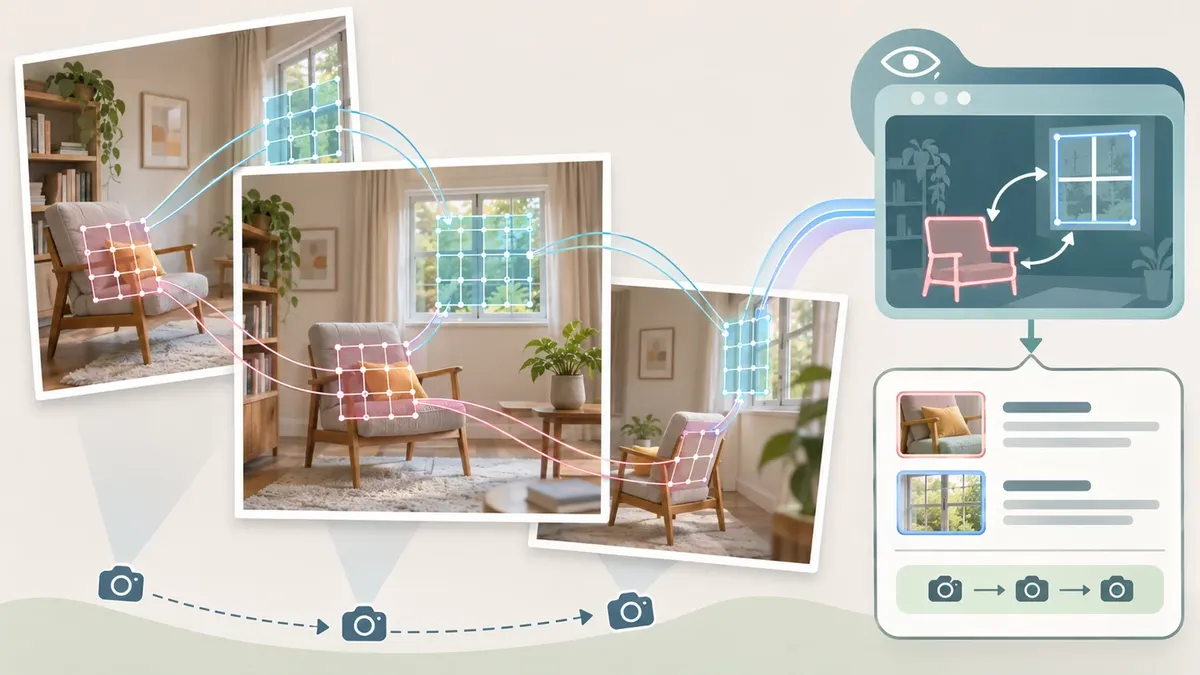
A model may detect useful information in an image without knowing how to use it. A new preprint tests whether translating visual features into explicit evidence can help AI reason across multiple views—and finds benefits that depend strongly on the kind of question.
The question: can AI use what its vision systems already know?
When people compare photos taken from different viewpoints, they can often work out whether the camera moved, whether an object shifted, or how two things are positioned. Vision-language models (VLMs), which answer questions about images, can struggle with these tasks: the clues may be spread across several views, and a single image rarely reveals a full 3D layout.
The authors of Parsing Visual Latents for Multimodal Spatial Reasoning ask whether information already present inside pretrained vision systems can help. Their proposed method, LatentParse, does not train the VLM to interpret those features. Instead, it tries to turn relationships encoded in them into a compact text report.
How LatentParse works
The method draws on three pretrained image encoders. CLIP helps connect object names with image regions; DINOv3 compares visually meaningful regions within and across views; and VGGT encodes relationships between multiple views. The researchers use the encoders’ internal patch features—not VGGT’s decoded depth maps, 3D points, or camera poses.
A VLM first acts as an analyst. It cannot see the photos, but it can use predefined tools to inspect the features: for example, locating an object, tracking it across views, or estimating how image content shifts. The tools compare features within each encoder, and the analyst uses agreement between encoders to judge how reliable a finding appears. It then writes a short report. In a separate step, the VLM receives the original photos, the question, and that report, and gives its answer.
The team tested five VLMs on three benchmarks: MMSI-Bench, MV-RoboBench, and SPAR-Bench. They compared LatentParse with a photo-only baseline and with a simple alternative that presented the features directly as grayscale images. They also tested controls, including features taken from a different question, and compared an analyst that chose tools with one that followed a fixed sequence.
What the tests found
Across the three benchmarks, LatentParse improved the average accuracy of all five tested models over the photo-only baseline by 0.7 to 2.4 percentage points. Simply adding the feature images did not produce consistent gains. This distinction matters: in these tests, the useful step was not merely supplying more visual input, but expressing relationships measured in the features as evidence the answering model could read.
The clearest improvement was on camera-related questions in MMSI-Bench. For Qwen3.8-27B, the paper reports accuracy rising from 34.4% to 39.5% across that benchmark. On its camera-related questions, accuracy increased from 31.4% to 50.6%. The authors also report that using features from another question removed the gain in a control test, suggesting that matching the features to the scene mattered.
The results were not uniformly positive. For the same model on MMSI-Bench, LatentParse lowered accuracy on multi-step reasoning questions: among paired questions, the score fell from 35.9% to 26.2%. The authors describe examples where a report pointed toward the wrong choice or misread the direction of camera movement. On some other benchmark categories, scores also fell. Overall averages therefore conceal important differences between task types.
What remains uncertain
These are benchmark results, not evidence that the method will improve spatial reasoning in everyday settings or in a robot operating in the world. The study tested a particular set of models, datasets, tools, and feature encoders. Some tool settings were manually designed and calibrated, and the analysis step added substantial processing time: in one small comparison, it took about 99 seconds per question for the tool-choosing analyst, compared with 79 seconds for a fixed sequence. The tool-choosing version did not significantly outperform that fixed sequence in the reported comparison.
The paper also notes that the gains are concentrated in camera-related questions and that multi-step reasoning can suffer. The authors suggest that future work could choose between photo and feature evidence based on the question. That is a research direction, not a result established here.
This article is based on the paper text supplied for an arXiv preprint, not independent replication or a confirmed peer-reviewed publication. Preprints can change, and benchmark accuracy does not by itself show why a method succeeds or how well it generalizes. The findings are best read as evidence that structured reports from visual features may help on some multi-view tasks, while leaving reliability and broader applicability open.
- vision-language models
- spatial reasoning
- LatentParse
- computer vision
- multimodal AI
- camera motion
Reviewed cross-references
These connections were reviewed by a model, not independently fact-checked by a human. Similarity does not imply agreement; consult the original papers and the evidence below.
WorldMind tests spatial reasoning without turning every imagined view into an image
Supporting evidence: Both studies report improved spatial-reasoning results when models receive structured latent spatial evidence: LatentParse turns encoder-feature measurements into a text report, while WorldMind exposes aligned world-model features during simulated viewpoint changes. This supports the bounded idea that latent evidence can aid spatial reasoning, but the systems, training regimes and evaluations differ, so the results are not a direct comparison.
Model review: · openai-codex/gpt-6-luna
Evidence and provenance
Selected excerpts, not complete papers. PDF extraction can omit figures or damage equations, tables and reading order; sources may be preprints.
2611.31021v1 — Original paper
Excerpt reference:
static/papers/2611.31021v1.md:216-278
Basis: Paper text
Source SHA-256:e672a316539ac2a7ea721d00580e2a5ceefe52b3d41b2b43de1ec4e72df7f8062611.10151v1 — Original paper
Excerpt reference:
static/papers/2611.10151v1.md:175-217
Basis: Paper text
Source SHA-256:ec68e3e4d614bf5145dff43ee4393ebed691a9619d53a46141031431b199d2032611.10151v1 — Original paper
Excerpt reference:
static/papers/2611.10151v1.md:946-1023
Basis: Paper text
Source SHA-256:ec68e3e4d614bf5145dff43ee4393ebed691a9619d53a46141031431b199d203
Related reading
Automatically matched by shared topic keywords. These links do not imply that the sources agree or establish a consensus.
PruneGround narrows the search for objects in 3D scenes
Source published
Shared keywords: computer vision, spatial reasoning, vision language models
EgoLAM separates hand motion from camera motion
Source published
Shared keywords: camera motion, computer vision
Teaching vision-language AI when a short answer is enough
Source published
Shared keywords: multimodal ai, vision language models
How Event Cameras Learn Depth Without Dense Labels
Source published
Shared keywords: computer vision
Why hospital AI still struggles to think in 3D
Source published
Shared keywords: multimodal ai, spatial reasoning