TRANSMISSION // 2611.31012v1
AI Decision Models Show Promise for Early Emergency Assessment
Source published
In retrospective tests, 16 AI decision models had limited accuracy for full symptom triage. At specified error margins, drex-max could make an early emergency decision for 51.8% of cases; this does not justify replacing existing systems.
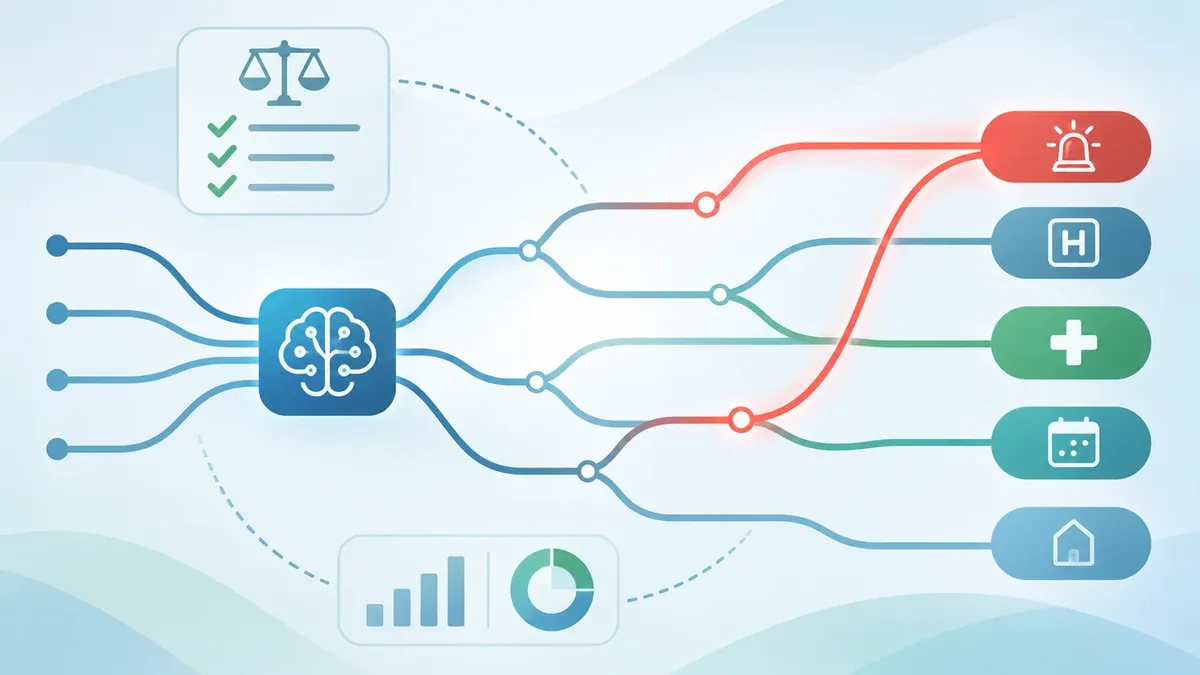
Could an AI system assess whether a case might be an emergency before a symptom checker finishes asking questions? Researchers tested 16 decision models—systems that choose from fixed care categories and return probabilities—to assess their triage accuracy and explore whether they could help make an emergency decision earlier.
Fixed choices, structured outputs
People increasingly use AI for health information, including decisions about whether to seek care. Free-text advice can be difficult to evaluate consistently: responses may vary in wording, and their meaning has to be interpreted. That concern motivated this study, but the researchers did not test whether the decision models they evaluated were more repeatable than chatbots.
Decision models choose among options defined in advance, such as self-care or emergency care, and return a probability for each option. Those values are model outputs; they should not be assumed to be calibrated probabilities or direct estimates of clinical risk.
The researchers asked how accurately these models could assign a triage category and whether, even if they could not make the full triage decision reliably, they might help identify emergencies using information available earlier in an assessment.
How the study worked
The team evaluated 16 models: 14 open-weight systems and two proprietary systems. They tested the models on 233 synthetic cases and 10,000 real-world records from a symptom-assessment application used in Germany. Together, these produced 163,728 assessments: 3,728 on synthetic cases and 160,000 on real-world records.
For synthetic cases, the reference triage levels came from the original publications. The case sets’ levels had been assigned by at least two licensed physicians; specifically, the Delshad set used a physician majority vote. For real-world records, the reference was the triage level assigned by the application—not an independent clinical judgment.
The researchers supplied synthetic cases in their original text form. Real-world cases were provided as structured German-language data, including demographics, the main complaint, risk factors, red-flag answers and other symptom responses. Models were asked to choose from fixed triage options. The team also tested a sequence of yes-or-no questions and an early-recognition setup that used only demographics, the main complaint, risk factors and red-flag answers.
The analyses were exploratory. For emergency recognition, researchers used separate probability thresholds to limit two kinds of error: missed emergencies and non-emergencies incorrectly flagged as emergencies. The proposed approach would let cases between thresholds continue through the assessment; in settings focused only on an emergency decision, cases below the rule-out threshold could instead finish. The team used 10-fold cross-validation to estimate performance: thresholds were set using nine folds and tested on the held-out fold.
What the results show
On synthetic cases, the top-performing model correctly matched the reference triage level in 72.1% of cases. On real-world records, the highest agreement with the application’s recommendation was 56.1%. That figure measures agreement with the app, not clinical correctness. All models tended toward overtriage on synthetic cases; 15 of 16 did so on real-world records. A frequent error was classifying self-care cases as needing non-emergency care.
Splitting triage into a sequence of binary questions did not consistently improve agreement: it increased for some models and decreased for others. The results do not establish decision trees as a general solution to triage accuracy.
The more promising finding concerned emergency recognition using reduced input. The open-weight model drex-max had the highest AUROC, 0.874. AUROC measures how well a model ranks emergencies above non-emergencies; it does not mean the model correctly identified 87.4% of cases.
Using separate thresholds, the researchers aimed for missed-emergency and false-alarm shares of about 5% each. In held-out cases, the observed shares were approximately 4.8–5.0% for missed emergencies and 4.9–5.0% for non-emergencies flagged as emergencies. For drex-max specifically, the emergency decision could be made after the red-flag questions for 51.8% of cases at these margins. This was a retrospective analysis of model outputs, not a test of a deployed system or a demonstrated improvement in patient care. Coverage differed by model and by the chosen error margins.
Limits and implications
The two case sources have different limitations. Synthetic cases had physician-assigned reference levels but may not capture the variety of real patient situations. Real-world records describe actual user interactions, but their comparison standard was the app’s own recommendation, so disagreements could reflect errors by either the model or the app.
All real-world records came from one German application, whose questions and symptom categories shaped the information provided to models. Synthetic cases were in English, while real-world cases were in German; language may have contributed to differences. The researchers also note that prompts and response options can affect results. They tested general-purpose models without triage-specific adaptation.
The study’s conclusion is cautious: the tested decision models should not replace existing triage engines. Their probabilities may warrant further evaluation as a way to identify some emergencies earlier, with uncertain cases handled according to the needs of a particular care setting. Acceptable error margins require clinical and regulatory judgment.
This article is based on an arXiv preprint, which may not have undergone peer review. The study was retrospective and exploratory; it does not show that the tested systems are approved, ready for medical use, or beneficial in a real-world workflow. Further research would need to test other applications, languages and adapted models.
- AI triage
- symptom assessment
- decision models
- emergency recognition
- healthcare AI
- preprint
Reviewed cross-references
These connections were reviewed by a model, not independently fact-checked by a human. Similarity does not imply agreement; consult the original papers and the evidence below.
A proposed evidence-sufficiency triage for clinical AI
Shared method: Both studies use decision models that assign probabilities to predefined options and apply thresholds to support an early or selective decision. The symptom-assessment study evaluates early emergency recognition, while Qiu et al. assess whether clinical evidence supports a diagnosis and route cases among single-run acceptance, repeated assessment, or clinician review. This is a methodological connection, not evidence that their tasks, thresholds, or performance transfer between settings.
Model review: · openai-codex/gpt-6-luna
Evidence and provenance
Selected excerpts, not complete papers. PDF extraction can omit figures or damage equations, tables and reading order; sources may be preprints.
2611.31012v1 — Original paper
Excerpt reference:
static/papers/2611.31012v1.md:53-97
Basis: Paper text
Source SHA-256:51caa23515bee1aff9368b9113cdd787b47006781a479bd2ea6ca4d4009cfd3f2611.31012v1 — Original paper
Excerpt reference:
static/papers/2611.31012v1.md:98-145
Basis: Paper text
Source SHA-256:51caa23515bee1aff9368b9113cdd787b47006781a479bd2ea6ca4d4009cfd3f2611.27390v1 — Original paper
Excerpt reference:
static/papers/2611.27390v1.md:179-254
Basis: Paper text
Source SHA-256:49c82fb3cdf6531010e79dec1c93e19e6db2f01baf7de3c36510bf2bf1160337
Related reading
Automatically matched by shared topic keywords. These links do not imply that the sources agree or establish a consensus.
A proposed evidence-sufficiency triage for clinical AI
Source published
Shared keywords: ai triage
When Clinician Edits Help—and When They Could Teach AI to Make Things Up
Source published
Shared keywords: healthcare ai
Why hospital AI still struggles to think in 3D
Source published
Shared keywords: healthcare ai
Fast AI decision models followed shopping defaults almost every time
Source published
Shared keywords: decision models
Can decision models match records for less?
Source published
Shared keywords: decision models