TRANSMISSION // 2611.30986v1
A new way to steady reward training for diffusion models
Source published
iTDM changes how diffusion models learn from rewards, aiming to prevent a mismatch between generated examples and the model being updated from destabilizing training.
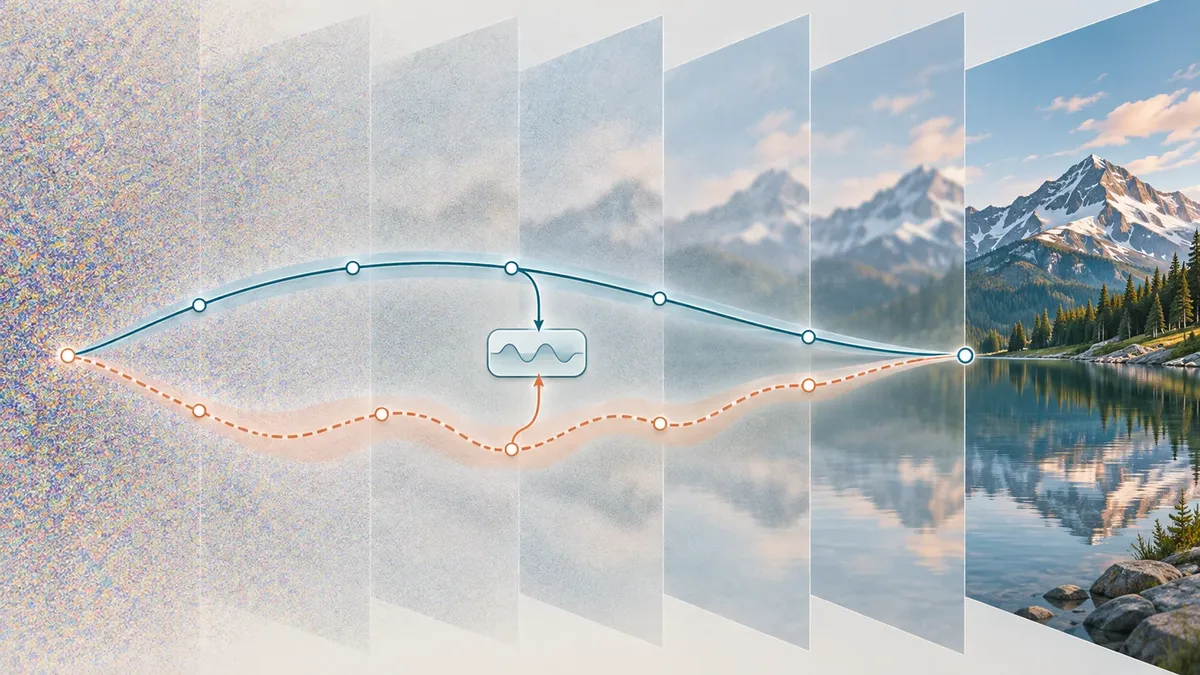
Training an image generator to follow prompts or preferences is not just a matter of rewarding good outputs. The training update must also account for how those outputs were produced. A preprint proposes iTDM, a method designed to keep that distinction from causing drift.
Why the training update matters
Diffusion models generate images by gradually transforming noise into a result. Reinforcement learning can further tune them to perform tasks such as following detailed prompts, rendering text, or producing images that score well on a preference measure. Some newer approaches make this tuning more efficient by using deterministic sampling and avoiding backpropagation through the entire generation path.
The paper argues that these methods can run into a mismatch: the examples used for training come from a behavior policy—the process that generated them—while the model being updated has its own predicted velocity, or direction of movement through the diffusion process. Those velocities need not match. The difference may arise, the author says, with classifier-free guidance, training from fixed or older samples, or before an online model has become self-consistent.
Many existing methods are described as a form of signed reward-weighted regression. They weight a training error by a reward or by an advantage: a reward adjusted relative to a baseline, often the average reward for a prompt. Baselines are commonly used to reduce noise in reinforcement-learning updates. But the paper’s theoretical analysis says that, in this particular regression setup, baseline subtraction can change the expected update when the behavior and trainable policy velocities differ. The author calls the resulting effect baseline-induced gradient drift.
What iTDM changes
Instantaneous Trajectory Distribution Matching, or iTDM, instead frames each update as matching the model toward a reward-guided target distribution at a particular noise level. The method uses a mathematical identity to turn that target into a sample-level update, without training a separate network to estimate the reward-guided target score.
It does, however, use an auxiliary denoiser: a second, lightweight model component trained to estimate the behavior distribution’s velocity from re-noised generated samples. The policy update is anchored to this estimate, while a pretrained reference model provides regularization. In the paper’s theory, baseline invariance holds exactly when the auxiliary estimator reaches its optimum. In practice, the estimator is learned, so the guarantee is approximate to the extent that its velocity estimate is inaccurate; the paper discusses this error explicitly.
The experiments use Stable Diffusion 3.5 Medium at 512-by-512 resolution, with lightweight LoRA adapters. They examine online training with and without classifier-free guidance, as well as offline training from samples produced by a frozen model. Tasks include compositional image generation, text rendering, and preference alignment. The reported evaluation includes task-specific measures and additional measures on DrawBench prompts intended to check performance beyond the training targets.
What the paper reports—and what it does not establish
Across these experiments, the author reports that iTDM trained more stably than the compared methods and performed well on the tested tasks. On GenEval2, a benchmark for more demanding combinations of image attributes, the paper reports that iTDM reached a score of 0.75 nearly three times faster than the named comparison methods, and later reached 0.87 without the training collapse seen in some comparisons. The abstract also reports strong in-domain and out-of-domain results across compositional generation, text rendering, and preference alignment.
These are results from the paper’s particular setup, not evidence that iTDM will improve every diffusion model, reward, or training regime. The approach depends in practice on an auxiliary denoiser estimating the behavior velocity; the exact theoretical baseline guarantee applies at that estimator’s optimum. The paper evaluates one base model and a specified collection of benchmarks and metrics. Those tests cannot settle how well the method transfers to other model families, tasks, or deployment conditions. Also, preference and quality scores are measurements made by particular evaluators, not a complete account of human judgment.
The source is an arXiv preprint, rather than a peer-reviewed publication identified in the supplied record. Its claims and comparisons should therefore be treated as provisional. The paper provides a code link, but the reported results still need independent reproduction and scrutiny. The central contribution is a proposed way to separate reward-guided policy improvement from the distribution that supplied training examples—and an experimental case that this separation can make diffusion-model tuning more stable in the settings tested.
- diffusion models
- reinforcement learning
- image generation
- reward alignment
- iTDM
- machine learning
Related reading
Automatically matched by shared topic keywords. These links do not imply that the sources agree or establish a consensus.
A Guidance-Inspired Regularizer for Diffusion Training
Source published
Shared keywords: diffusion models, image generation, reinforcement learning
A learned clock helps diffusion models spend sampling steps more wisely
Source published
Shared keywords: diffusion models, image generation, reinforcement learning
Can a One-Step Image Generator Learn Preferences Without Losing the Plot?
Source published
Shared keywords: diffusion models, reinforcement learning
Diffusion models may learn more from some noise than others
Source published
Shared keywords: diffusion models, image generation, machine learning
A Look Ahead, Not a Higher Order: Rethinking Faster Diffusion Sampling
Source published
Shared keywords: diffusion models, image generation, machine learning