TRANSMISSION // 2611.30983v1
MedUIGym tests whether AI can navigate clinical software
Source published
A benchmark tests AI agents on clinical workflows inside a simulated electronic health record, finding that multi-step tasks remain difficult and training gains vary.
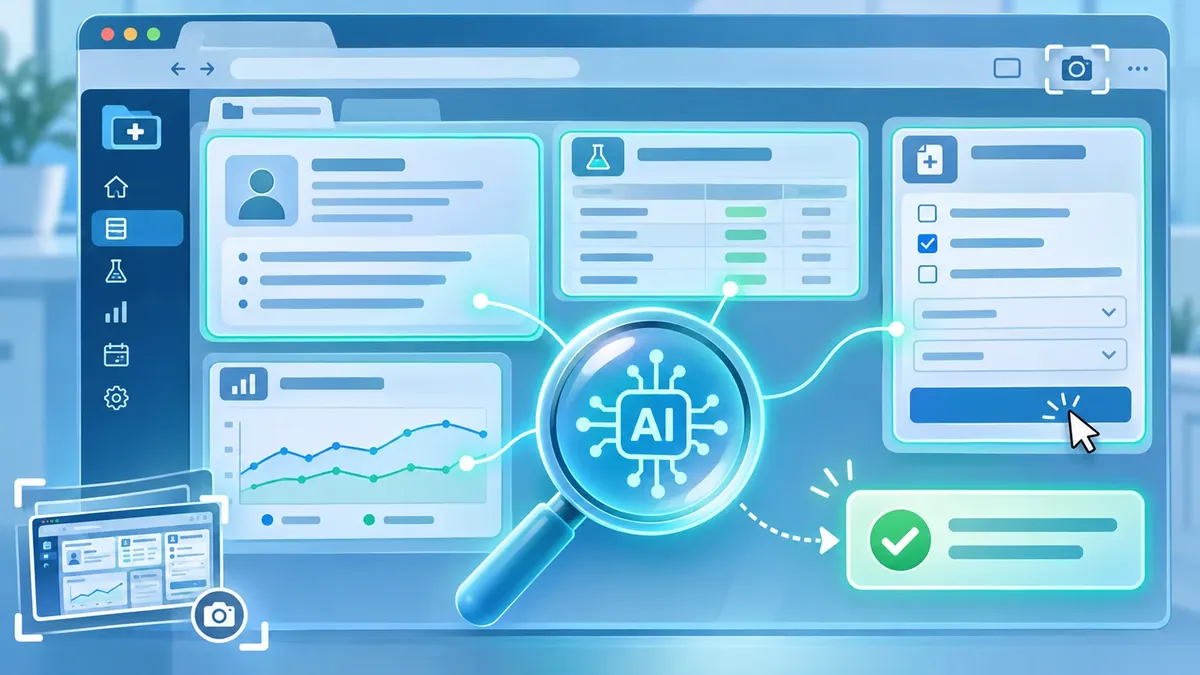
AI may answer a medical question yet still fail to find the right chart detail, select the correct control or save an order. MedUIGym is a simulated test environment designed to measure those computer-use skills alongside task outcomes.
The challenge is the interface, not just the answer
Electronic health records (EHRs) are used to review patient histories, document care and place orders. An AI system may reason about medical information and still struggle to use the software: it must locate the right record, interpret what appears on screen, choose a control and check whether an action worked.
Many medical AI benchmarks assess answers or structured database requests rather than navigation through a graphical user interface (GUI). The authors of MedUIGym aim to make this hands-on part of clinical work easier to evaluate and train. Their environment combines tasks from existing benchmarks in a simulated hospital EHR.
One environment, two ways to interact
MedUIGym’s leaderboard includes 15,739 tasks from 17 sources, grouped into six families: information retrieval, clinical decision-making, cohort queries, clinical actions, clinical documentation and outcome prediction. Tasks range from finding a test result to reviewing records and entering an order. The source material includes patient-derived and synthetic records.
Agents can use screenshots and mouse-and-keyboard actions to operate the EHR. A paired native-tool interface provides access to the same clinical records through database queries or FHIR requests, a standard for exchanging healthcare data. This allows researchers to compare screen-based interaction with structured tools using shared records and task criteria.
The environment checks final answers and required chart changes, such as saved orders or notes. It can also record trajectories—the sequence of observations and actions an agent takes—and pair them with task scores. These records support offline training; scores can provide rewards for online reinforcement learning, in which an agent learns from repeated attempts and feedback.
The paper reports benchmarking 12 vision-language models and training two Qwen3.5 models. Across the evaluated systems, workflows that combine chart review, treatment choices and documentation remained difficult. Errors included targeting the wrong record or control and incorrectly configuring queries or forms. More reasoning effort helped on some queries but did not consistently improve results across task types.
Training results were encouraging but mixed. Supervised fine-tuning raised the internal average scores of both Qwen3.5 models, while the smaller model’s average on external tasks fell. The authors also report that reinforcement-learning training improved external average scores for both models. These findings do not mean that every training approach or model improved on every dataset.
What the benchmark can—and cannot—show
The study compared GUI and native-tool performance on 601 tasks evaluated through both interfaces. For the tested model, source-averaged scores were lower through the GUI: 44.7 versus 64.7 on in-distribution tasks, and 43.5 versus 69.3 on out-of-distribution tasks. These averages highlight the challenge of screen-based interaction in this evaluation; they do not establish that GUI agents are generally less capable in real clinical settings. The paper separately notes that 396 tasks had identical instructions across the interfaces, so the 601-task comparison should not be mistaken for a comparison limited to that identical-instruction subset.
MedUIGym is a benchmark and training environment, not a clinical trial. The simulated EHR was designed to represent clinical tasks, but benchmark success does not show how an agent would perform across real hospitals, software systems or workflows. The study does not test whether using an agent improves patient outcomes. More broadly, benchmark scores alone cannot establish that an agent makes reliable care decisions or is safe to deploy.
The findings also depend on the selected tasks, models, scoring rules and training setup. Performance varied across sources, and the authors report mixed effects between methods and datasets. Further evaluation would be needed to understand how well the results transfer beyond this environment. MedUIGym offers researchers a testbed for a specific question: how well can AI agents complete clinical tasks through a simulated EHR’s graphical interface?
- MedUIGym
- clinical AI
- electronic health records
- GUI agents
- vision-language models
- AI benchmarks
Reviewed cross-references
These connections were reviewed by a model, not independently fact-checked by a human. Similarity does not imply agreement; consult the original papers and the evidence below.
VirtualTrialHarness aims to make clinical database studies more consistent
Shared method: Both studies evaluate whether an agent’s completed clinical workflow meets explicit outcome criteria: MedUIGym checks answers and chart changes, while VTHarness checks executable cohort outputs against references. This is a shared verification approach, not evidence that either system’s performance generalizes to the other’s tasks or setting.
Model review: · openai-codex/gpt-6-luna
Evidence and provenance
Selected excerpts, not complete papers. PDF extraction can omit figures or damage equations, tables and reading order; sources may be preprints.
2611.30983v1 — Original paper
Excerpt reference:
static/papers/2611.30983v1.md:234-294
Basis: Paper text
Source SHA-256:5a00052c42dafde457ce2a1d8029bbb98688252e023bfbe447ae3f20d3b32b8c2611.05551v1 — Original paper
Excerpt reference:
static/papers/2611.05551v1.md:210-258
Basis: Paper text
Source SHA-256:6c36510ec07017aa3e4034f5fa5bfeeae84d664accc19b81f96a3d728a1d8078
Related reading
Automatically matched by shared topic keywords. These links do not imply that the sources agree or establish a consensus.
Can AI Judges Spot Unsafe Clinical Actions?
Source published
Shared keywords: clinical ai, electronic health records
ScopeAct divides smartphone tasks between AI models
Source published
Shared keywords: vision language models
A model that tracks changing ICU physiology
Source published
Shared keywords: clinical ai
GUI Agent Failures Cluster in Tested Tasks
Source published
Shared keywords: gui agents
Why a personal AI assistant needs to find the right person first
Source published
Shared keywords: ai benchmarks, vision language models