TRANSMISSION // 2611.30959v1
The Hidden CO Glow in CMB Maps
Source published
A halo-model study finds that redshifted carbon-monoxide emission may matter mainly through its correlation with infrared light, especially in forecasts for future high-resolution CMB surveys.
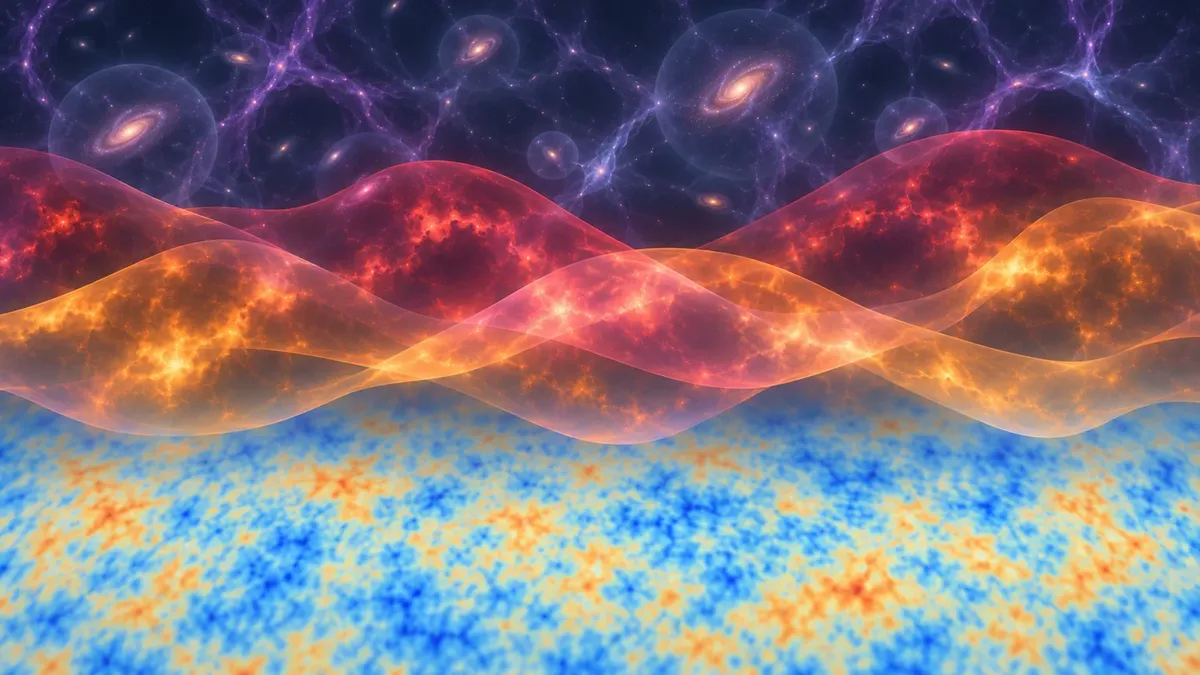
The cosmic microwave background is faintly patterned by the early universe, but at small angular scales its signal is mixed with emissions from galaxies and hot gas. An analytic model estimates how carbon-monoxide lines from distant star-forming galaxies contribute to this foreground—and how their correlation with infrared emission could affect cosmological measurements.
Why look for carbon monoxide in CMB data?
The cosmic microwave background (CMB) is the afterglow of the early universe. On the smallest angular scales studied by high-resolution telescopes, its temperature patterns share the sky with emissions from galaxies and hot gas. Researchers must model these foregrounds to interpret the maps accurately.
One possible contaminant is carbon monoxide (CO). Star-forming galaxies emit CO at specific frequencies, but cosmic expansion shifts those lines before they reach us. A telescope band can collect several CO transitions from galaxies at different distances. Blended together, the lines can act like a broad, continuum-like signal rather than a narrow feature that is easy to remove.
The signal may matter especially because CO emission can correlate with the Cosmic Infrared Background (CIB), the combined infrared glow of distant galaxies. Both emissions are linked in the model to star formation. Giorgia Zagatti and colleagues developed an analytic framework for estimating the CO signal and its cross-correlation with the CIB, then forecast how these signals might affect CMB analyses.
Modeling galaxies in dark-matter haloes
The researchers used a halo model: a mathematical framework connecting galaxies to the dark-matter haloes that host them. It distinguishes central galaxies from satellites and assigns separate occupation models to CO and CIB emitters.
The framework includes CO rotational transitions up to J = 13. It calculates the CO auto-spectrum—how CO emission correlates with itself—and the CO×CIB cross-spectrum. The model links CO line luminosity and infrared luminosity to the same star-formation rate, so their correlation follows from the model rather than being added as an independent signal. The authors also tested alternative prescriptions for star formation and for the relative brightness of different CO transitions.
To estimate the consequences for observations, they used Fisher forecasts. This method projects how well an experiment might constrain model parameters and how fitted parameters could shift if a signal present in the sky were omitted. They compared ACT-like and proposed CMB-HD-like configurations. These are forecasts, not detections of CO by either experiment.
The cross-signal is the larger concern
At angular multipole ℓ = 3000, the baseline model predicts CO×CIB power of about 0.4, 0.7 and 1.9 μK² at 90, 150 and 220 GHz, respectively. The CO auto-spectrum is much smaller, around 0.02 μK² in each band. The predicted cross-signal grows with frequency and is comparable to the kinetic Sunyaev–Zel’dovich (kSZ) power at 220 GHz.
The ACT-like forecast does not meaningfully constrain most CO occupation parameters. Omitting CO leaves the forecast cosmological parameters essentially unbiased. But other fitted foreground parameters shift: the radio-source amplitude and spectral index by about two standard deviations, and the thermal and kinetic Sunyaev–Zel’dovich (tSZ and kSZ) parameters by less than about one standard deviation. A foreground that is difficult to measure directly can still affect estimates of other components.
For the CMB-HD-like forecast, the model predicts a high-significance CO detection and constraints on the minimum halo masses of CO and CIB emitters. The size of biases from omitting CO depends on both the multipole range and the assumed error budget. With the reference 3% error floor, cosmological-parameter shifts are below one standard deviation when the analysis uses the ACT-like multipole range, and reach up to about two standard deviations when it includes the full CMB-HD range. With a 10% floor, shifts remain below 0.8 standard deviations even over that full range; with a 1% floor, they reach about two standard deviations even using the ACT-like range. The floor is a simplified proxy for additional uncertainties, not a measured property of a future survey.
What remains uncertain
Predicted amplitudes depend strongly on assumptions about star-formation rates and CO line brightness. In the tested models, these choices change the amplitude by factors of roughly two to five, depending on frequency, while affecting the overall shape less. The baseline describes main-sequence star-forming galaxies and does not include a separate starburst population. It also assumes one CO line-brightness pattern for all galaxies, although excitation may vary with galaxy properties and redshift.
The forecasts have limitations as well. The authors say Gaussian covariance and assumed instrumental noise are imperfect, particularly for a highly sensitive future experiment. Their error floor stands in for non-Gaussian effects and instrumental uncertainties; a more realistic covariance is needed for firmer forecasts. They did not make a dedicated forecast for the Simons Observatory.
The source is an arXiv preprint presented as an Astronomy & Astrophysics manuscript; the extracted text leaves receipt and acceptance dates as placeholders. The results are model-based forecasts, not a new direct detection by a CMB survey. The authors report that their implementation is publicly available. They argue that CO should be included in foreground models for future high-resolution CMB analyses, while the size of its effects remains dependent on model assumptions and forecast uncertainties.
- cosmic microwave background
- carbon monoxide
- cosmic infrared background
- foreground modeling
- halo model
- star-forming galaxies
Related reading
Automatically matched by shared topic keywords. These links do not imply that the sources agree or establish a consensus.
A fast generator for the millimeter-wave sky
Source published
Shared keywords: cosmic microwave background
CO Traces a Nearby-Galaxy Speed–Brightness Relation
Source published
Shared keywords: carbon monoxide
Carbon Maps Reveal a Porous, Turbulent Stellar Nursery
Source published
Shared keywords: carbon monoxide
Gas persists inside the dust gaps of three planet-forming disks
Source published
Shared keywords: carbon monoxide
Molecular outflows offer clues to how massive young stars gather gas
Source published
Shared keywords: carbon monoxide