TRANSMISSION // 2611.30897v1
How rare features can fade while their numbers hold steady
Source published
A forecasting method estimates when recursive generative training may erode the defining core of a rare group—even if its overall share appears stable.
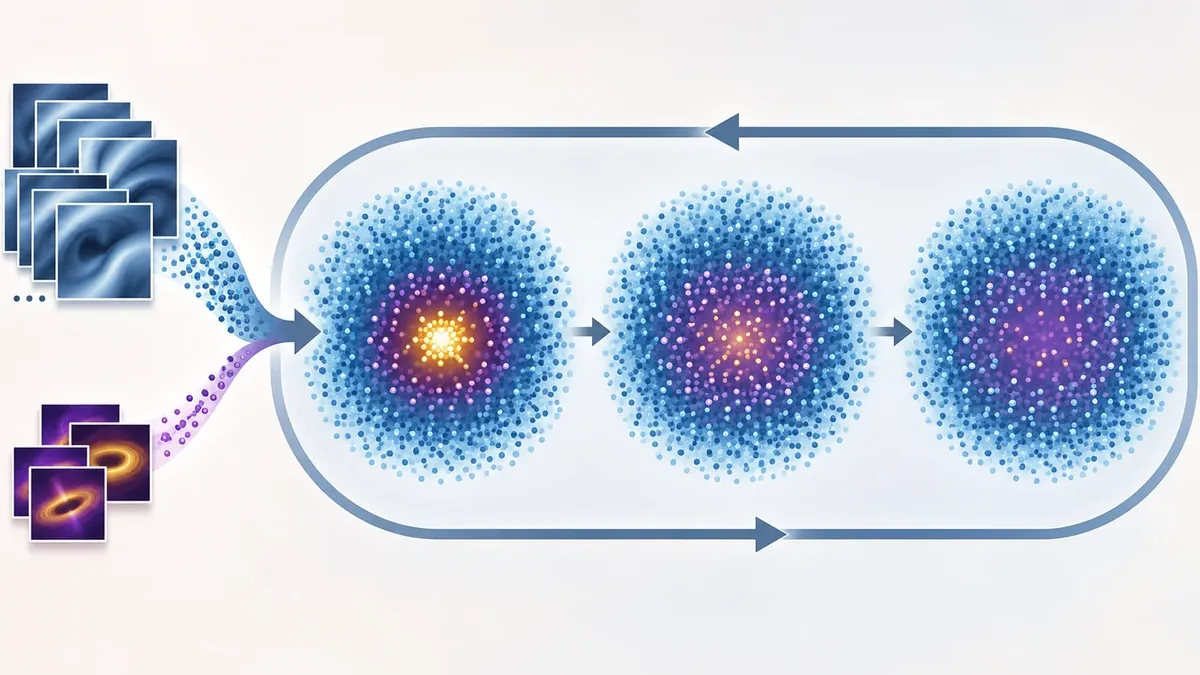
When a generative model is repeatedly retrained on a mixture of fresh examples and its own outputs, a rare category can retain its headline sample count while losing the features that make it recognizable. Jingyao Zhang, Mingyu Du and Luhan propose a way to forecast that more subtle failure using measurements from single training steps, rather than repeatedly running full chains.
The question: what does it mean for a rare mode to survive?
A generator can still produce plenty of examples from a rare category while producing fewer of its most characteristic examples. Imagine a stream of generated images still being classified as bags, but increasingly showing unusual, less typical bags. A count of “bag” images alone would miss this change.
The paper separates a broad rare region from a smaller core within it. Its central question is whether researchers can predict the chance that this core will shrink below a chosen level after several rounds of recursive training—without having to train a new multi-generation chain for every combination of settings.
A forecast built from one-generation experiments
The authors study a fixed-size training pool assembled each round from fresh real examples and synthetic examples produced by the previous model. Some synthetic examples may also be perturbed before being fed back into training. They track counts in the rare region and its core, then define failure as the fitted generator’s clean coverage of a region falling below a specified fraction of that region’s reference coverage at the end of a set number of rounds. This is a finite-horizon endpoint, not a claim that every temporary dip is permanent: a chain can fall below the threshold earlier and recover by the final round.
Their method combines two pieces. First, an exact probability calculation describes how fresh, unperturbed synthetic, and perturbed synthetic examples contribute to regional counts under the fixed quotas. Second, separate one-generation model fits estimate how a learner responds to different count states. Those response estimates are assembled into a forecast of the count distribution and terminal failure risk. The authors freeze their forecasts before checking them against independent recursive chains.
The distinction between a rare region and its core also helps explain a possible hidden failure. Perturbations can move common examples into the broad rare region while spreading core examples outward into its periphery. In that case, the category’s overall share may grow even as its characteristic center thins. The paper also derives a geometric result for a particular comparison: when two Gaussian perturbation policies have equal per-row variance, which policy produces more boundary crossings reverses at a particular distance from a boundary. The direction depends on geometry, not variance alone.
What the tests found
In a controlled count benchmark spanning 2,178 settings, exact count propagation had a risk mean absolute error of 0.49 percentage points, compared with 1.85 points for a Gaussian approximation. This supports using the discrete count calculation in the tested settings, where rare-event tails matter.
The authors then tested ten two-dimensional learners. Forecasts had six-round core-risk errors of 2.60–5.69 percentage points for nine learners they classified as stationary. Standard DDIM, a diffusion-model sampling variant, was a notable exception: its error was 16.38 points, and a stability probe flagged outlier drift across rounds. That result matters because the forecasting method relies on one-generation responses being representative of later generations. A probe designed to detect such problems was not a perfect screening tool: on five prospectively tested learners, some borderline cases were missed or inconclusive.
For Fashion-MNIST, the researchers trained on images from two classes and used a fixed classifier to define the rare region and its core. In the tested latent flow-matching setup, the calibrated forecast’s six-round core-risk error was 3.14 points, versus 10.78 points for a simpler method that copied training proportions. The authors also report that latent perturbation could increase the broad region’s share while reducing core coverage. These findings concern this particular dataset, class pairing, representation and training setup; they do not establish how common the effect is in deployed generative systems.
What remains uncertain
The method is a forecasting framework, not a general guarantee that a model will or will not collapse. It needs new single-generation calibration for a new perturbation mechanism, and it can fail when a learner’s behavior changes across generations. Its accuracy also depends on tracking enough of the data’s structure: in some tests, a simple regional count missed variation within the core, while richer counts improved forecasts. More detailed states, however, need more data to estimate reliably.
The image perturbation study was narrow: it examined one class pair, one reference prevalence and two noise levels. The authors note that, at its four validated settings, the calibrated method and the simpler baseline landed on the same side of the chosen 20% risk threshold despite differing in probability accuracy. Thus, the reported improvement in forecasting accuracy does not by itself demonstrate better decisions across a wide range of practical thresholds.
This account is based on the supplied text for arXiv preprint 2611.30897v1, presented as a working draft. The paper says code and experiment records will be released upon publication; they were not available in the supplied evidence. The results should therefore be read as the authors’ reported findings, not as independently verified or peer-reviewed conclusions. Read the preprint.
- generative AI
- model collapse
- recursive training
- rare modes
- synthetic data
- risk forecasting
Reviewed cross-references
These connections were reviewed by a model, not independently fact-checked by a human. Similarity does not imply agreement; consult the original papers and the evidence below.
From AGI to ASI: What Might Follow Human-Level AI?
Supporting evidence: Both discuss risks from recursive use of AI-generated data: Zhang et al. forecast and test erosion of a rare mode’s characteristic core over six training rounds, while Genewein et al. summarize evidence that naive iterative training on self-generated data can cause performance plateaus or degeneration. These are related but distinct outcomes, and the report’s statement is broad rather than a directly comparable experiment.
Model review: · openai-codex/gpt-6-luna
Evidence and provenance
Selected excerpts, not complete papers. PDF extraction can omit figures or damage equations, tables and reading order; sources may be preprints.
2611.30897v1 — Original paper
Excerpt reference:
static/papers/2611.30897v1.md:15-59
Basis: Paper text
Source SHA-256:d461fb6f4046769c68860e3a47023494c6e8803accaded5f2ebfc78da1bb5c7e2606.12683v3 — Original paper
Excerpt reference:
static/papers/2606.12683v3.md:1473-1523
Basis: Paper text
Source SHA-256:0a92eb39a74960f76e95825bc4457190ca7b7ec935cc8292a73f30659c5c4a6e
Related reading
Automatically matched by shared topic keywords. These links do not imply that the sources agree or establish a consensus.
Combining volatility measures to improve financial risk forecasts
Source published
Shared keywords: risk forecasting
A Mathematical Case for Neural Flow Matching
Source published
Shared keywords: generative ai
Can a bacterium’s genome help predict how it looks under antibiotics?
Source published
Shared keywords: generative ai
When Mock Jurors Blame AI, Who Pays?
Source published
Shared keywords: generative ai
Generative AI in information systems: promise meets governance
Source published
Shared keywords: generative ai