TRANSMISSION // 2611.30862v1
Reading Reionization Through the Intergalactic Medium
Source published
A new framework interprets the cosmic 21-cm power spectrum through the changing state and structure of intergalactic hydrogen, tested against three simulations.
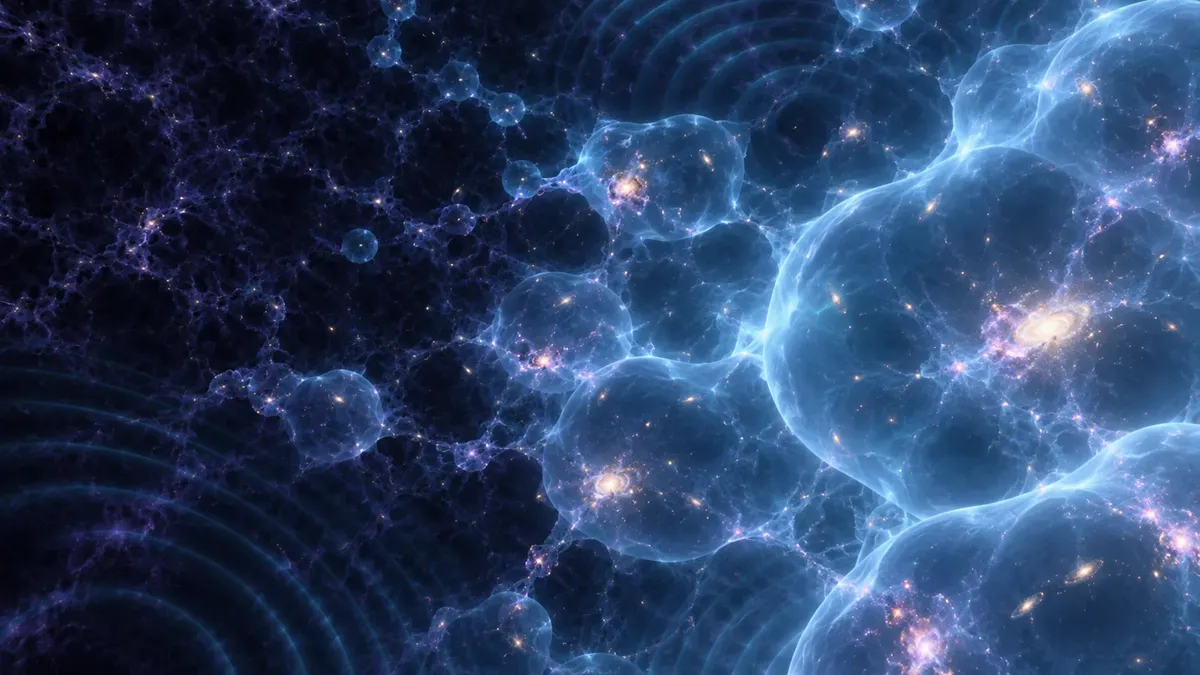
How can astronomers infer the history of cosmic reionization from the faint 21-cm signal of hydrogen? This study proposes a way to read the signal through the condition of the intergalactic medium itself, then tests the approach in three simulations.
The early universe was not always transparent to light. During the Epoch of Reionization, radiation from the first stars and galaxies gradually transformed much of the hydrogen between galaxies from neutral to ionized. Reconstructing how that transition unfolded can reveal both the changing cosmic gas and the sources that drove it.
One promising clue is the 21-centimetre signal from neutral hydrogen. Its power spectrum—a statistical description of how signal fluctuations vary across different spatial scales—can encode the distribution of neutral and ionized regions. But turning that pattern into a history of reionization is not straightforward: different assumptions about the first ionizing sources can lead to different interpretations.
In this work, Ivelin Georgiev and colleagues propose a framework that starts with the state of the intergalactic medium, or IGM, rather than focusing only on the properties of the sources. The aim is to provide a physically motivated description of the 21-cm power spectrum that complements source-centred interpretation methods.
A model built around cosmic gas
The framework combines ideas from perturbation theory, which describes how small variations develop, and percolation theory, which studies how connected regions form and grow. It uses several IGM properties to describe the signal: the overall ionized and neutral fractions, the clustering of ionizing sources, and characteristic sizes of ionized regions and neutral islands.
The distinction between volume-weighted and mass-weighted ionization fractions matters. The first describes what share of space is ionized; the second tracks what share of hydrogen mass is ionized. These are related but not identical ways to summarize a clumpy universe. Together with source clustering and region sizes, they offer a compact physical account of the conditions that shape the signal.
The authors also extend the approach across redshift—the cosmic time information carried by the expansion of the universe. In principle, tracking how the fitted parameters change can constrain the midpoint and duration of reionization, as well as the evolving global ionization fraction.
Tests across simulations
The abstract reports tests on three reionization simulations: C2-Ray, 21cmFAST and POLAR. These simulations use differing cosmological, astrophysical and numerical assumptions, giving the authors a way to check whether the framework can describe more than one simulated scenario.
According to the authors, the framework constrains the IGM parameter space and recovers the reionization midpoint and duration, the minimum halo mass associated with ionizing sources, and the redshift evolution of the global ionization fraction. They also report that it recovers the evolution of ionized and neutral regions, using a radial mean free path method described in related work. These are claims about tests in simulations, not measurements establishing the history of the real universe.
The broader appeal is that the framework could help connect several kinds of evidence. The authors point to possible joint analysis with observations of high-redshift galaxies and quasars, as well as the cosmic microwave background. Combining probes may help constrain reionization from different angles, although the abstract does not report a specific joint observational analysis.
What remains uncertain
This account is based on the paper’s abstract, not its full text. It therefore does not provide the detailed equations, parameter ranges, quantitative fit results, or comparisons needed to assess how accurately the method performs in each simulation. Nor does it establish how robust the approach is to observational complications or whether the simulated recovery translates into reliable constraints from real 21-cm data.
The source is an arXiv preprint, a research manuscript shared before or outside the usual journal peer-review process; its eventual publication status is not established by the material available here. The findings should therefore be read as the authors’ reported simulation results, rather than as settled observational conclusions.
The central contribution is a complementary way to organize the interpretation of a difficult cosmic signal: describe the evolving hydrogen environment, then connect that description to the 21-cm power spectrum. Whether it can deliver useful constraints from future observations will depend on further testing and on how well real data can be measured and interpreted.
- Epoch of Reionization
- 21-cm power spectrum
- intergalactic medium
- neutral hydrogen
- cosmological simulations
- early galaxies
Reviewed cross-references
These connections were reviewed by a model, not independently fact-checked by a human. Similarity does not imply agreement; consult the original papers and the evidence below.
A six-ray method for mapping cosmic reionization
Shared method: The IGM parametrisation paper uses RMFP-BSD estimates of ionised- and neutral-region sizes as comparison data for its inferred parameters; the RMFP-BSD paper develops and tests that statistic, reporting a narrower spread than the conventional mean-free-path method in its simulations. This is a methodological connection, not independent confirmation of the parametrisation’s accuracy; the RMFP-BSD tests described here use particular simulations and do not establish performance across all reionization models.
Model review: · openai-codex/gpt-6-luna
Evidence and provenance
Selected excerpts, not complete papers. PDF extraction can omit figures or damage equations, tables and reading order; sources may be preprints.
2611.30862v1 — Original paper
Excerpt reference:
static/papers/2611.30862v1.md:2561-2619
Basis: Paper text
Source SHA-256:f05cc488d2bdca1414e08dabf9c2bada3ff31b269c51c21514e8e7f90adb40ad2611.30863v1 — Original paper
Excerpt reference:
static/papers/2611.30863v1.md:577-699
Basis: Paper text
Source SHA-256:519cfea807be8d85517f5ae7dbf0e20fac5d563391fd88786c603c9810ef3c102611.30863v1 — Original paper
Excerpt reference:
static/papers/2611.30863v1.md:508-576
Basis: Paper text
Source SHA-256:519cfea807be8d85517f5ae7dbf0e20fac5d563391fd88786c603c9810ef3c10
Related reading
Automatically matched by shared topic keywords. These links do not imply that the sources agree or establish a consensus.
A six-ray method for mapping cosmic reionization
Source published
Shared keywords: intergalactic medium
Could ancient magnetic fields have brought forward cosmic reionization?
Source published
Shared keywords: cosmological simulations, early galaxies
A galaxy 330 million years after the Big Bang shines through the cosmic dawn
Source published
Shared keywords: early galaxies, neutral hydrogen
Can Gaussian processes recover the SKA’s 21-cm signal?
Source published
Shared keywords: epoch of reionization
A U-Net Emulates Lyman-Alpha Forests in Vast Volumes
Source published
Shared keywords: cosmological simulations