TRANSMISSION // 2611.30814v1
A fiber delay line aims to preserve light’s polarization
Source published
A proposed switchable fiber delay line uses Faraday mirrors to counter polarization changes. Numerical results are promising, but do not establish performance across every wavelength or input state, or in a built device.
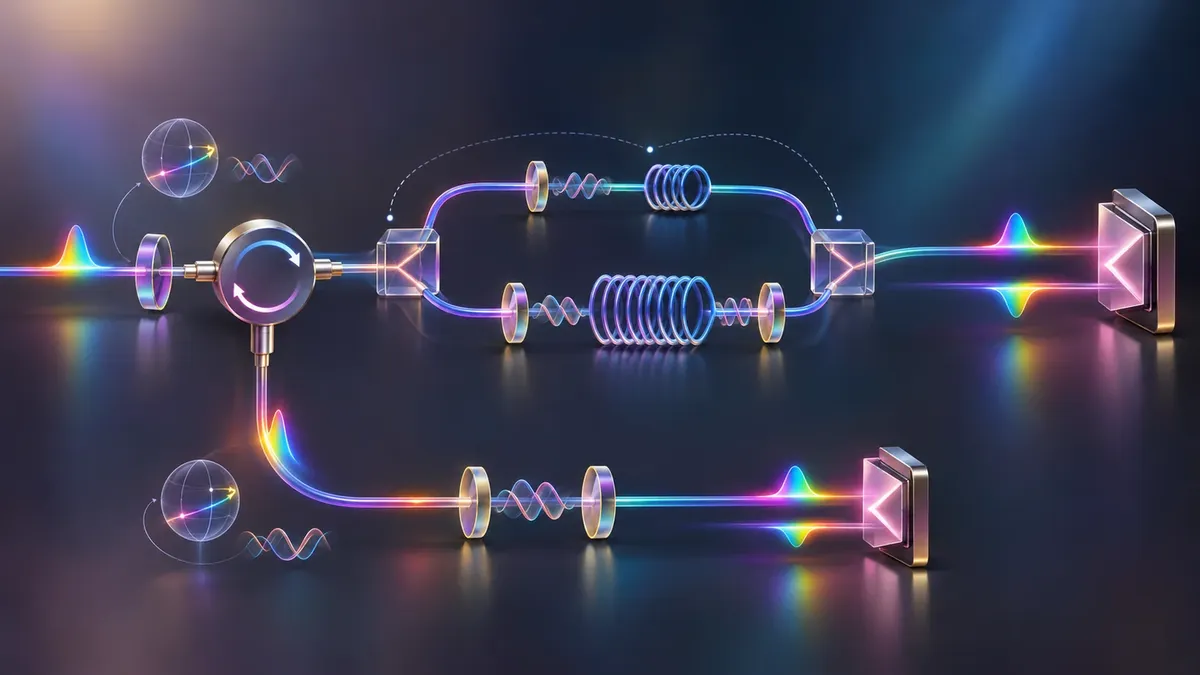
Ordinary optical fiber can change the polarization of light passing through it. Researchers describe a programmable delay-line design that uses Faraday mirrors to counter those changes, and model how the approach behaves when the light’s wavelength differs from the mirrors’ design wavelength.
A pulse of light can carry information in its polarization, a property describing the orientation and relative phase of its electric field. As light travels through fiber, temperature changes and mechanical disturbances can alter that state. For systems that encode information in polarization, including some quantum-communication schemes, delaying a pulse without changing its polarization can be useful.
Salem F. Hegazy, Salah S. A. Obayya and Bahaa E. A. Saleh propose a switchable fiber delay line intended to preserve an unknown input polarization while delaying light by up to one microsecond. Their central question is how well Faraday mirrors can compensate for fiber-induced polarization changes, especially when the light’s wavelength is away from the mirrors’ central design wavelength.
A switchable route and a return pass
The design sends light through a series of stages. At each stage, an optical switch selects either a short or a longer fiber path, setting the total delay. At the far end, a Faraday mirror reflects the light, which then travels back through the fiber. The returning signal is routed via an optical circulator to a second Faraday mirror in another path before exiting.
A Faraday mirror combines a magneto-optic rotator with a mirror. Under the ideal conditions described in the paper, its action converts the incoming polarization to the orthogonal state. On the return pass, this can compensate for polarization transformations introduced by the fiber. The paper’s relation holds for any unitary fiber transformation; separately, it assumes polarization fluctuations are slow compared with the light’s round-trip time. This is not an unconditional guarantee for every wavelength or operating condition.
For an eight-stage example, the authors calculate a maximum delay of one microsecond and a delay increment of about 3.92 nanoseconds. The delay expression also includes a fixed offset, so these figures should not be read as meaning that the selectable range necessarily begins at zero. The design uses ordinary single-mode fiber rather than polarization-maintaining fiber, which the authors note preserves only particular polarization states.
What the simulations indicate
The authors examine fiber dispersion and the wavelength-dependent rotation of the Faraday mirrors. They calculate delay deviations across wavelengths as well as polarization effects from dispersion in the fiber and Faraday rotators. At the central design wavelength, the idealized model restores the input polarization. Away from it, the rotators’ action changes with wavelength, so compensation is imperfect.
The paper’s abstract reports numerical mean fidelity above 99% over a 50-nanometer deviation from the central wavelength. Fidelity measures how closely the output polarization matches the input. The detailed simulations described in the paper show selected cases at 1.50 and 1.60 micrometers around a 1.55-micrometer center; they do not demonstrate that the stated threshold holds continuously across the whole band or for every possible input polarization.
The simulations consider four selected input states and randomized mathematical transformations representing the fiber. In many modeled cases, the average output fidelity is higher with the random fiber transformation than with the fiber omitted. The authors explain that the fiber’s transformation changes the axis associated with the wavelength-dependent mirror error, sometimes bringing the output closer to the intended state. This is a result of the model and its assumptions, not evidence that adding fiber generally improves polarization in practical systems.
What remains uncertain
The results are numerical rather than a reported experimental demonstration of a complete physical delay-line prototype. The tested input states and modeled fiber transformations do not cover every possible polarization or real-world fiber behavior. The paper models fiber and Faraday-rotator dispersion and discusses delay deviation and an alternative implementation using polarization-maintaining fiber. But a complete device’s performance—including its switches, routing, losses and other components—has not been established by a reported prototype test.
The provided materials contain conflicting or unclear publication information: the record and paper text do not agree cleanly, and the paper includes a journal citation line alongside an unresolved placeholder. That discrepancy cannot be resolved from the available source material. The design is best understood here as a proposed approach supported by simulations, not as a verified hardware result or a confirmed publication history.
- optical delay line
- Faraday mirror
- polarization
- optical fiber
- photonics
- quantum communication
Reviewed cross-references
These connections were reviewed by a model, not independently fact-checked by a human. Similarity does not imply agreement; consult the original papers and the evidence below.
Weather’s daily signature in fiber polarization drift
Supporting evidence: Both papers identify polarization variation in optical fiber as relevant: Hegazy et al. describe Faraday mirrors compensating fiber-induced fluctuations in a delay line, while Ramaswamy et al. report diurnal and seasonal patterns in polarization-signal spectral area on a 15-km aerial-inground link. The findings are compatible but concern different systems and measures; the weather study does not test the delay line or its compensation.
Model review: · openai-codex/gpt-6-luna
Evidence and provenance
Selected excerpts, not complete papers. PDF extraction can omit figures or damage equations, tables and reading order; sources may be preprints.
2611.30814v1 — Original paper
Excerpt reference:
static/papers/2611.30814v1.md:837-890
Basis: Paper text
Source SHA-256:713185fb51fa1e64697aaac7abe65bb9bff6f68af1b480fd737f41e1a94b73d12607.07629v3 — Original paper
Excerpt reference:
static/papers/2607.07629v3.md:13-65
Basis: Paper text
Source SHA-256:784fc2587eb8ac3e41428554df644290d3b79103c3ca0cfb4e4cc88ec4860785
Related reading
Automatically matched by shared topic keywords. These links do not imply that the sources agree or establish a consensus.
Weather’s daily signature in fiber polarization drift
Source published
Shared keywords: optical fiber, quantum communication
Before quantum keys, Sweden’s fiber links need a checkup
Source published
Shared keywords: optical fiber, quantum communication
A compact photon-pair source stays stable in deployment
Source published
Shared keywords: quantum communication
When a quantum key begins with incomplete clues
Source published
Shared keywords: quantum communication
A faster, steadier route to entanglement across fiber
Source published
Shared keywords: optical fiber