TRANSMISSION // 2611.30785v1
A Transformer designed for hyperbolic space
Source published
PVFormer rebuilds Transformer attention in proper velocity space, a way to represent hyperbolic geometry without bounded coordinates. The authors report improved benchmark results and faster attention in selected graph tests, but the evidence does not establish broad real-world benefits.
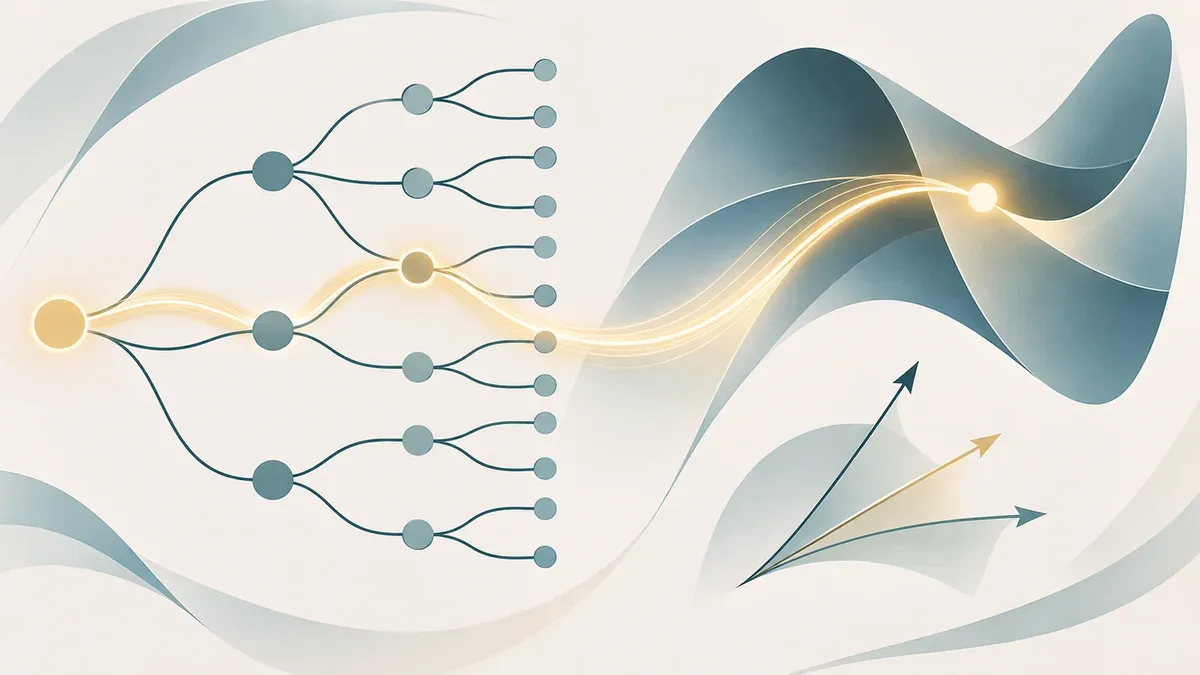
Hierarchies—such as categories that branch from general to specific—can be awkward to represent with ordinary flat geometry. PVFormer is a Transformer architecture designed to work directly with hyperbolic geometry, while avoiding some constraints and conversion steps used by other representations.
Why change the geometry of attention?
Transformers compare pieces of information, decide which ones matter, and combine them. In standard Transformers, those operations are built for Euclidean space: a familiar, flat geometry. But when data have a strongly branching structure, such as a hierarchy, hyperbolic geometry can offer a different way to arrange representations.
That creates a design challenge. It is not enough to replace one similarity score: the transformations that produce attention inputs and the process that combines them should also respect the chosen geometry. The authors argue that existing approaches based on the Poincaré or Lorentz models can involve constraints, projections, or trips into tangent spaces that complicate computation.
Their proposed alternative, PVFormer, operates in proper velocity (PV) space. This is not a different underlying geometry from the Lorentz model. Rather, it represents the same hyperbolic geometry using unconstrained vectors, without requiring points to remain inside a bounded ball or explicitly satisfy a hyperboloid constraint.
Three parts of the design
PVFormer adapts three familiar parts of attention. First, it transforms representations into queries and values using rotations that preserve the PV geometry, according to the paper’s mathematical results. The authors note a trade-off: these transformations are restricted to equal-dimensional rotations, which may limit what the model can express compared with more general transformations.
Second, the model uses a Busemann-based score to compare queries and keys. In accessible terms, this score evaluates a query in relation to a direction, giving attention a geometry-aware notion of similarity. The paper derives that the score approaches the ordinary Euclidean inner product as curvature approaches zero.
Third, instead of combining values with a standard weighted average, PVFormer uses a geometric midpoint. For large graphs, it also introduces a linear-attention variant intended to avoid computing every pairwise score. That matters because a full attention score matrix grows quadratically with the number of nodes or tokens.
What did the authors test?
The paper reports experiments on graph benchmarks, plus semi-supervised classification using Mini-ImageNet and 20News-Groups. For the latter, the authors test constructed nearest-neighbor graphs and graph-free settings. They follow a protocol based on Hypformer, a prior hyperbolic Transformer, and report measures including accuracy, F1 score, and ROC-AUC.
Under that protocol, the authors report higher results than the Hypformer reference on the small and medium graph datasets and on the three large-graph benchmarks they tested. They also report higher 20News-Groups results across the tested graph settings and in the graph-free setting. Mini-ImageNet results are above the Hypformer reference in the reported comparisons as well. These are the paper’s reported comparisons, not independently verified findings or evidence that the method will outperform alternatives on other tasks.
A separate efficiency test compares attention computation. On an A100 GPU, the authors report that PV linear attention takes less time per step than Hypformer’s linear attention in the tested settings. On two real large-graph benchmarks, they report reductions in attention-branch time of 11.7% to 33.9%. These measurements concern the attention branch, not necessarily total training or inference time. Full PV Busemann attention remains quadratic and becomes impractical at larger scales; the linear variant is intended for those cases.
What remains uncertain?
The results cover specific datasets, protocols, and implementations. Efficiency measurements depend on hardware and experimental setup, and selected attention timings do not establish lower end-to-end costs. The stability diagnostics concern the operators and stress tests examined in the paper, not every possible training condition.
The authors acknowledge that their query and value transformations may limit expressiveness and do not cover dimension-changing maps. They have not trained PVFormer at large-language-model scale. The paper lists a code repository that may enable independent checks, but the reported results still need replication and broader evaluation.
The source is an arXiv version 1 preprint. Although the manuscript identifies itself with NeurIPS 2026, this account does not independently verify its publication or peer-review status. The work presents an architectural proposal; whether its geometric choices provide reliable advantages beyond the tested benchmarks remains an open question.
- hyperbolic geometry
- Transformers
- attention
- graph learning
- representation learning
- PVFormer
Related reading
Automatically matched by shared topic keywords. These links do not imply that the sources agree or establish a consensus.
When “Hyperbolic” AI Geometry Behaves Almost Euclidean
Source published
Shared keywords: hyperbolic geometry, representation learning
VoluCompose compresses medical scans for AI while preserving benchmark performance
Source published
Shared keywords: hyperbolic geometry
A GAN-based route to learning from full 3D brain MRI
Source published
Shared keywords: representation learning
VenusGenome learns from the company microbial genes keep
Source published
Shared keywords: representation learning
Separating structure from detail in language models
Source published
Shared keywords: representation learning