TRANSMISSION // 2611.30779v1
How SignalCount Estimates Text-Based Counts in Seconds
Source published
SignalCount combines an exact database count with a calibrated sample to estimate how many records meet a text-based criterion, without calling an LLM judge for each query. In a production deployment, its intervals covered the judge-defined count in 92% of held-out estimates, but the estimates ran about 15% high overall.
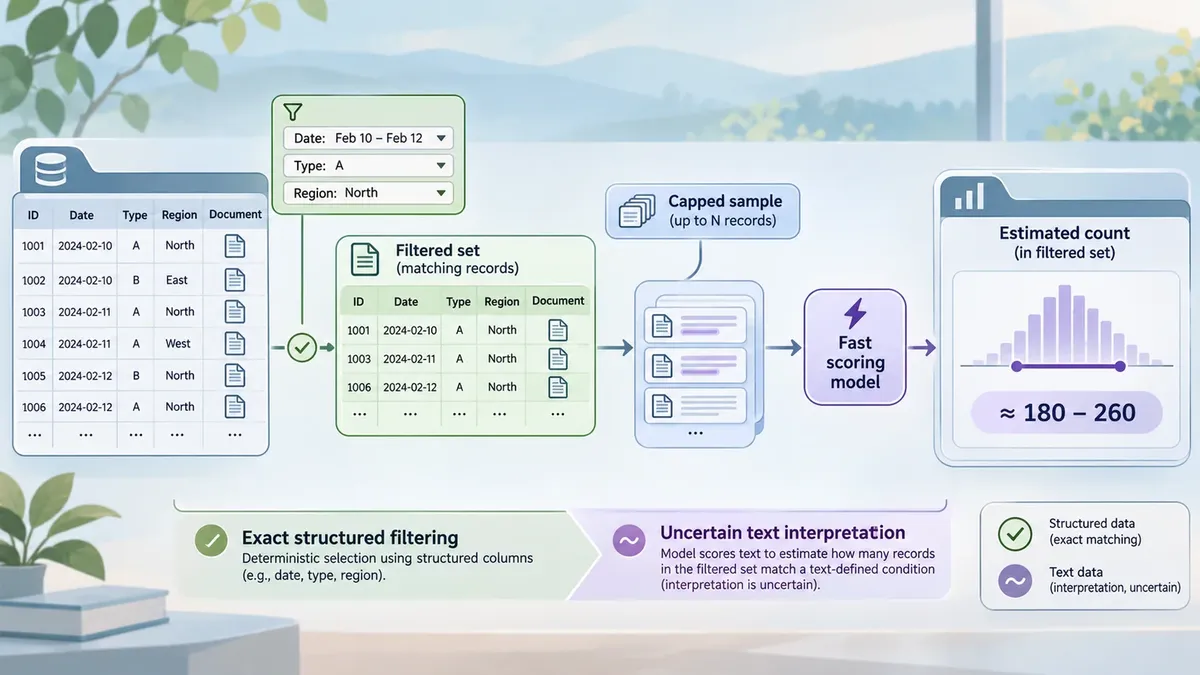
A database can easily count records with matching ages or dates. But what if the question depends on understanding a note—such as why someone stopped a medication? SignalCount estimates that kind of count quickly, while reporting uncertainty about the result.
Counting what a document means
Many databases contain both structured fields—such as age, date, or location—and free-text documents. Structured filters can narrow down records precisely, but a question like “How many people stopped a medication because it did not work?” requires interpreting text. The wording may vary, and the reason may not have its own database field.
A slow, detailed pipeline can ask a large language model (LLM) judge to assess records one by one. But users may want a quick count while refining a query, before deciding whether to run that full process. SignalCount, described in a preprint by Matteo Agius-D’Arrigo and colleagues, is designed to provide that preliminary count in seconds.
Estimate from a bounded sample
SignalCount first applies the structured filters and counts the matching records exactly. In the same database scan, it draws a uniform sample of up to 1,000 records. A fast classifier scores the sampled documents for the user’s text-based criterion. The system converts those scores into estimated probabilities of acceptance by the production LLM judge, averages the probabilities, and multiplies that average by the exact record count.
The key step happens before a user submits a query: the classifier’s scores are calibrated using logged cases where the production judge has already issued a verdict. This lets SignalCount estimate a new criterion without asking the judge to label a fresh sample at query time. The authors say the classifier work is capped by the sample size, although the database still has to scan the relevant scope to count and sample records.
The result comes with a nominal 90% prediction interval. It combines uncertainty from sampling with additional, one-sided margins intended to allow for calibration errors. Those margins vary with the estimated match rate and are fitted using split conformal prediction across tenants—customer organizations in the deployed service. For rare criteria, a sample with no apparent matches does not automatically produce a zero upper bound; the system includes a separate bound for that situation.
What the production evaluation found
The authors evaluated SignalCount through a multi-tenant production deployment, using real tenant data. For its latency workload of 112 estimates, the 99th-percentile response time was 3.76 seconds. In the tested workloads, latency after the database scan stayed roughly flat as filtered sets grew beyond the 1,000-record sample. The scan itself still takes work, and its time depends on the database scope and filters.
For accuracy, the team tested estimates on tenants held out from fitting the calibration. Across repeated tenant splits, the nominal 90% intervals covered the count returned by the production pipeline in an average of 92% of held-out estimates. That is empirical coverage across the tested estimates, not a guarantee for every query. The point estimates were about 15% high in aggregate relative to the judge-defined counts. Errors also varied by estimated match rate: some groups tended to be overestimated, while the highest-rate group was underestimated in the reported median signed error.
That distinction matters. A classifier can be close to calibrated when its predictions are pooled across many records yet still systematically misestimate counts for particular criteria. The paper reports that fitting rate-dependent margins improved interval coverage, but those wider intervals do not eliminate bias in the point estimate.
What the results do—and do not—establish
SignalCount’s target is the production pipeline’s LLM judge, not an independent human assessment of whether each record truly meets a criterion. The study therefore evaluates agreement with that pipeline’s verdicts; it does not establish that the judge itself is correct. The calibration also depends on a particular classifier and judge, and the authors say it must be refitted if either changes. Estimates apply only to records with documents available to the pipeline.
The coverage results are averages over held-out tenants and criteria. The authors note that their evaluation sampled criteria in strata rather than simply following the mix of routine production queries, and that calibration margins may transfer imperfectly to new settings. Their data cannot be released because it contains tenant records, criteria, and documents.
The paper is an arXiv preprint, so its claims should be treated as preliminary rather than as independently established results. Within those limits, SignalCount offers a practical design: use an exact count for structured conditions, a capped sample for text interpretation, and past judge decisions to estimate how the classifier’s scores translate into counts. Its reported speed and coverage are promising for interactive exploration, but the residual bias and dependence on the production judge remain central qualifications.
- SignalCount
- database systems
- approximate query processing
- semantic predicates
- large language models
- calibration
- sampling
Reviewed cross-references
These connections were reviewed by a model, not independently fact-checked by a human. Similarity does not imply agreement; consult the original papers and the evidence below.
When Should a Text-to-SQL System Abstain?
Shared method: Both papers use conformal methods to calibrate uncertainty: SignalCount fits split-conformal, rate-dependent margins for count intervals across tenants, while the Text-to-SQL study uses conformal calibration for a false-abstention bound. This is a shared methodological family, not the same procedure or a comparison of performance; their tasks and guarantees differ.
Model review: · openai-codex/gpt-6-luna
Evidence and provenance
Selected excerpts, not complete papers. PDF extraction can omit figures or damage equations, tables and reading order; sources may be preprints.
2611.30779v1 — Original paper
Excerpt reference:
static/papers/2611.30779v1.md:13-106
Basis: Paper text
Source SHA-256:b9b68c341b1f0b7a57008a73fb252a5c646fb6390be332ea514a5f8ee5cd4b562611.30779v1 — Original paper
Excerpt reference:
static/papers/2611.30779v1.md:1582-1645
Basis: Paper text
Source SHA-256:b9b68c341b1f0b7a57008a73fb252a5c646fb6390be332ea514a5f8ee5cd4b562611.31190v1 — Original paper
Excerpt reference:
static/papers/2611.31190v1.md:13-83
Basis: Paper text
Source SHA-256:8c63ad99db4ef5bf6c02f6c97165aaea8dab4cae2c04b452f96694de707e951a2611.31190v1 — Original paper
Excerpt reference:
static/papers/2611.31190v1.md:131-177
Basis: Paper text
Source SHA-256:8c63ad99db4ef5bf6c02f6c97165aaea8dab4cae2c04b452f96694de707e951a
Related reading
Automatically matched by shared topic keywords. These links do not imply that the sources agree or establish a consensus.
A Safety Check Before AI Changes Live Infrastructure
Source published
Shared keywords: database systems
When an AI Vote Should End in a Refusal
Source published
Shared keywords: large language models
Why rare training facts may help AI make discoveries
Source published
Shared keywords: large language models
When 4-Bit Language Models Run Faster—and Where Evidence Is Thin
Source published
Shared keywords: large language models
AI debate can become training data—but agreement is not proof
Source published
Shared keywords: large language models