TRANSMISSION // 2611.30738v1
A smarter search for leaner quantum graph states
Source published
A search algorithm explores equivalent graph-state descriptions to reduce entangling gates, but its success depends on graph type and available computing resources.
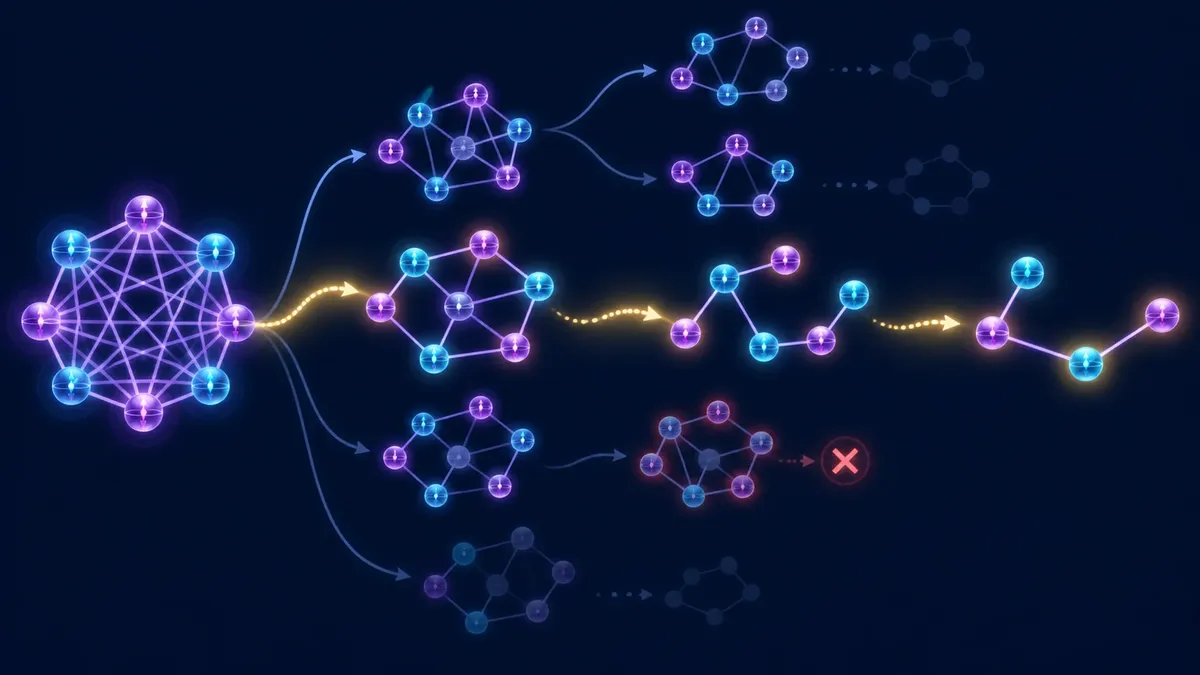
Quantum graph states can be described by many equivalent graphs, yet some descriptions require fewer entangling gates to prepare. A new study tests whether a straightforward search algorithm can find leaner versions—and where that approach runs into limits.
Why the shape of a graph matters
A graph state is a quantum state represented by a network: each vertex stands for a qubit, and each edge corresponds to a controlled-Z (CZ) gate used in preparation. Fewer edges mean fewer such two-qubit gates. The graph’s maximum degree—the largest number of connections at any one vertex—also relates to how many rounds of CZ gates are needed: the paper says the circuit depth is at least this degree and at most one greater.
The same quantum resource can have different graph descriptions. One way to move between them is local complementation: choose a vertex and toggle the connections among its neighbors. This changes the graph while preserving the state up to local Clifford operations, which the authors describe as relatively inexpensive compared with entangling gates. The practical question is whether a sequence of these transformations can produce a graph with fewer edges and, as a secondary goal, lower maximum degree.
Searching the family of equivalent graphs
Harada and colleagues recast the task as a search through the set of graphs reachable by local complementations. They use greedy best-first search (GBFS), which prioritizes graphs according to a simple score: first, fewer edges; then, lower maximum degree. The algorithm records previously visited states to avoid repeating work. The researchers also test an “orbit search” version that uses graph isomorphisms to recognize structurally identical graphs even when their vertex labels differ.
They compare these methods with three alternatives: local search, a local-search method combined with graph decomposition, and an integer-linear-programming approach initialized using simulated annealing. The test collection includes random and structured graphs, as well as graphs derived from quantum error-correcting codes. Runs were limited to 300 seconds and 8 GB of memory per instance on a single thread. Those limits matter: a search that stops because it runs out of time or memory cannot establish that it has found the best possible graph.
Strong results, with important exceptions
Across many tested graph classes, GBFS and orbit search found graphs with edge counts and maximum degrees that were equal to or better than those produced by the comparison methods. The paper reports especially consistent results on random graphs, bounded-degree graphs and complete multipartite graphs. For random graphs with 13 vertices, both search methods found optimal solutions for all tested instances.
But there is no universal winner. The decomposition-based local-search method performed better on distance-hereditary graphs, a family it was specifically designed to handle. Some comparisons also depended on the measure: a method could do well at reducing edges without doing equally well at reducing maximum degree. On some quantum error-correcting-code instances, the search methods improved the graph, while other instances showed little or no reduction. The authors say GBFS and orbit search performed best on most, not all, of the code-derived graphs they examined.
The study also offers a reason not to stop at the first apparent dead end. In some runs, the search had to pass through graphs with more edges before reaching one with fewer. Analyses of successfully solved instances found that multiple local minima were encountered in many cases. A local-search strategy that stops at its first local minimum can therefore miss a better option.
What the results do—and do not—show
When the GBFS search exhausts the entire reachable set, its bookkeeping lets it certify the best graph according to the paper’s two-part objective. But exhaustion is not guaranteed under a resource limit. The study reports that the method can find promising results before proving optimality, making it useful as an anytime approach: it can return its best-so-far graph if computation has to stop. That is not the same as a guarantee that every result found under a limit is optimal.
The experiments are computational comparisons, not demonstrations that the optimized graphs improve performance on a quantum processor. Fewer CZ gates and a lower maximum degree are preparation-cost measures; the paper does not establish hardware-level gains in fidelity, execution time or total system resources. Its scope is also limited to local complementations. The authors identify extending the method to other transformations as future work.
The source is an arXiv preprint, a research manuscript that may not have undergone peer review. Its findings should be read as evidence from the reported benchmarks, not as a final verdict on graph-state optimization. The results suggest that exploring beyond the first local minimum can pay off, while also showing that performance depends on graph structure and computational budget.
- quantum computing
- graph states
- greedy best-first search
- local complementation
- quantum error correction
Related reading
Automatically matched by shared topic keywords. These links do not imply that the sources agree or establish a consensus.
How Matroids Connect Quantum Codes and Secret Sharing
Source published
Shared keywords: graph states, quantum error correction
Quantum error correction that adapts as noise drifts
Source published
Shared keywords: quantum computing, quantum error correction
Adding a third layer to quantum error correction
Source published
Shared keywords: quantum computing, quantum error correction
A quantum decoder that learns to adapt to changing noise
Source published
Shared keywords: quantum computing, quantum error correction
Making Mid-Circuit Quantum Measurements Easier to Understand
Source published
Shared keywords: quantum computing, quantum error correction