TRANSMISSION // 2611.30733v1
Can AI measure a city’s “personality”?
Source published
A new method gives AI city-specific documentary portraits and the same questionnaire, then tests whether scores hold up across repeated runs and changed sources.
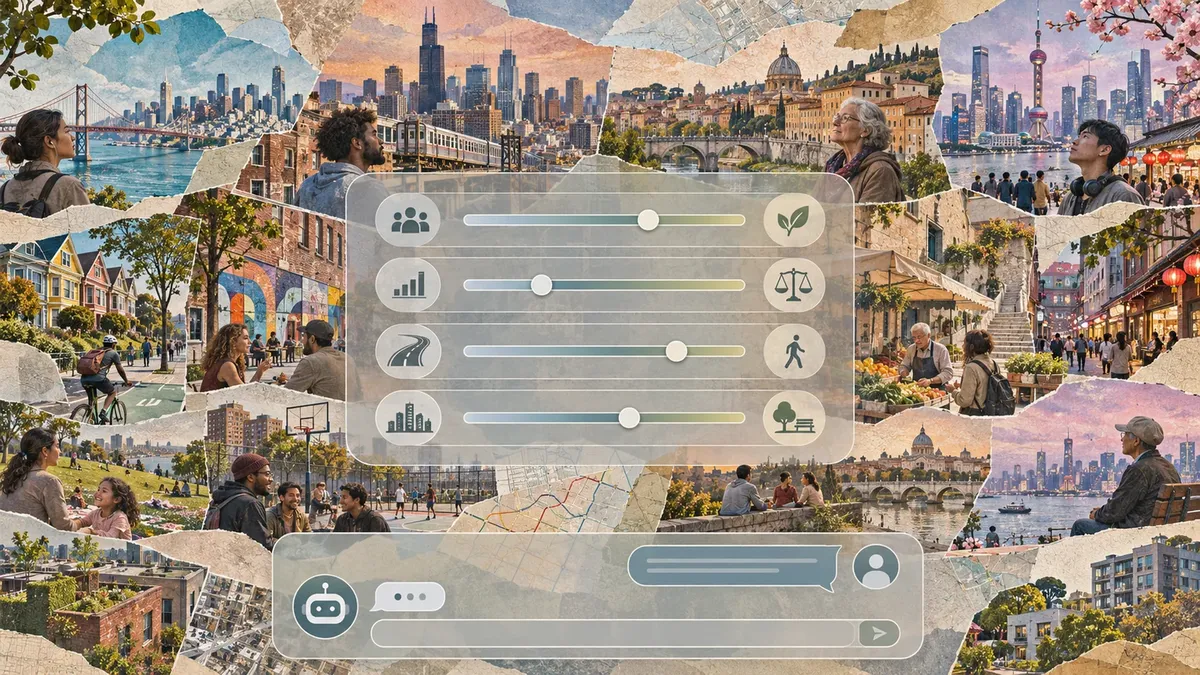
Tokyo, New York and Paris received repeatable—but not identical—profiles when an AI assessment used different documentary portraits. The results describe how selected sources portray cities, not an objective personality each city possesses.
A city can seem lively, reserved, orderly or spontaneous. But these descriptions depend on whose experience is represented, which neighborhoods are included and what sources are consulted. Andrei Khurshudov’s preprint introduces a way to test how an AI-generated city profile changes when the evidence changes.
The method, called the SCD City Personality Assessment (SCD-CPA), gives a separate ChatGPT persona to each city. Each persona receives a curated documentary portrait and is asked the same 24 questions. The questions use four opposing pairs: public expressiveness versus reserve; reinvention versus continuity; technical or managerial priorities versus people-centered ones; and formal organization versus spontaneity.
The familiar four-letter format is inspired by the structure of the Myers-Briggs Type Indicator, but Khurshudov defines new questions and scoring rules for cities. It is not a test of residents’ individual personalities, does not use the MBTI questionnaire and does not establish that cities have fixed psychological traits. Rather, it measures how a city is portrayed in the supplied records.
A fixed questionnaire, changeable evidence
For each question, the AI returns a score from −4 to +4, or “N/A” if the portrait lacks enough information. The researcher combines responses into a score for each dimension. Fresh conversations were run under three reasoning-effort settings within one model family; the original portraits for Tokyo, New York and Paris were also replaced with alternative versions.
The main methodological evaluation included 33 assessments across the three cities. Tokyo’s original portrait was assessed 18 times. Its scores matched exactly on 85.4% of comparable question pairs within the same setting, and 98.7% differed by no more than one point. These figures describe repeatability in the tested setup—not whether the scores accurately capture a city.
The alternative portraits changed some results. New York’s organization-versus-spontaneity score moved from a strong spontaneous orientation toward near-neutral, while Tokyo’s technical-versus-people-centered score weakened. Because the alternative portraits differed in both length and content, the study cannot identify which change produced those shifts. The results show that source selection matters even when the questions and scoring remain fixed.
The method was also applied to Shanghai, Dubai, Mumbai, Lagos and São Paulo, with one assessment at each of three settings per city. Across this five-city application, 77.8% of comparable item scores matched exactly and 99.4% were within one point. This shows the procedure was applied to additional cities; it is not a second large-scale validation study. With only one run per setting in this phase, differences cannot be confidently attributed to the settings themselves.
What the numbers can—and cannot—say
The method’s appeal is its explicit structure: researchers can hold questions constant, disclose evidence portraits and measure how responses vary. But consistent answers are not necessarily accurate answers. The portraits are curated, and choices about sources, dates, languages and neighborhoods shape what the AI sees. The model’s interpretation—and any influence from its prior training—cannot be fully inspected, despite instructions to use the supplied documents.
The questionnaire is exploratory. Its four dimensions are defined by Khurshudov, not established through statistical validation as universal or independent traits. A score near zero could reflect sources emphasizing both sides, neither side, or conflicting accounts; the score alone cannot distinguish these possibilities. The paper’s near-neutral band for cautious letter labels is provisional, not a validated threshold.
This is an arXiv preprint, so its claims should be treated as preliminary, not settled. The three-city evaluation is small, most comparisons across settings involve few runs, and the five application-city portraits are not included in the public reproducibility archive described in the paper. The study does not test independent AI model families or establish agreement with residents’ views.
SCD-CPA is best understood as a framework for comparing documented portrayals—not a definitive personality test for places. Its useful question is less “What is this city really like?” than “How does this evidence set lead an AI to describe it, and what changes when the evidence changes?”
- AI
- urban perception
- city branding
- language models
- document-grounded AI
- preprint
Related reading
Automatically matched by shared topic keywords. These links do not imply that the sources agree or establish a consensus.
A Separate Control Channel Could Make Language Models Easier to Steer
Source published
Shared keywords: language models
Fine-tuning as a probe for hidden AI behaviours
Source published
Shared keywords: language models
Small language models offer a route to personalized sleep guidance
Source published
Shared keywords: language models
Can AI cyber assistants help defenders without helping attackers?
Source published
Shared keywords: language models
A weight-editing attack may weaken open AI guardrails
Source published
Shared keywords: language models