TRANSMISSION // 2611.30697v1
A smaller alphabet for the information bottleneck
Source published
A mathematical result shows that, for classical data with a small label set, the information bottleneck can be approximated using a compressed representation whose size depends on the labels and chosen accuracy—not the full data alphabet.
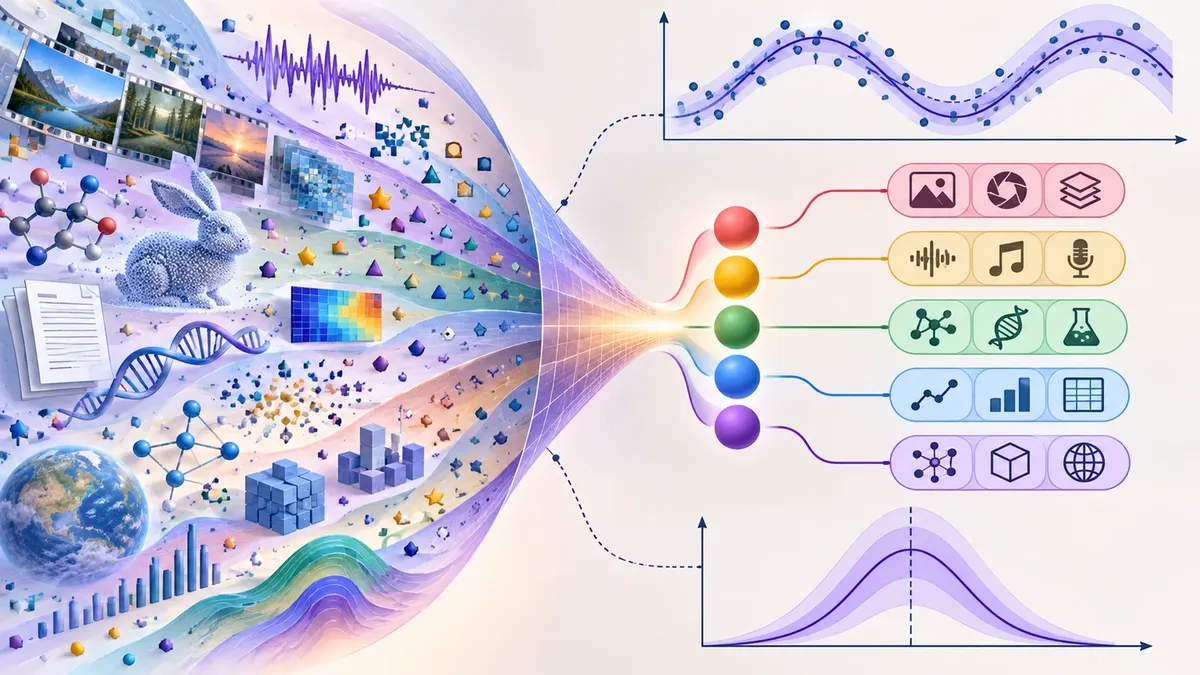
The information bottleneck asks how much a compressed version of data can preserve about a relevant target, such as a label. Christoph Hirche and Andreas Winter show that, in the classical setting, an approximate solution need not use a representation as large as the data’s full set of possible values. Their bound depends instead on the target’s size and the desired accuracy.
Compressing data is useful only if the compressed version keeps what matters. In machine learning, for example, a system may need to shrink an image while retaining information that helps identify its label. The information bottleneck is a mathematical way to describe this trade-off: it asks how much information a compressed representation can retain about a target, while limiting how much information it carries about the original data.
A practical obstacle is the size of that representation. A standard mathematical bound says that an optimal representation can be chosen from an alphabet no larger than the data alphabet plus one. That is reassuring when the data have few possible values. But a data space such as all images in a particular digital format can be enormous, even when the label set—say, the categories to be recognized—is modest.
Christoph Hirche and Andreas Winter ask whether the representation can be bounded in terms of the smaller label set instead. Their paper gives an affirmative answer for an approximation: for any chosen accuracy, it provides explicit bounds on the approximation error and the required representation size, with both depending on the number of possible labels and the accuracy parameter, rather than on the size of the original data alphabet.
Group data by what they say about the target
The key idea is to group data values that have similar relationships to the target. In a labelled dataset, two different inputs might be treated alike if seeing either one leads to nearly the same distribution of labels. The authors show how to replace the original input with a compact group identifier, then use a recovery step to reconstruct a version of the input that preserves the relevant statistical relationship with the labels approximately.
This is a form of approximate sufficiency: the compressed variable need not preserve every detail of the input, only enough to retain nearly the same information about the target. The authors bound how many groups are needed by covering the space of possible label distributions with a finite set of approximations. In plain terms, if many inputs imply similar probabilities over a small set of labels, they can be represented using fewer distinct codes.
They then connect this compression to the information bottleneck function. The bottleneck value for the compressed data is no greater than the value for the original data, but the paper bounds the gap between them. This also yields a limit on the size of the intermediate representation needed to approximate the original bottleneck function. The result is mathematical; it is not a report of a new machine-learning system or a benchmark showing faster training.
When the bound may be especially useful
The paper discusses ordinary classification, where each input has one label. If labels are fully determined by the input, the authors note that their approach can achieve an exact reduction using a number of groups tied to the label count. They also consider cases with ambiguous inputs—ones associated with more than one label—and multi-label data. For the latter, the number of possible label combinations can itself grow quickly, so a label-based bound is not automatically small in every task.
The main practical promise is therefore conditional: when the target set is comparatively small and the desired approximation is suitable, the representation bound can avoid dependence on an extremely large input alphabet. The paper does not establish that every real dataset will be easy to compute with, or that a particular neural network will use this construction effectively. Applying the theory to a dataset still requires working with its probability distribution and choosing an accuracy level.
Quantum extensions have limits
The authors also extend some cardinality arguments to settings involving quantum information. These are specific mixed classical–quantum cases, including situations where the compressed variable remains classical. The paper does not solve the fully quantum version; its conclusion identifies dimension bounds in that general setting as an open question. Quantum systems also require different mathematical tools because, unlike classical data, quantum states cannot in general be copied or treated as ordinary probability distributions.
This is a theoretical contribution, not an experimental comparison. Its bounds establish what can be guaranteed under the stated mathematical setup, but do not by themselves show how much computation a real implementation would save. The available source is an arXiv preprint, and the extracted text contains equation and layout artifacts, so precise formula details are not reproduced here. The broad result and its stated scope are clear: approximate classical information-bottleneck representations can be bounded using the size of the target alphabet and a chosen error tolerance, while the fully quantum problem remains unresolved.
- information bottleneck
- data compression
- information theory
- machine learning
- quantum information
Reviewed cross-references
These connections were reviewed by a model, not independently fact-checked by a human. Similarity does not imply agreement; consult the original papers and the evidence below.
Why Some Quantum Data Cannot Be Compressed Without Losing Correlations
Shared method: Both preprints use recovery maps to study compression: Hirche and Winter invoke approximate recovery in a method for bounding the classical information-bottleneck alphabet, while Wolff and colleagues relate recoverability to mutual-information loss in their quantum compression analysis. The first concerns classical variables and approximation; the second reports quantum examples resisting substantial compression, so this shared tool does not establish that the classical bound applies to fully quantum data.
Model review: · openai-codex/gpt-6-luna
Evidence and provenance
Selected excerpts, not complete papers. PDF extraction can omit figures or damage equations, tables and reading order; sources may be preprints.
2611.30697v1 — Original paper
Excerpt reference:
static/papers/2611.30697v1.md:91-167
Basis: Paper text
Source SHA-256:23f79dbbc5439d90305d1043d4a7dce91ee8e30d40a8b2b578623208f8cd421f2611.28361v1 — Original paper
Excerpt reference:
static/papers/2611.28361v1.md:204-299
Basis: Paper text
Source SHA-256:43faf2147750f034df270f7450f0c247452976fa98da3cae765c8723578266c3
Related reading
Automatically matched by shared topic keywords. These links do not imply that the sources agree or establish a consensus.
Why Some Quantum Data Cannot Be Compressed Without Losing Correlations
Source published
Shared keywords: information bottleneck, quantum information
Nuclear symmetry breaking rearranges where correlations live
Source published
Shared keywords: quantum information
How quantum systems behave over the long run
Source published
Shared keywords: quantum information
A product-state bound connects quantum privacy and testing
Source published
Shared keywords: quantum information
A convergent hierarchy probes classical explanations of quantum states
Source published
Shared keywords: quantum information