TRANSMISSION // 2611.30676v1
Why trapped-ion error correction may need cooling built into the schedule
Source published
A simulator that tracks heating ion by ion finds that transport can undermine error correction—and that targeted cooling restores improving error rates in the modeled system.
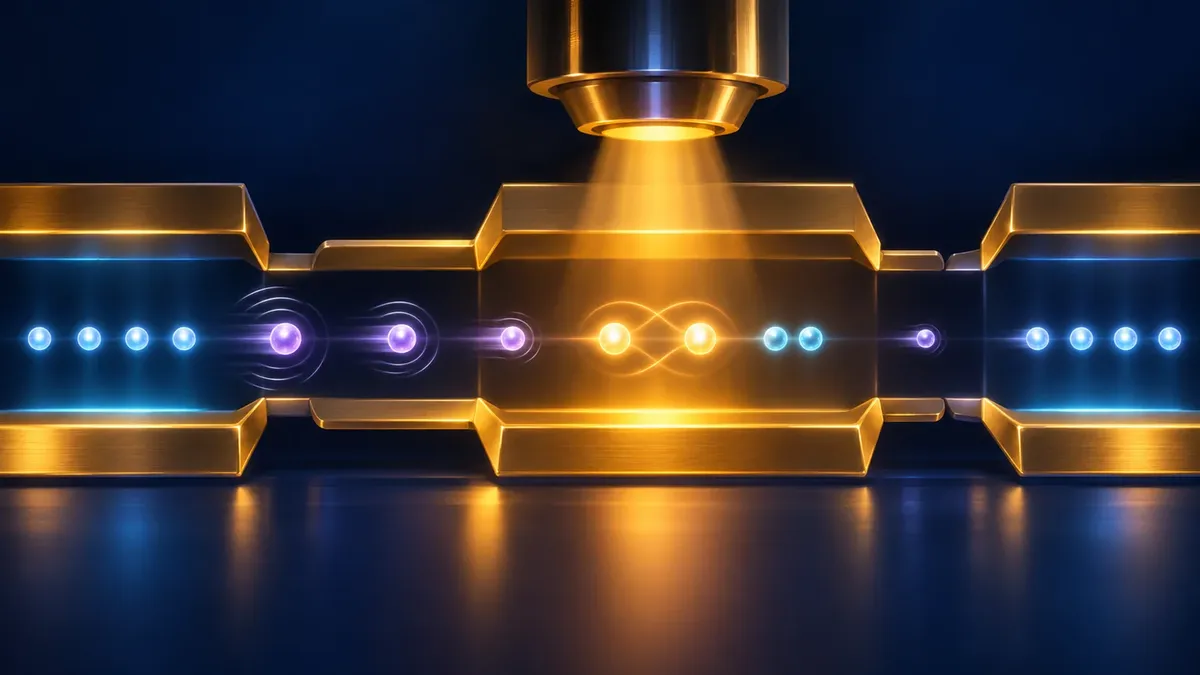
Moving ions between trap zones makes flexible quantum-computing layouts possible, but movement can heat them and make later gates less reliable. A new simulation framework tests how that heating affects error correction, and whether cooling can help.
In a trapped-ion quantum computer, ions can be moved between zones so different qubits can interact. That flexibility comes with a complication: shuttling ions, rearranging them, and splitting or merging chains can excite their motion. This motional energy is often described in terms of phonons. As it builds up, it can make two-qubit gates less reliable.
A new study asks whether this transport-related heating could cancel out the benefits of using larger quantum error-correcting codes—and whether a cooling schedule could prevent that. The work introduces THeatA, a software framework for simulating error correction in a linear quantum charge-coupled device (QCCD), an architecture that moves ions between dedicated trap zones.
Tracking the journey, not just the circuit
In quantum error correction, a logical qubit is protected by repeatedly measuring groups of physical qubits for signs of errors. In a QCCD device, those measurements require moving ions so the relevant qubits can meet in a gate zone. A circuit diagram alone does not capture the added transport, its duration, or the heating it causes.
THeatA translates syndrome-measurement circuits into instructions for a one-dimensional trap. Its compiler inserts operations such as shuttling, splitting, merging, and physical swaps, and tracks the mean phonon number of each ion as the schedule proceeds. A noise-simulation pipeline then uses those tracked values and the time each ion spends idle to estimate errors in the gates and the circuit’s logical error rate. The simulated circuits are decoded using minimum-weight perfect matching.
The researchers tested rotated surface codes over three rounds of syndrome extraction. They compared strategies that cooled measurement ancillas, used cooled auxiliary ions to reduce motion in memory chains, or cooled the data–ancilla pair near the gate zone shortly before a two-qubit gate. In the model, data ions cannot be directly laser-cooled without risking their stored quantum information; auxiliary coolant ions provide an indirect route.
What the simulations found
Without cooling, the simulated logical error rate did not improve as the code distance increased across the tested small code sizes. The authors traced this result to heating-dependent gate errors: when they removed the effect of phonon number from the gate-error calculation while keeping other modeled noise, logical error rates fell as code distance increased.
Cooling strategy mattered. Cooling ancillas after measurement reduced errors but did not restore improving logical-error scaling. Cooling through memory chains also had limits: merging a cooled ion with a long chain dilutes its effect, and the merge itself adds some heating.
The strongest result came from a strategy that used resident coolant ions in the gate zone. Before a two-qubit gate, the compiler isolated the data–ancilla pair and merged it with the precooled ions, reducing the pair’s tracked motional excitation. With the study’s chosen settings, logical error rates decreased between code distances 3 and 5 and between 5 and 7. This is evidence of improving error suppression across those tested steps—not a demonstration of scalable fault-tolerant computing.
The team also varied the assumed duration and residual phonon number of an abstract cooling instruction. In most tested combinations with cooling durations of 1–10 milliseconds and residual phonon numbers up to 2, both code-distance comparisons met the authors’ criterion for improving logical error rates. Longer cooling takes time, however, and background heating continues during that time; even zero residual excitation did not preserve the criterion at the longest tested duration of 75 milliseconds.
Important caveats
These are simulation results, not a demonstration on a working processor. The conclusions depend on the selected architecture, noise rates, transport costs, and code settings. The study examines one linear layout, one code family, and three extraction rounds; larger codes, more rounds, other architectures, and other codes remain open questions.
The cooling model is especially idealized. It assumes that merging chains completely equalizes their mean motion, and that a cooling instruction resets motion to a chosen residual value after a fixed time. It does not simulate the detailed dynamics of a particular cooling method. The authors also note that some gate-error estimates are clipped at the maximum of their lookup table, making affected reported logical-error rates lower bounds. The paper says background heating resets at round boundaries, which makes its modeled heating effect a lower bound under that assumption.
THeatA’s contribution is therefore a way to study transport, heating, and cooling together in a schedule—not proof that the proposed cooling strategy will work as modeled in hardware. The paper is a preprint, and its authors identify calibration of hardware-specific heating costs and more realistic cooling dynamics as important next steps.
- trapped-ion quantum computing
- quantum error correction
- QCCD
- motional heating
- surface codes
- quantum cooling
Reviewed cross-references
These connections were reviewed by a model, not independently fact-checked by a human. Similarity does not imply agreement; consult the original papers and the evidence below.
For silicon quantum memory, the route can matter as much as the circuit
Supporting evidence: Both studies find, in simulations of different hardware, that transport-related costs can affect logical QEC performance: Ishikawa et al. report that modeled motional heating prevents surface-code logical-error suppression under evaluated QCCD conditions unless cooling is added, while Chow and Baugh report that silicon-code logical error rates vary with shuttle noise and layout. The mechanisms, platforms and code evaluations differ, so this supports only the bounded point that transport effects matter in these modeled QEC settings—not a direct performance comparison.
Model review: · openai-codex/gpt-6-luna
Evidence and provenance
Selected excerpts, not complete papers. PDF extraction can omit figures or damage equations, tables and reading order; sources may be preprints.
2611.30676v1 — Original paper
Excerpt reference:
static/papers/2611.30676v1.md:1828-1926
Basis: Paper text
Source SHA-256:17076c0f5248325ce56ef484d75ffa7c424e63533a7710db0281fe91eabb2ee62611.13371v1 — Original paper
Excerpt reference:
static/papers/2611.13371v1.md:12-68
Basis: Paper text
Source SHA-256:ba12666871c5c83bc582d6cfe8966911a966c0ca2ac3773bd04b32dc0c120a99
Related reading
Automatically matched by shared topic keywords. These links do not imply that the sources agree or establish a consensus.
How surface codes can correct qubit leakage
Source published
Shared keywords: quantum error correction, surface codes
GARI++ splits quantum error correction into a fast first pass and a smaller cleanup
Source published
Shared keywords: quantum error correction, surface codes
Why finite surface codes can obscure coherent-error recovery limits
Source published
Shared keywords: quantum error correction, surface codes
Tracing photon noise from atomic scattering to quantum algorithms
Source published
Shared keywords: quantum error correction, surface codes
When the Most Likely Error Is Not the Best Correction
Source published
Shared keywords: quantum error correction