TRANSMISSION // 2611.30632v1
How to combine robot skills without making them clash
Source published
GeoMerge-OPD combines response-space regularization, parameter merging and on-policy distillation to integrate robotic skills. Tests show promising results, but real-world evidence remains limited.
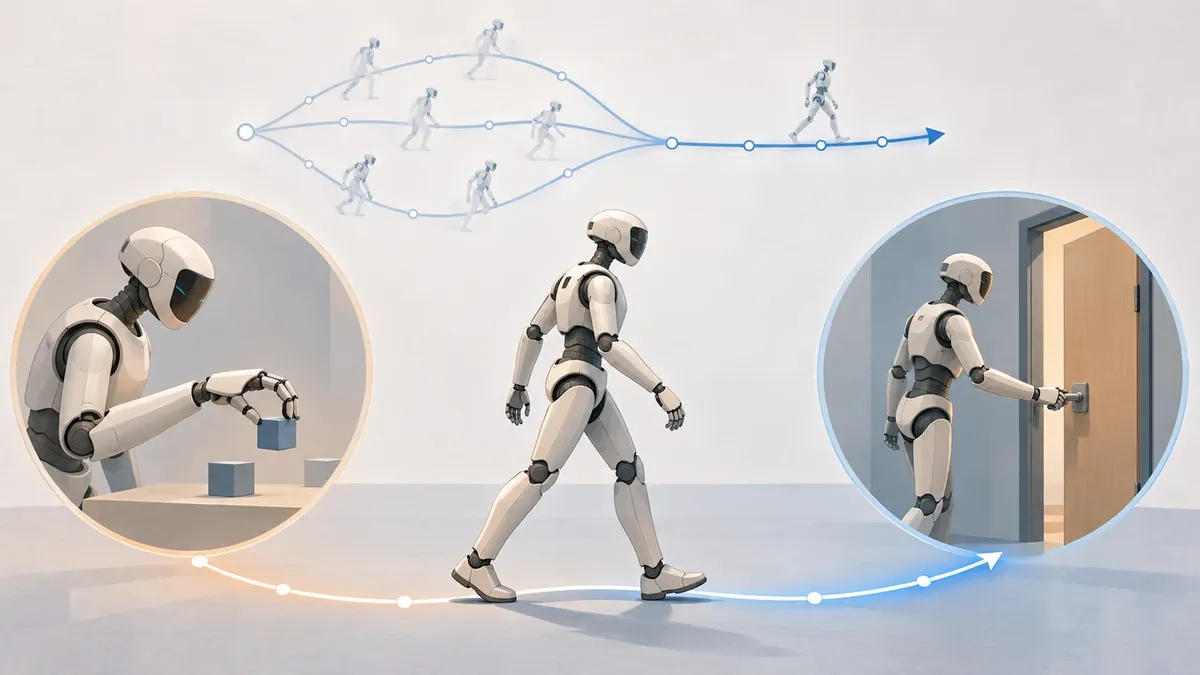
A robot policy that can open a door may not combine that ability smoothly with bending to pick something up. GeoMerge-OPD is a proposed way to merge separate skills while reducing the unwanted behavior that can arise when they share one model.
A robot that can bend and grasp, walk toward a door, and open it would be more versatile than a robot with a separate policy for each skill. But combining specialist policies is not simply a matter of averaging their model weights. When two skills call for different movements, merging can produce actions neither specialist would take. In the example studied here, a merged humanoid policy moved its lower body during a task that required bending and grasping in place.
A new preprint, GeoMerge-OPD: Balanced Skill Integration in Vision-Language-Action Models, asks whether a shared policy can retain distinct skills without that kind of interference. The authors propose a three-stage approach: shape how each specialist is fine-tuned, merge the specialists’ parameters, then refine the merged policy using feedback from those specialists.
From specialists to one policy
The method’s first step, called G-isometry, regularizes how a specialist’s parameter updates affect its responses to task inputs. In plain terms, the researchers aim to prevent a small number of response directions from dominating too strongly. They then statically merge the specialists into a student policy with some initial ability across tasks.
Finally, that student acts in the environment, and the relevant specialist acts as its teacher. Rather than learning only from demonstrations or from the teacher’s finished actions, the student receives supervision at observations it has encountered itself and at intermediate stages of generating an action. This on-policy distillation is intended to correct remaining differences between the student’s behavior and the specialists’ behavior.
The experiments use two vision-language-action (VLA) model backbones: systems that combine visual and language inputs with action generation. Tests cover SIMPLE, a benchmark for humanoid whole-body control, and LIBERO and LIBERO-PRO, benchmarks for manipulation. The paper also reports a small real-robot evaluation.
What the tests found
On SIMPLE, the researchers tested three tasks: BendPick, CloseDoor and OpenOven. GeoMerge-OPD completed 26 of 30 evaluation trials across the tasks. Joint fine-tuning—a baseline trained on pooled tasks—completed 22 of 30 when given the same regularized merged initialization. The result suggests that the full method can help preserve a more balanced set of skills in this particular test; it does not establish that every skill combination will benefit.
On LIBERO, the paper reports a 97.1% average success rate for GeoMerge-OPD, compared with 96.2% for joint fine-tuning from the pretrained base. On LIBERO-PRO, which evaluates policies under perturbations, the method’s average was 67.3%, versus 64.9% for joint fine-tuning from the regularized merge. It was not best on every perturbation category: that baseline scored higher on object perturbations and language paraphrasing.
The paper’s real-world test is narrower. A Unitree G1 humanoid attempted two stationary box-manipulation tasks, with 10 trials per task. The shared policy succeeded in 17 of 20 trials overall, compared with 18 of 20 for the task-specific specialists. On the lifting task, it succeeded in 7 of 10 trials, versus 8 of 10 for the relevant specialist. These results offer an initial demonstration, not evidence that the approach can reliably combine walking and manipulation on a real robot.
How certain is the result?
The proposed explanation is that specialist updates can push a shared policy in opposing directions, and that controlling their response patterns before merging can reduce disruptive shifts. The authors report measurements consistent with this account. They also caution that the diagnostic does not prove that concentrated responses cause task failures; their theoretical analysis uses simplifying assumptions, including fixed activations in parts of the analysis.
The evidence is promising but bounded. The real-world evaluation covers only two stationary tasks, while the authors identify more complex combinations of locomotion and manipulation as future work. Some comparisons and ablations use a single training run; repeated runs are reported for selected post-training comparisons, with the merged initialization held fixed. The paper also notes limits in the number of experts and breadth of evaluation.
This article is based on an arXiv preprint, a research manuscript that may not have undergone peer review. Its benchmark results describe the tested models, tasks and setups; they do not guarantee performance in other settings. The paper presents GeoMerge-OPD as a research approach to skill integration, not a ready-made solution for dependable general-purpose robots.
- robotics
- vision-language-action models
- robot learning
- model merging
- on-policy distillation
- humanoid robots
Reviewed cross-references
These connections were reviewed by a model, not independently fact-checked by a human. Similarity does not imply agreement; consult the original papers and the evidence below.
How to Help Robot AI Remember Language While Acting
Shared method: Both studies use parameter merging: GeoMerge-OPD statically merges separately fine-tuned task experts before distillation, while Aissi et al. merge a VLM with its VLA derivative using learned SVD-component coefficients. This is a shared broad technique, not the same merging procedure or objective; the latter targets retaining language and action capabilities, whereas GeoMerge-OPD integrates task skills.
Model review: · openai-codex/gpt-6-luna
Evidence and provenance
Selected excerpts, not complete papers. PDF extraction can omit figures or damage equations, tables and reading order; sources may be preprints.
2611.30632v1 — Original paper
Excerpt reference:
static/papers/2611.30632v1.md:61-101
Basis: Paper text
Source SHA-256:9d56065d9bf3e7b41961c7d858422bfc7d474527ce47943e3c2ead22311848922611.18891v2 — Original paper
Excerpt reference:
static/papers/2611.18891v2.md:86-210
Basis: Paper text
Source SHA-256:84bcd02bcd6c4bb09c54cabb7b209b01165a8cea617e40299ea30a027b28b51e
Related reading
Automatically matched by shared topic keywords. These links do not imply that the sources agree or establish a consensus.
How to Help Robot AI Remember Language While Acting
Source published
Shared keywords: model merging, robot learning, vision language action models
Robots Learn From Teachers, Then From Failure
Source published
Shared keywords: on policy distillation, robot learning
Can a general AI model control a robot arm?
Source published
Shared keywords: robot learning, vision language action models
A critic helps robot policies learn from logged experience
Source published
Shared keywords: robot learning, vision language action models
A shared action vocabulary for robots—and humans
Source published
Shared keywords: robot learning, vision language action models