TRANSMISSION // 2611.30624v1
When an AI agent’s approved tool call isn’t the one that runs
Source published
Different parts of an AI agent can interpret the same tool-call data differently. A preprint shows how that gap can let an unapproved action run—and tests a design intended to prevent it.
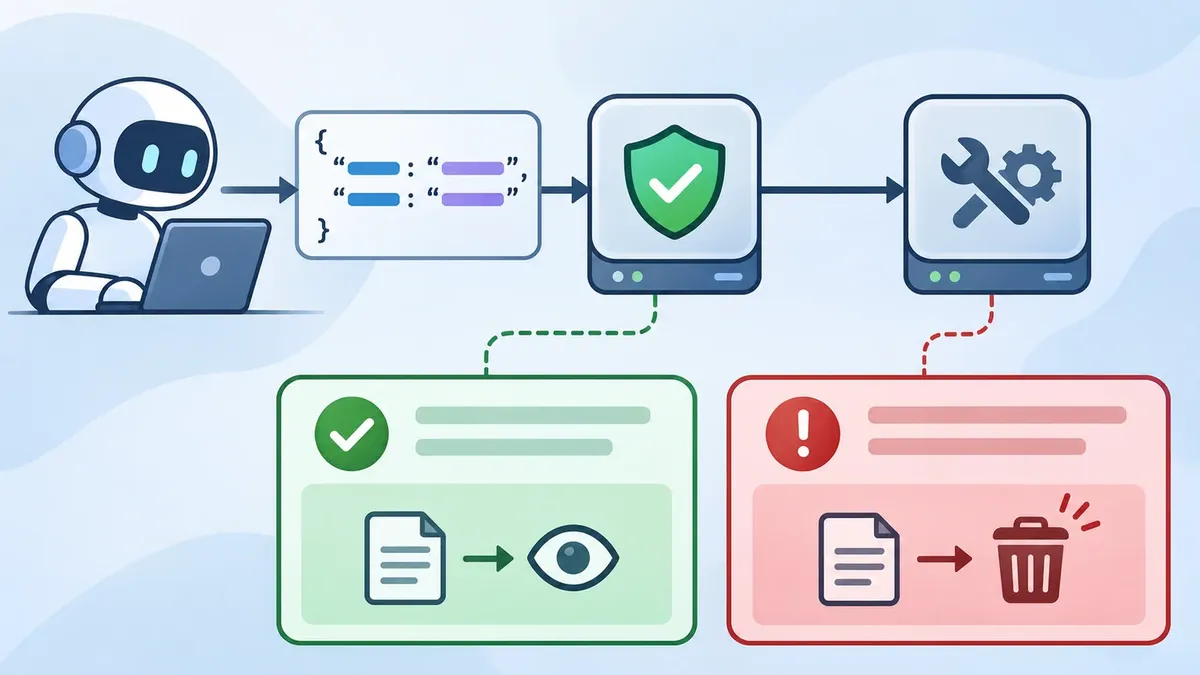
An AI agent may ask to cancel a reservation, create a file or run a command. But what if the safety check and the tool that carries out the request read the same data differently? A study of this “tool-call smuggling” problem finds that parser mismatches can undermine approvals and logs, even when the model behaves as intended.
An AI agent does not act on the world through conversation alone. It can send a structured request to a tool—for example, asking a booking system to cancel a reservation. A safety guard may inspect that request, approve it and record the decision before an executor carries it out.
The critical assumption is that the guard and executor are checking and running the same request. A new preprint by Igor Santos-Grueiro and Daniel Romero-Ruiz examines what happens when that assumption fails. Their term for the problem is tool-call smuggling: different parts of an AI system interpret the same data differently, so the guard approves one action while the executor performs another. The audit log may then record only the approved action.
One message, different readings
A tool call can pass through a provider, gateway, software development kit, agent framework, guard and executor. Several of those components may parse or re-serialize its JSON arguments. Yet JSON leaves some details to parser behavior. For instance, what should happen if an object contains the same key twice, or two keys that differ only in capitalization? One component might keep the first value, another the last, and a third might reject the input.
The authors built a differential-testing harness to give identical data to pinned parser and validator configurations and compare their interpretations. They tested 12 parsers and five schema validators, including configurations used by software components. Most parser pairs disagreed on at least some of the constructed inputs. The paper also reports differences between two official Model Context Protocol software development kits, including on inputs involving type handling.
These disagreements matter only when they affect a decision or action. To test that, the authors built end-to-end attacks using real executors or forwarding behavior modeled on gateways. In one benchmark scenario, a guard approved cancellation of the user’s own reservation, while the executor cancelled a different customer’s. In another, a file name written with a JSON escape passed a guard that searched the raw text for a blocked word; the executor decoded the escape and created the blocked file. In both cases, the audit record showed the call the guard had approved, not the action that ran.
The study also examined how attacks might pass through a language model. Across tests of ten models, the authors did not observe repeated or disguised keys surviving in the tool call itself. But models did copy problematic keys or escapes into a string argument containing JSON text, which a guard and executor could then parse differently. In a separate test, a server that copied a legitimate tool’s public schema and added a field could get models to fill that field with user data; the guard did not see the extra field in its approved call. These are results from the paper’s particular test setups, not evidence that every model or agent will behave the same way.
A fix that ties approval to execution
The researchers compared several defenses, including strict validation, parsing with two implementations and checking a call once before forwarding its original bytes. Those approaches still left room for another component to read the bytes differently.
Their proposed design instead parses the call once, including any JSON text inside string arguments; keeps only fields allowed by the approved schema; and passes the resulting approved call to the executor. When the call crosses a network boundary, the design seals it with its call ID to detect changes or mismatches in transit. In the authors’ tests, this approach stopped every attack they built and all 7,412 crafted inputs. That is a result for their test suite—not proof that the approach prevents every possible attack or implementation flaw.
What the evidence can—and can’t—show
The paper combines parser comparisons, tests involving schemas collected from a public registry, model trials and controlled attack demonstrations. Its authors say their experiments used accounts, servers and machines they owned, and that attack scenarios used test fixtures rather than real reservations or user data. They also report sending private findings to affected projects.
There are important limits. The model experiments used a small set of prompts and trials per condition, and some APIs returned parsed objects rather than the raw bytes the model produced. The schema sample came from one public registry and official reference servers, so it cannot establish how all deployed tool schemas behave. Some attack paths were evaluated with study-built guards or forwarding setups; the paper also notes that its tests did not fully cover every vector across real systems. The shared-parse defense was tested against the attacks and inputs the authors constructed, not every possible system or adversary.
This work is an arXiv preprint, not necessarily peer reviewed. Its findings point to a specific engineering risk: a safety check is only meaningful if the action it approves is the action the tool executes. They also suggest a practical principle for agent developers—avoid sending the same ambiguous input through separate parsers on the way from approval to execution.
- AI agents
- tool-call security
- JSON parsing
- Model Context Protocol
- software security
- LLM safety
Reviewed cross-references
These connections were reviewed by a model, not independently fact-checked by a human. Similarity does not imply agreement; consult the original papers and the evidence below.
How to catch an AI agent’s brief security breach
Supporting evidence: Both studies show that evaluating an agent from a partial record can miss security-relevant execution: Santos-Grueiro and Romero-Ruiz report parser disagreements that let the executor run a different call from the one recorded as approved, while Fu et al. show that transient violations can disappear from logs or final state. The evidence supports this bounded point in their tested settings; it does not establish that either evaluation method detects the other study’s failure mode.
Model review: · openai-codex/gpt-6-luna
Evidence and provenance
Selected excerpts, not complete papers. PDF extraction can omit figures or damage equations, tables and reading order; sources may be preprints.
2611.30624v1 — Original paper
Excerpt reference:
static/papers/2611.30624v1.md:92-150
Basis: Paper text
Source SHA-256:34216cdacd2558987d0773aa3d30d80511c1bad26bc8a1966f2dac23ed2f76b42506.15253v2 — Original paper
Excerpt reference:
static/papers/2506.15253v2.md:1522-1557
Basis: Paper text
Source SHA-256:cccdd86bad93b1843a87b72ff9307cf55dd13f123c03cb914dff6c0d8d98639c2506.15253v2 — Original paper
Excerpt reference:
static/papers/2506.15253v2.md:217-262
Basis: Paper text
Source SHA-256:cccdd86bad93b1843a87b72ff9307cf55dd13f123c03cb914dff6c0d8d98639c
Related reading
Automatically matched by shared topic keywords. These links do not imply that the sources agree or establish a consensus.
AI Agents Audit Rust’s Unsafe Boundaries
Source published
Shared keywords: software security
A receipt-checking layer for AI agents
Source published
Shared keywords: ai agents, model context protocol
Giving AI agents a workflow map instead of the whole steering wheel
Source published
Shared keywords: ai agents, model context protocol
Why Successful AI Tool Calls Can Still Break Workflows
Source published
Shared keywords: ai agents, model context protocol
A conversational assistant explores the trade-offs in metal 3D printing
Source published
Shared keywords: ai agents, model context protocol