TRANSMISSION // 2611.30572v1
Teaching Robots Through Verified Synthetic Touch
Source published
VeriTouch generates visual and tactile robot demonstrations, checks them for plausible contact signals, and derives actions for policy training. The authors report improvements across four policies on five real-world tasks, but the supplied evidence is an abstract, so details and limitations remain unclear.
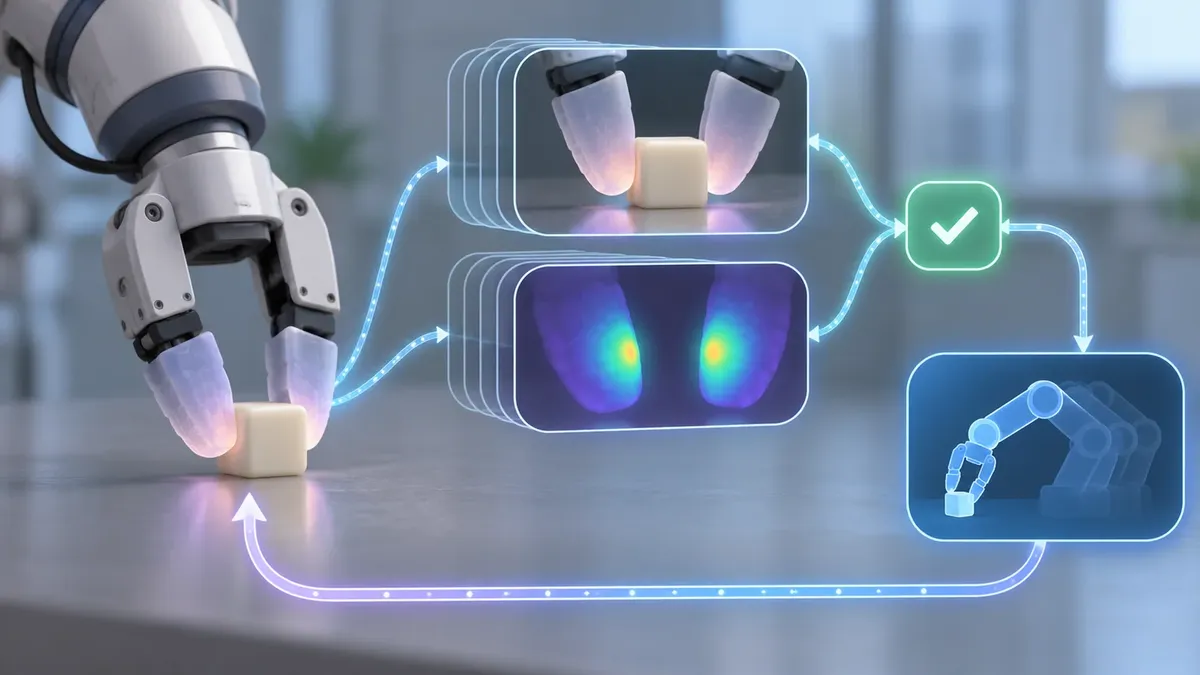
Robots need more than pictures to learn contact-rich tasks: they also need to know what touch should feel like, and when. VeriTouch proposes generating synthetic demonstrations that combine video, tactile signals and actions, then filtering out sequences that appear unreliable.
Why add touch to robot training?
A robot learning to handle objects needs examples of how a task looks and what happens at the point of contact. Cameras can show a gripper approaching an object, but tactile signals can capture contact and deformation. Collecting real demonstrations is costly, while building realistic simulations is difficult. Synthetic data could help—but only if its visual events, touch signals and actions fit together plausibly.
A paper introducing VeriTouch presents a system designed to generate and check these combined demonstrations before using them to train robot policies. The evidence available for this account is the paper’s abstract, not its full text.
Generate, check, then infer actions
The framework has three named components. VeriGen takes initial images and task instructions and generates complete manipulation trajectories as dual-view videos paired with tactile sequences. The authors say it combines a dedicated tactile expert with a pretrained video model, aiming to represent both visual details and the changing patterns of touch during contact.
Next, VeriEval acts as a filter. It assesses visual quality and, in particular, whether tactile feedback seems realistic, whether the implied contact forces are plausible, and whether tactile signals line up in time with visible contact. This matters because a generated demonstration could look convincing while pairing a touch signal with the wrong moment or an implausible interaction.
Finally, VeriIDM estimates actions from videos that have passed verification. According to the abstract, it uses scene information from both camera views alongside detailed gripper information and movement across neighboring frames. Those inferred actions, together with the generated observations, can then supply training examples for robot policies.
What the authors report
The authors say they tested the approach on five real-world tasks. Synthetic data improved all four evaluated policies, and adding more synthetic trajectories further increased policy performance without additional real-world data collection.
These results suggest that the proposed pipeline may make synthetic demonstrations more useful by treating tactile reliability and timing as things to check, rather than assuming every generated sequence is a good training example. But the abstract does not identify the tasks or policies, give numerical results, describe comparison conditions, or explain how verification was validated. It therefore does not let readers judge the size or robustness of the reported improvements.
What remains uncertain
A verifier can only screen for problems it is equipped to recognize. The abstract describes checks for realism, force plausibility and visual–tactile timing, but does not say how often those checks reject useful data or miss flawed examples. Nor does it establish how well policies trained this way transfer to unfamiliar tasks, objects or settings. These are open questions, not reported failures.
The source is an arXiv preprint, and the supplied material contains only its abstract. The claims summarized here are therefore the authors’ reported findings; the available evidence is not enough to assess experimental details, broader generalization or independent replication. VeriTouch offers a promising recipe for producing and screening multimodal training data, but the abstract alone cannot show how far its benefits extend.
- robot learning
- tactile sensing
- synthetic data
- world models
- robot manipulation
Reviewed cross-references
These connections were reviewed by a model, not independently fact-checked by a human. Similarity does not imply agreement; consult the original papers and the evidence below.
A robot's-eye view, generated from outside video
Supporting evidence: Both papers report policy gains after adding generated observations to robot-learning data: VeriTouch reports improvements across four policies on five contact-rich tasks using verified synthetic visuo-tactile trajectories, while AuroraWorld reports higher average success with generated egocentric views than without egocentric input in its ARX X5 evaluation. These results support the bounded point that synthetic observations can help in the evaluated settings; they do not establish comparable effect sizes or performance across the different methods, tasks, and evaluation protocols.
Model review: · openai-codex/gpt-6-luna
Evidence and provenance
Selected excerpts, not complete papers. PDF extraction can omit figures or damage equations, tables and reading order; sources may be preprints.
2611.30572v1 — Original paper
Excerpt reference:
static/papers/2611.30572v1.md:163-203
Basis: Paper text
Source SHA-256:3a556e823387ef6a21c430ed29565613ad56d4ae76ec2df38d235e2f4bca5f242611.00177v1 — Original paper
Excerpt reference:
static/papers/2611.00177v1.md:1858-1936
Basis: Paper text
Source SHA-256:51fa1c602592723ce01037eb0349bc8a528b48be281a4916ec37096c8fc249ae2611.00177v1 — Original paper
Excerpt reference:
static/papers/2611.00177v1.md:902-1021
Basis: Paper text
Source SHA-256:51fa1c602592723ce01037eb0349bc8a528b48be281a4916ec37096c8fc249ae
Related reading
Automatically matched by shared topic keywords. These links do not imply that the sources agree or establish a consensus.
A robot's-eye view, generated from outside video
Source published
Shared keywords: robot learning, robot manipulation, world models
How RoboRecast adapts robot demonstrations to new situations
Source published
Shared keywords: robot learning, robot manipulation
How a robot hand uses touch when the lighting changes
Source published
Shared keywords: robot learning, tactile sensing
Can a Robot Learn a New Task by Watching One Video?
Source published
Shared keywords: robot learning, robot manipulation
Can a general AI model control a robot arm?
Source published
Shared keywords: robot learning, robot manipulation