TRANSMISSION // 2611.30534v1
Teaching robot policies to handle stale observations
Source published
DelayOPSD trains asynchronous robot policies to imitate the same policy acting synchronously. The authors report the highest average success among compared methods on LIBERO and Kinetix, plus gains in a real-robot test.
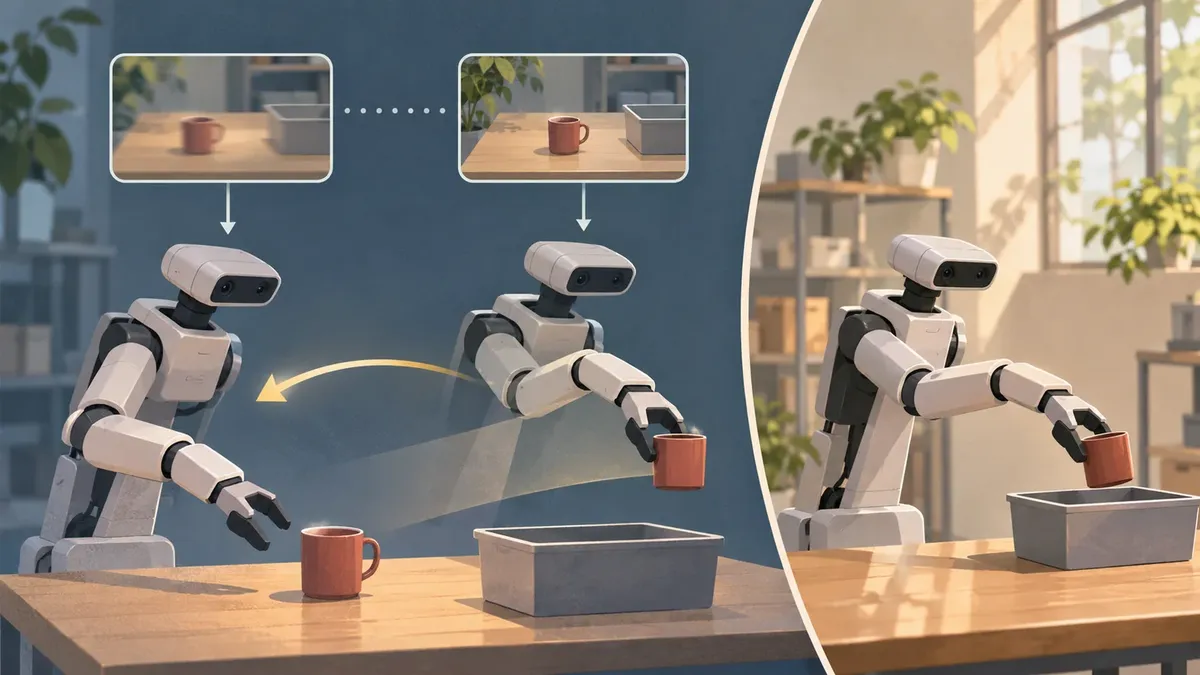
An asynchronous robot policy can plan its next action chunk while the current one is being carried out. But that plan may rely on an older observation. DelayOPSD explores whether training can help a policy cope with this mismatch.
Some robot policies generate actions in chunks using flow-based methods, which involve iterative computation. Asynchronous execution can keep a robot moving while its next chunk is being prepared. The cost is that planning may use an observation from before the robot finished its current actions. How can training account for that delay?
The authors report that actions predicted using observations from planning and execution times differ little on expert demonstrations, but diverge more on the policy’s own delayed rollouts—particularly in failed episodes. This finding motivates training on the policy’s own delayed rollouts, rather than relying only on demonstrations. It does not establish that those rollouts represent every condition the policy may encounter in deployment.
DelayOPSD uses a synchronous teacher and a delayed student during training. The teacher is the same policy run with the observation available at execution time; the student sees only an earlier observation and the actions still being carried out. The student learns to match the teacher throughout its own denoising process, the iterative procedure used to generate an action chunk. The abstract says the method adds no modules at deployment, so the teacher role is used during training rather than as an additional deployed component.
For a reported 10-step delay, SmolVLA trained on demonstrations achieved 70.2% success, compared with 70.4% for naive asynchronous execution. Training on its own rollouts achieved 78.7%. Across LIBERO and Kinetix, the authors report that DelayOPSD achieved the highest average success among the methods they compared. In a real-robot test, they report an increase from 46% to 62% success.
The supplied abstract does not give trial counts or uncertainty ranges for these figures. Their precision and variability therefore cannot be assessed from the available evidence; the full paper may contain further experimental details. The source is an arXiv preprint, and the supplied material does not establish peer review. These results are reported findings, not proof that the method will improve every asynchronous policy or transfer to all robots and tasks.
- robotics
- vision-language-action policies
- asynchronous inference
- robot learning
- self-distillation
Reviewed cross-references
These connections were reviewed by a model, not independently fact-checked by a human. Similarity does not imply agreement; consult the original papers and the evidence below.
Teaching robot policies to anticipate their next move
Supporting evidence: Both preprints report improved asynchronous VLA control in their tested settings: DelayOPSD reports higher real-robot success than naive asynchronous execution, and JEPA-Tuner reports reduced handoff action step change versus naive asynchronous execution for π0.5 on LIBERO at two delays. These are complementary, not directly comparable outcomes from different methods and evaluations; the selected excerpts do not establish that either method generally outperforms the other.
Model review: · openai-codex/gpt-6-luna
Evidence and provenance
Selected excerpts, not complete papers. PDF extraction can omit figures or damage equations, tables and reading order; sources may be preprints.
2611.30534v1 — Original paper
Excerpt reference:
static/papers/2611.30534v1.md:1175-1219
Basis: Paper text
Source SHA-256:c09c87e349a779402d58780a27f1e8b1428632ed37e56aa598dbddfb22a7c8ec2611.29096v1 — Original paper
Excerpt reference:
static/papers/2611.29096v1.md:1359-1444
Basis: Paper text
Source SHA-256:3fe2963ae17176851aa4c236645dda04dd30260e7758db6d62247a27cc65321e
Related reading
Automatically matched by shared topic keywords. These links do not imply that the sources agree or establish a consensus.
Teaching robot policies to anticipate their next move
Source published
Shared keywords: asynchronous inference, robot learning
A faster handoff between robot policies
Source published
Shared keywords: asynchronous inference
AI coding agents build a robotics simulation benchmark
Source published
Shared keywords: robot learning
A finger-guided gripper aims to scale robot learning
Source published
Shared keywords: robot learning
Can a general AI model control a robot arm?
Source published
Shared keywords: robot learning