TRANSMISSION // 2611.30516v1
A robot plan that knows what remains—and when to consult a demonstration
Source published
JEPA-ICL uses predicted task progress to guide a robot’s actions and find relevant moments in demonstrations. Early tests show promise, with important limits.
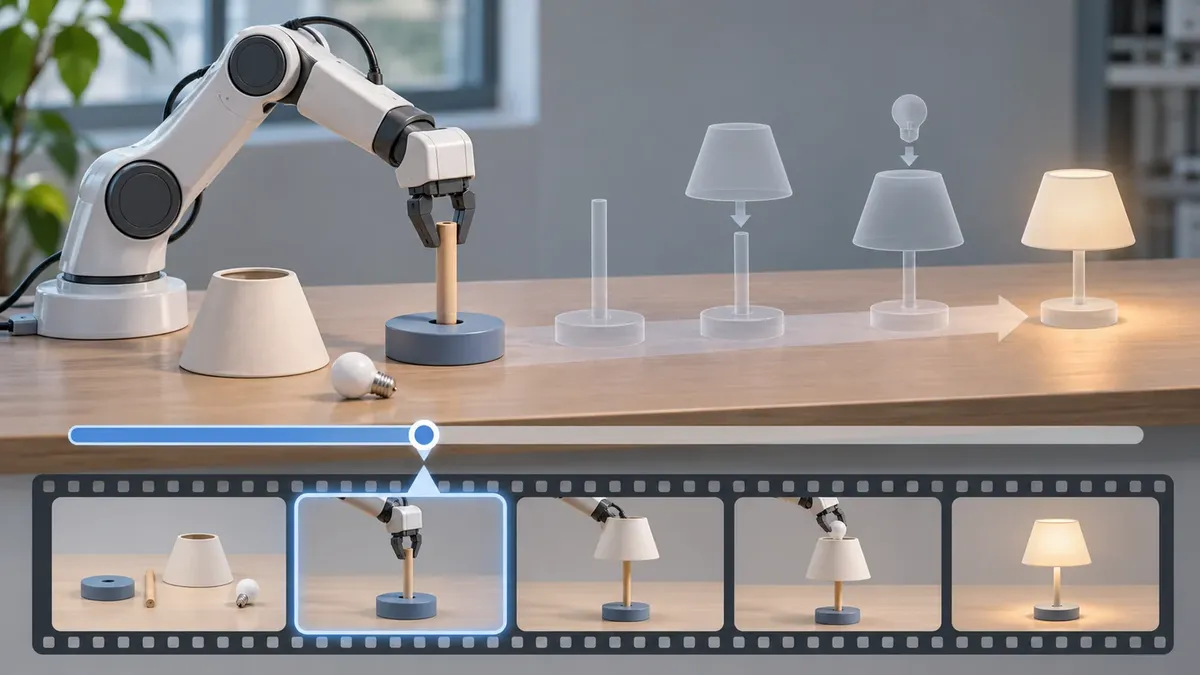
A robot can watch a successful demonstration and still struggle to use it: it may move differently, look different, or be at another point in the task. JEPA-ICL aims to address this alignment problem by representing what remains to be done, then using that representation both to plan actions and to find a matching stage in a demonstration.
A demonstration is useful only if a robot can tell which part applies now. Matching by elapsed time can fail when the robot moves faster or slower than the demonstrator. JEPA-ICL, a vision-language-action system, links the robot’s estimate of task progress to guidance from a recorded demonstration.
Planning around what remains
JEPA-ICL represents a task stage through predicted future visual features, ending at completion of the current subtask. A joint-embedding predictive architecture, or JEPA, predicts a representation of a future scene rather than reconstructing every detail of its image.
The system predicts four ordered checkpoints between the robot’s current state and the subtask’s end. That plan describes the remaining process, rather than just a fixed number of steps ahead. It also helps find a corresponding stage in a demonstration. The robot then reads nearby features describing what happens next and uses them as context for choosing actions. The match is updated as the robot moves.
Planning and demonstration use are connected within a shared policy. During training, the policy is supervised to predict demonstrated actions, and the action loss under aligned demonstration context also updates the shared backbone that produces the plan. At deployment, the system can run without a demonstration. If one is supplied, its frames are encoded and cached so relevant context can be retrieved during execution.
What the tests found
The researchers evaluated JEPA-ICL in simulation on the Imitator Game, LIBERO and LIBERO-Plus, and on a physical two-arm gear-assembly task. Results differ across benchmarks and conditions.
On the Imitator Game, after pretraining on 15 tasks, JEPA-ICL achieved 80% success on seen tasks, compared with 68% for Zero-WAM; both systems were given a human video. On LIBERO, JEPA-ICL reached 97.6% average success without a demonstration. The authors note that this benchmark is close to saturation. In a comparison within the same policy, adding the plan raised average success by 0.8 percentage points.
LIBERO-Plus tests performance under changes including lighting, camera, background and sensor noise. JEPA-ICL averaged 73.2% without a demonstration. A version trained further with demonstrations and given one at test time reached 75.2%. Since this comparison changes both training and test-time input, it does not isolate the demonstration’s effect alone; the paper reports separate analyses of those contributions.
In the physical gear-assembly task, JEPA-ICL succeeded in 12 of 20 trials without a demonstration, 13 of 20 with one from the training setup, and 16 of 20 with one recorded in the deployment setup. The comparison baseline succeeded in 8 of 20 trials. These small counts from one task are an initial test, not broad evidence of real-world reliability.
How the demonstration was matched mattered. In the Imitator Game, progress-aligned retrieval produced larger gains than matching by visual similarity, while shuffling the demonstration’s frame order reduced success. The paper also describes a failure: during a repeated two-object operation, retrieval returned to the segment for the first object when the robot had moved on to the second.
What remains uncertain
The authors say their experiments do not isolate design choices within the plan, such as intermediate checkpoints and recurrent prediction. They also do not measure how training with demonstration context changes the plan itself. The simulation results came from one training run evaluated once with fixed seeds, so no variance estimates are reported. The physical test covers one gear-assembly task across a training setup and a parallel deployment setup.
The supplied source identifies the work as an arXiv preprint, but does not establish its peer-review status. The results should therefore be read with the usual caution about preliminary research. Overall, JEPA-ICL offers a way to make planning and demonstration retrieval depend on the same estimate of task progress. The reported experiments suggest benefits in the tested settings, but do not establish how well the method will generalize to other robots, tasks or environments.
- robotics
- robot manipulation
- vision-language-action models
- JEPA
- robot learning
- demonstration learning
- in-context learning
Reviewed cross-references
These connections were reviewed by a model, not independently fact-checked by a human. Similarity does not imply agreement; consult the original papers and the evidence below.
Teaching robot policies to anticipate their next move
Shared method: Both papers train policies with predictive objectives tied to future representations and actions, but their methods differ: JEPA-ICL predicts ordered JEPA states to plan the remaining subtask and align demonstration stages; JEPA-Tuner predicts action-conditioned future policy guidance and trains the action expert under observed and predicted guidance. JEPA-ICL also reports confusion between repeated stages, so this connection does not establish uniformly reliable demonstration alignment or comparable performance. The excerpts are selected and PDF extraction may limit interpretation.
Model review: · openai-codex/gpt-6-luna
Evidence and provenance
Selected excerpts, not complete papers. PDF extraction can omit figures or damage equations, tables and reading order; sources may be preprints.
2611.30516v1 — Original paper
Excerpt reference:
static/papers/2611.30516v1.md:82-172
Basis: Paper text
Source SHA-256:addb8cbc619029faa27aa9504299bdaeb9f10bc3987343bf3d4bd044d93d8adb2611.30516v1 — Original paper
Excerpt reference:
static/papers/2611.30516v1.md:1182-1250
Basis: Paper text
Source SHA-256:addb8cbc619029faa27aa9504299bdaeb9f10bc3987343bf3d4bd044d93d8adb2611.29096v1 — Original paper
Excerpt reference:
static/papers/2611.29096v1.md:422-521
Basis: Paper text
Source SHA-256:3fe2963ae17176851aa4c236645dda04dd30260e7758db6d62247a27cc65321e
Related reading
Automatically matched by shared topic keywords. These links do not imply that the sources agree or establish a consensus.
Teaching robot policies to anticipate their next move
Source published
Shared keywords: robot learning, vision language action models
How a robot can learn from its own attempts
Source published
Shared keywords: in context learning, robot manipulation, vision language action models
How Robot Memory Can Guide the Next Move
Source published
Shared keywords: in context learning, robot manipulation, vision language action models
Can a general AI model control a robot arm?
Source published
Shared keywords: robot learning, robot manipulation, vision language action models
Can a Robot Learn a New Task by Watching One Video?
Source published
Shared keywords: in context learning, robot learning, robot manipulation