TRANSMISSION // 2611.30480v1
Can AI improve its vision by revisiting its own computations?
Source published
A training-free method called Lobals sends multimodal AI models back through selected internal layers to revisit visual information. Tests show gains across several benchmarks, alongside extra computing cost and open questions about how broadly the approach applies.
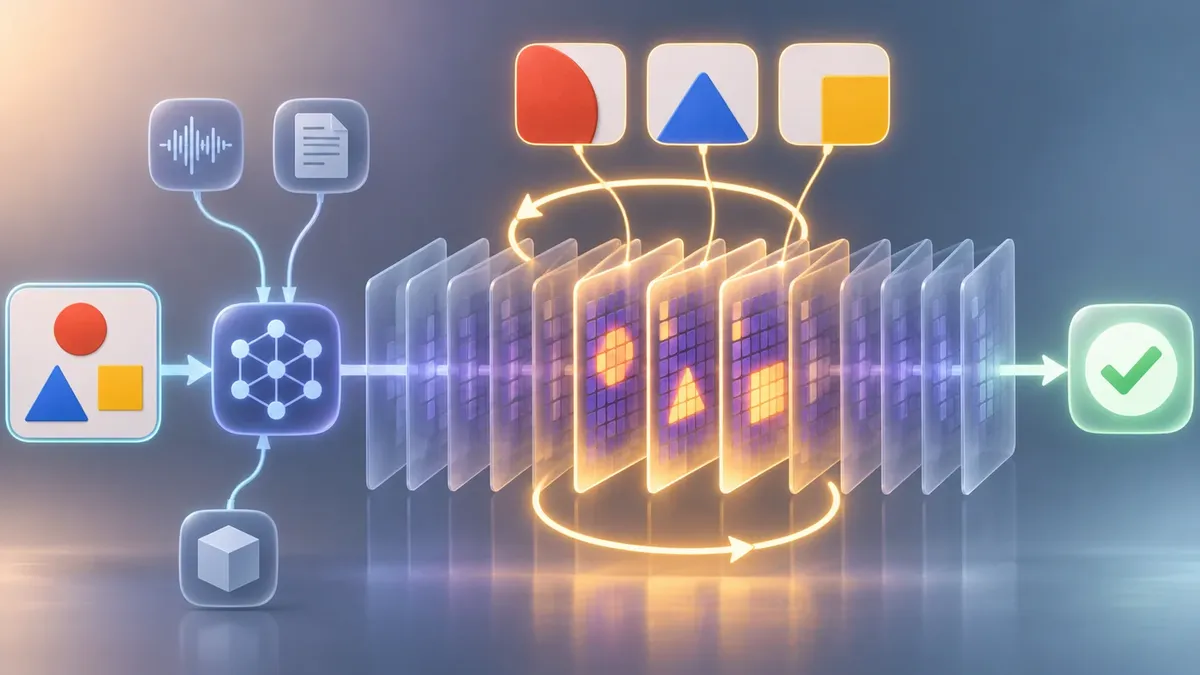
When an AI answers a question about an image, could it benefit from another pass over its own internal processing—not by generating a longer explanation, but by revisiting hidden computations? A preprint proposes Lobals, a method that selects layers where a model pays relatively strong attention to image tokens and runs that part of its network again.
A second look inside the model
Multimodal large language models (MLLMs) combine image-processing components with a language model to answer questions about pictures. A familiar way to give an AI more time is to ask it to produce a longer chain of reasoning. This paper explores a different option: spend extra computation inside the model, in representations that are not directly visible as words.
The authors ask whether an MLLM can improve visual perception by revisiting some of its own layers during inference. They propose Lobals, short for “Look Back in the Latent Space.” It does not retrain the model or add an external tool. Instead, during generation, it identifies a short, continuous run of layers where the model’s attention is most strongly directed toward visual tokens, then forwards the internal representation through those layers again.
Finding layers that can be revisited
Before developing Lobals, the researchers tested whether repeating layer computations could leave ordinary responses intact. They examined four models: Qwen3-VL-2B, Qwen3-VL-8B, Qwen3-VL-32B, and InternVL3.5-14B. For an initial fluency test, they used 500 COCO images per model with the prompt “Describe the image.” They fed hidden states back into different layer ranges and used GPT-5.1 to judge whether the resulting descriptions were fluent.
The tested models had ranges in which re-forwarding preserved fluent output. The precise range differed across models. The authors’ proposed rule identifies its beginning as the first layer where an “attention sink” pattern emerges—a point at which generated tokens direct substantial attention toward the first token—and its end as the layer just before the final one. In an analysis of Qwen3-VL-8B, re-forwarding within the identified range left hidden states highly similar to their original values. Re-forwarding through earlier layers changed them more substantially. These observations motivate the method; they do not establish that the same rule will work for every MLLM.
Lobals measures attention to visual tokens across the reusable range at each decoding step. It selects the contiguous window with the highest combined visual-attention ratio, runs the representation through that window again, then continues toward the output. In plain terms, the model gets an additional internal pass through layers that appear especially engaged with the image.
What the benchmark tests showed
The researchers evaluated Lobals on six benchmarks covering general image-and-language tasks, object hallucination, and fine-grained visual understanding. They tested three main model backbones and compared the method with the base models and three other training-free decoding approaches.
Across the reported results, Lobals had the best or tied-best average performance for each of the three main backbones. It improved upon or matched each corresponding base model on every metric reported in the main comparison. The picture varied by task and model, however: other methods sometimes scored higher on individual benchmarks. The paper also reports additional improvements on LLaVA-NeXT-13B, an extra model beyond the three in the main comparison.
The authors tested whether simply repeating any layer window would explain the gains. Fixed or randomly selected windows could help on some settings but hurt on others. Attention-based selection performed more consistently across the expanded set of comparisons. This supports the value of the selection strategy in the tested settings, not a guarantee of improvement on new models or tasks.
Examples in the paper illustrate the intended benefit: one model that miscounted oysters gave the correct count after using Lobals; another avoided inferring rain from an image that showed cloudy weather. Such examples help make the method concrete, but they are not a substitute for benchmark-wide evidence. The authors also caution that attention to visual tokens is not itself a causal measure of how much the model relies on visual information. Their attention analysis is consistent with their proposed explanation, but does not prove that explanation.
Extra computation, unresolved questions
The method has a real inference-time cost. For Qwen3-VL-8B, the paper reports 1.70 times the baseline wall-clock latency on MMHal-Bench, with throughput falling to 63.8% of baseline. So this is not a free improvement: systems using Lobals would need to weigh benchmark performance against slower generation and additional computation.
The authors identify three further limitations. Attention may not always be a reliable guide to the most useful layers. Attention-sink patterns may be weaker or absent in future model designs, undermining the rule used to find the reusable range. And the window length must be selected for each model; performance does not rise steadily as the window gets longer.
These results come from a preprint, not a peer-reviewed publication identified in the supplied source. The experiments cover a limited set of models and benchmarks, and the reported gains should be read in that context. The paper suggests that revisiting internal computation can help some vision-language models use image evidence more effectively, while leaving open how reliably the approach will transfer and whether its accuracy gains justify its added runtime.
- multimodal AI
- vision-language models
- latent computation
- visual perception
- AI hallucination
- inference-time methods
Reviewed cross-references
These connections were reviewed by a model, not independently fact-checked by a human. Similarity does not imply agreement; consult the original papers and the evidence below.
When a Vision-Language Model’s Uncertainty Spikes, Could a Pause Help?
Supporting evidence: Both papers report gains from inference-time computation changes in their tested multimodal models: Yang et al. report improved performance after re-forwarding selected layers in autoregressive MLLMs, while Xu et al. report reduced hallucinations after selective latent refinement in diffusion models. This supports only the bounded observation that such interventions helped in these separate evaluations, not that the methods are equivalent or that either generalizes to the other architecture or benchmarks.
Model review: · openai-codex/gpt-6-luna
Evidence and provenance
Selected excerpts, not complete papers. PDF extraction can omit figures or damage equations, tables and reading order; sources may be preprints.
2611.30480v1 — Original paper
Excerpt reference:
static/papers/2611.30480v1.md:157-240
Basis: Paper text
Source SHA-256:efd73bc9f6f8706e4fbd7f0b8eb2a8dd2b55442a4fb4db40cb7fcf833f5ff28c2611.12901v1 — Original paper
Excerpt reference:
static/papers/2611.12901v1.md:68-121
Basis: Paper text
Source SHA-256:b1b679fa8e7cc9ce8b9cb0767f7c0937e07ecb22251d8657e98882fdeba526a6
Related reading
Automatically matched by shared topic keywords. These links do not imply that the sources agree or establish a consensus.
Robots Can Plan Around What They Can’t See
Source published
Shared keywords: vision language models
Can visual AI learn to work without its tools?
Source published
Shared keywords: vision language models
Teaching Visual AI When to Call a Tool
Source published
Shared keywords: multimodal ai
HighwayVerse Tests AI Across the Inspection Chain
Source published
Shared keywords: multimodal ai
AtariBench exposes AI models’ difficulty turning moving images into reliable actions
Source published
Shared keywords: vision language models