TRANSMISSION // 2611.30477v1
A critic helps robot policies learn from logged experience
Source published
OVOGO uses a value-learning critic to improve flow-based robot policies from recorded experience, reporting gains in simulation and a small real-robot test.
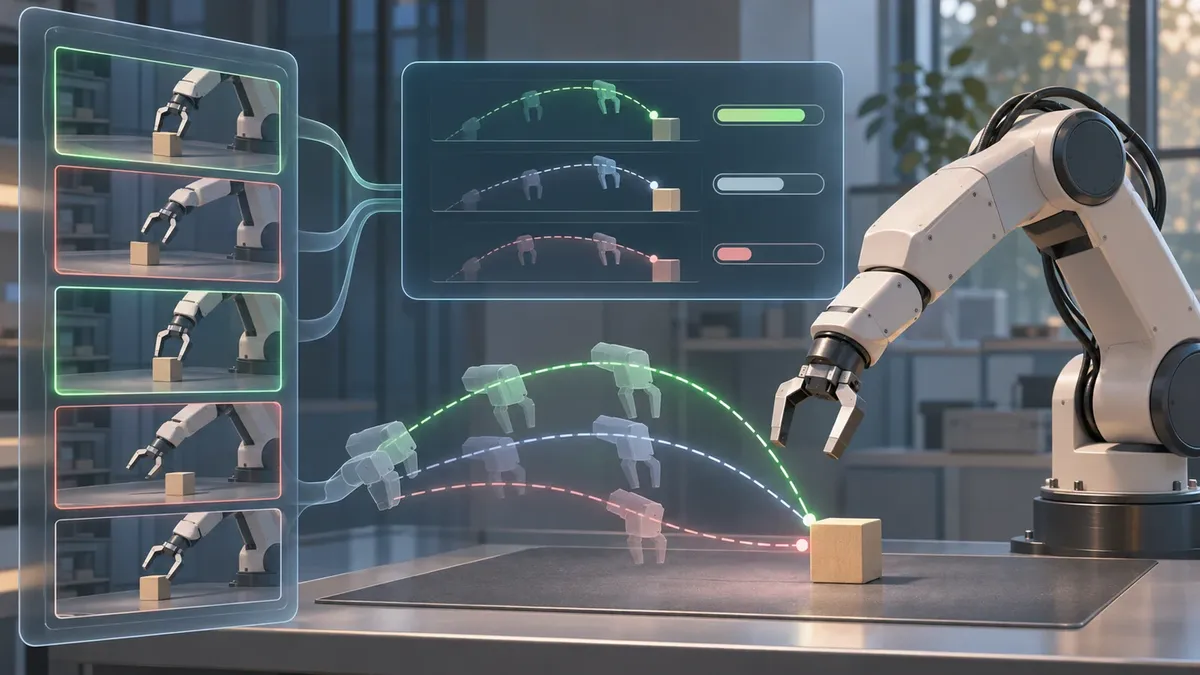
Robot policies can learn from past successes and failures, but collecting new physical interactions is costly. OVOGO proposes a way to reuse logged data while testing fresh, computer-generated actions. Its reported results are promising, though the real-robot evaluation is small and the work is a preprint.
Robots learn by acting, but every physical attempt takes time and can involve setup, supervision or risk. A robot may already have a store of earlier attempts—including successful, failed and imperfect ones. Can a policy improve from those records without needing a new real-world interaction for every training update?
A paper introducing OVOGO explores that question for flow-based vision-language-action models, or VLAs. These systems take in visual observations and instructions and generate robot actions through a multistep process. The authors’ central idea is to reuse recorded robot experience to learn which actions are promising, then use that guidance to adjust the policy’s action generator.
Learning from records, testing candidates in software
OVOGO has two stages. First, it trains a value model, called a Return-Anchored Ranking Critic (RARC), on a fixed dataset of logged robot interactions. The critic estimates how valuable actions are in a given situation. Crucially, its estimates of long-term returns are learned from actions the robot actually took and the outcomes that followed. Newly generated actions have no observed outcomes, so the method does not assign them made-up reward targets.
The critic also learns to rank some nearby alternatives to recorded actions. For example, it uses task outcomes and small action changes to help distinguish candidates, while a “guarded” ranking procedure limits how far these comparisons can push the critic’s scores. The authors’ aim is to give the critic useful discrimination without letting synthetic comparisons overwhelm values grounded in real experience.
In the second stage, the current policy generates groups of candidate action sequences at observations from the logged dataset. The frozen critic scores those candidates. Their scores are compared within each group to provide relative guidance for updating the policy. The update changes the policy’s action-generating component; it does not require new physical trials during this optimization stage or gradients through the critic. The method also retains successful behaviors already present in the records.
Reported results
The researchers tested OVOGO on three simulation benchmarks—RoboTwin 2.0, DexJoCo and LIBERO—and on a real-robot block-stacking task. In the standard simulation experiments, the authors report that OVOGO had the highest mean success rate among the methods they evaluated and improved on the starting policy in all three benchmarks. Those comparisons included approaches that adapt from successful demonstrations, use value-based adaptation, guide actions at inference time or optimize a policy using critic gradients.
The real-robot test used a UR5e arm with a dexterous hand. After training from recorded demonstrations and rollout experience, OVOGO succeeded in 16 of 20 trials, compared with 9 of 20 for the initial policy. That is an encouraging result for this task, but 20 trials are too few to establish how reliably the method will work across different robots, tasks or operating conditions.
A further experiment on RoboTwin added newly collected experience between rounds of offline training. OVOGO and the comparison method both improved as the dataset grew, with OVOGO reporting higher mean success in each round. This is an iterative process: the optimization within a round uses a fixed dataset, but the robot is deployed to collect more experience before the next round.
What remains uncertain
The proposed separation of logged experience and freshly generated candidates addresses a specific technical problem: how to score actions that have not been executed without treating their outcomes as known. The results suggest this approach can improve the tested policies, but they do not show that generated candidates are always judged correctly. The critic is learned from a particular dataset, and its estimates may not transfer to unfamiliar situations or actions far from the experience it has seen.
The evidence also has boundaries. The simulation evaluations report averages across three training seeds, while the real-robot result comes from one block-stacking task and 20 trials. These experiments cannot establish broad real-world reliability. The paper describes comparisons under shared benchmark protocols, but performance on these benchmarks is not a guarantee of performance in other settings.
This article is based on an arXiv preprint, not an independent assessment or a confirmed peer-reviewed publication. The paper says code and training details are provided, which may help others reproduce the work, but reproducibility and external validation still matter. For now, OVOGO is best understood as a promising method tested in defined simulations and one limited real-robot setting—not as evidence that robots can generally improve safely or reliably from deployment logs alone.
- robot learning
- vision-language-action models
- offline reinforcement learning
- flow-based policies
- robotics
- OVOGO
Related reading
Automatically matched by shared topic keywords. These links do not imply that the sources agree or establish a consensus.
Can a general AI model control a robot arm?
Source published
Shared keywords: robot learning, vision language action models
How to combine robot skills without making them clash
Source published
Shared keywords: robot learning, vision language action models
A shared action vocabulary for robots—and humans
Source published
Shared keywords: robot learning, vision language action models
Teaching Robot AI to Focus on Motion, Not Scenery
Source published
Shared keywords: robot learning, vision language action models
A robot plan that knows what remains—and when to consult a demonstration
Source published
Shared keywords: robot learning, vision language action models