TRANSMISSION // 2611.30454v1
How viscous neutron-star tides vary with temperature
Source published
A model study links direct-Urca bulk viscosity to dissipative tidal effects in neutron stars, finding a temperature-dependent maximum and stronger effects for intermediate masses.
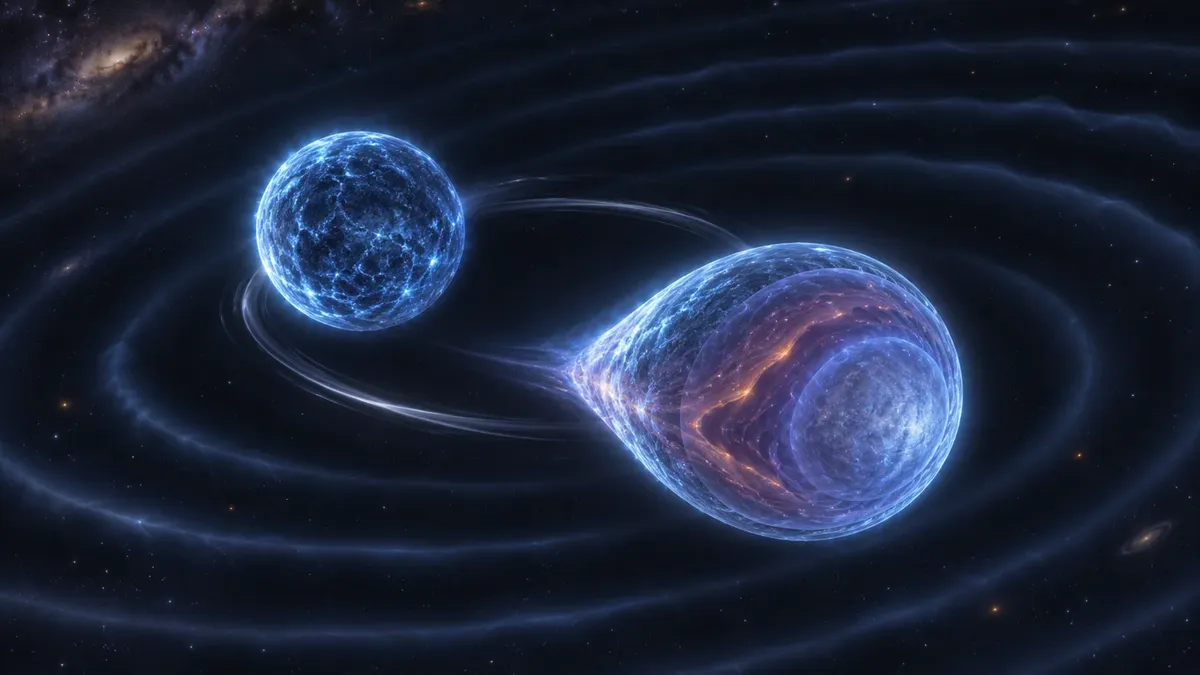
When two neutron stars orbit each other, each star’s gravity deforms its partner. A new preprint examines whether internal friction—bulk viscosity—can leave a dissipative imprint on that tidal response.
The question: can internal friction affect a star’s tidal response?
As neutron stars spiral around one another, each star’s gravity raises a tide on its companion. The matter inside a star may not respond instantly: processes that restore chemical balance can dissipate energy, changing how the star responds to the changing gravitational pull. The authors study one possible source of this effect: bulk viscosity associated with the direct Urca process.
Direct Urca is a weak-interaction process involving neutrons, protons and electrons. In the model considered here, it helps restore chemical equilibrium when the matter is disturbed. The central question is how this viscosity affects two measures of dissipative tidal response: the lag time, or delay in the response, and the dissipative deformability, which characterizes the dissipative part of the tidal response.
How the study was done
The authors calculate neutron-star models using cold equations of state from a momentum-dependent interaction model, with matter composed of neutrons, protons and electrons. They estimate direct-Urca bulk viscosity and include its temperature dependence through the weak-interaction rate. Their calculations cover the neutrino-transparent regime at temperatures up to a few MeV.
Because direct Urca operates only in part of a star, the authors also define an “effective bulk viscosity”: a volume-averaged quantity over the region where the process occurs. They then connect this quantity to the tidal measures and examine how those measures vary with temperature and stellar compactness—a measure of how concentrated a star is.
What the authors report
In their calculations, dissipative tidal effects reach their maximum at a temperature that approximately coincides with the temperature of maximum bulk viscosity at the onset of direct Urca. The effects are also more pronounced for intermediate-mass neutron stars than for maximum-mass configurations in the models studied.
The authors further derive causality-based upper bounds on the tidal quantities for canonical 1.4-solar-mass and maximum-mass stars. These are theoretical benchmarks, not detections: the paper proposes them as a way to assess whether bulk-viscous effects might be observable in gravitational-wave signals from binary neutron-star inspirals.
What remains uncertain
These results depend on the chosen matter composition, equations of state, and treatment of direct Urca. The abstract does not provide numerical values for the predicted effects or bounds, nor does it establish that detectors can measure them. The findings should therefore be read as model-based calculations, not evidence that bulk viscosity has already been observed in gravitational waves.
This report is based on the paper’s abstract, not a full-text assessment. The work is an arXiv preprint; its peer-review status is not established by the supplied source. Full methods, assumptions and numerical results should be checked in the paper itself: arXiv:2611.30454v1.
- neutron stars
- bulk viscosity
- direct Urca
- tidal effects
- gravitational waves
- astrophysics
Related reading
Automatically matched by shared topic keywords. These links do not imply that the sources agree or establish a consensus.
Simulated detector network sharpens the search for neutron stars’ faint internal vibrations
Source published
Shared keywords: gravitational waves, neutron stars, tidal effects
Neutron-star tides may matter more near merger
Source published
Shared keywords: gravitational waves, neutron stars
A future X-ray glimpse of SN 1987A could test neutron-star superfluidity
Source published
Shared keywords: direct urca, neutron stars
How three datasets constrain neutron-star matter
Source published
Shared keywords: gravitational waves, neutron stars
A New Search Strategy for Gravitational Waves from Eccentric Neutron-Star Binaries
Source published
Shared keywords: gravitational waves, neutron stars