TRANSMISSION // 2611.30451v1
Brown dwarf eclipses offer a new way to age M dwarf stars
Source published
Infrared eclipses of two brown dwarfs provide age clues for their M dwarf systems, while model differences—especially cloud treatment—shape the estimates.
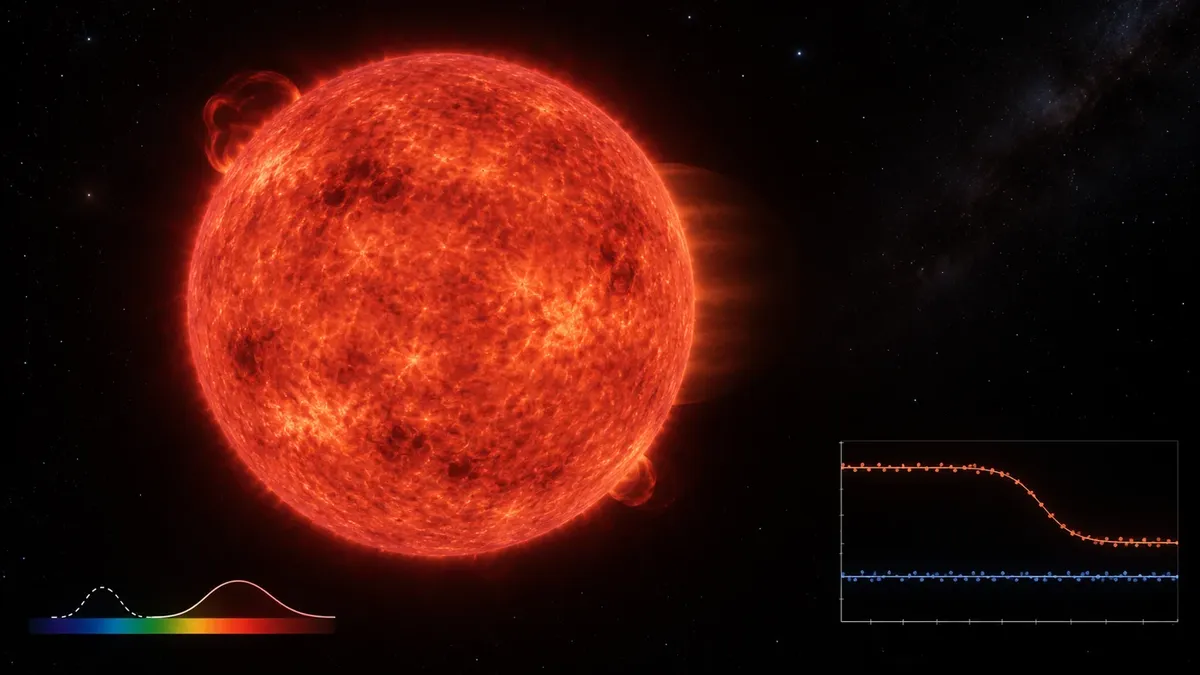
M dwarf ages are difficult to determine because these stars evolve slowly on the main sequence. A study tests another route: measure heat from a transiting brown dwarf, then use models of its cooling to estimate the age of its host system.
M dwarf stars change slowly during their main-sequence lives, making their ages challenging to determine. Aryan Gupta and colleagues investigate whether a close-orbiting brown dwarf can help: its measured mass and thermal emission can be compared with models of how brown dwarfs cool over time.
The study examines two systems, LP 261-75 and AD 3116. In each, the brown dwarf passes behind its host star in an event called a secondary eclipse. Comparing the system’s light before and during that passage lets astronomers estimate the infrared light emitted by the companion.
Measuring the companions’ emission
Using the WIRC instrument at Palomar, the team measured an eclipse depth of 6.1 ± 0.3 parts per thousand in the Kₛ band for LP 261-75C, and 9.1 ± 0.6 parts per thousand in the J band for AD 3116B. They combined these measurements with space-based transit photometry, radial velocities and host-star spectra to infer the brown dwarfs’ internal luminosities.
To estimate the host systems’ ages, the researchers compared the observations with five sets of atmospheric and evolutionary models. The approach assumes that each brown dwarf and its host star formed together and are therefore the same age. In simple terms, the companions’ measured properties are matched to predictions for how brown dwarfs of different ages should look.
Two systems, different lessons
For LP 261-75C, the models yield median ages ranging from 1.3 to 2.9 billion years. That is older than the previously proposed age of 0.1 to 0.2 billion years, which was based on presumed membership in the AB Doradus moving group. The authors report that the revised age, the host star’s high metallicity and the companion’s measured radius disfavor that membership.
The revised age also affects the inferred mass of LP 261-75B, a wider companion in the same system. The paper gives an estimate of about 62 to 68 times Jupiter’s mass, compared with an earlier estimate of about 21 times Jupiter’s mass. This is a model-based inference, not a direct weighing of the wide companion.
AD 3116B provides a separate check on brown dwarf models because it belongs to the Praesepe cluster, whose age is estimated at 0.6 to 0.8 billion years. The inferred age for AD 3116B depends strongly on how the models handle clouds: cloudy models give 0.4 to 0.6 billion years, while cloudless models give 1.0 to 1.3 billion years. Among the models considered, Sonora Diamondback—which includes cloud condensation and clearing across the L/T transition—offers a plausible simultaneous match to the observed eclipse depth and radius.
A method with model-dependent results
The findings show how emission measurements of transiting brown dwarfs could help constrain M dwarf ages. They also make clear that the inferred temperatures and ages are sensitive to differences between evolutionary models, particularly their treatment of clouds. The method relies on the systems being coeval and on models connecting observed emission to internal luminosity and cooling history.
The evidence available for this article is the paper’s abstract rather than its full text, so details of the procedures and uncertainty analysis could not be independently assessed here. The source is an arXiv preprint; the supplied information does not establish whether it has been peer reviewed. The results concern two systems and do not by themselves show how well the method will work across other M dwarfs or brown dwarf companions.
- M dwarfs
- brown dwarfs
- stellar ages
- secondary eclipses
- infrared astronomy
- cloud models
Related reading
Automatically matched by shared topic keywords. These links do not imply that the sources agree or establish a consensus.
A longer look at weather on brown dwarfs
Source published
Shared keywords: brown dwarfs
ALMA spots a faint signal from dust around GQ Lup B
Source published
Shared keywords: brown dwarfs
Teaching AI to account for uncertain molecular physics in brown-dwarf atmospheres
Source published
Shared keywords: brown dwarfs
Jets trace young stars in Auriga–California
Source published
Shared keywords: infrared astronomy
A star cluster’s motion can tell more than one kind of age
Source published
Shared keywords: stellar ages