TRANSMISSION // 2611.30444v1
A faster way to test whether cosmic dawn signals are recovered reliably
Source published
A simulator models the early-universe signal, radio foregrounds and antenna response. In 100 synthetic tests, 94 injected signals fit within their 95% credible bands, but real-world effects remain unmodelled.
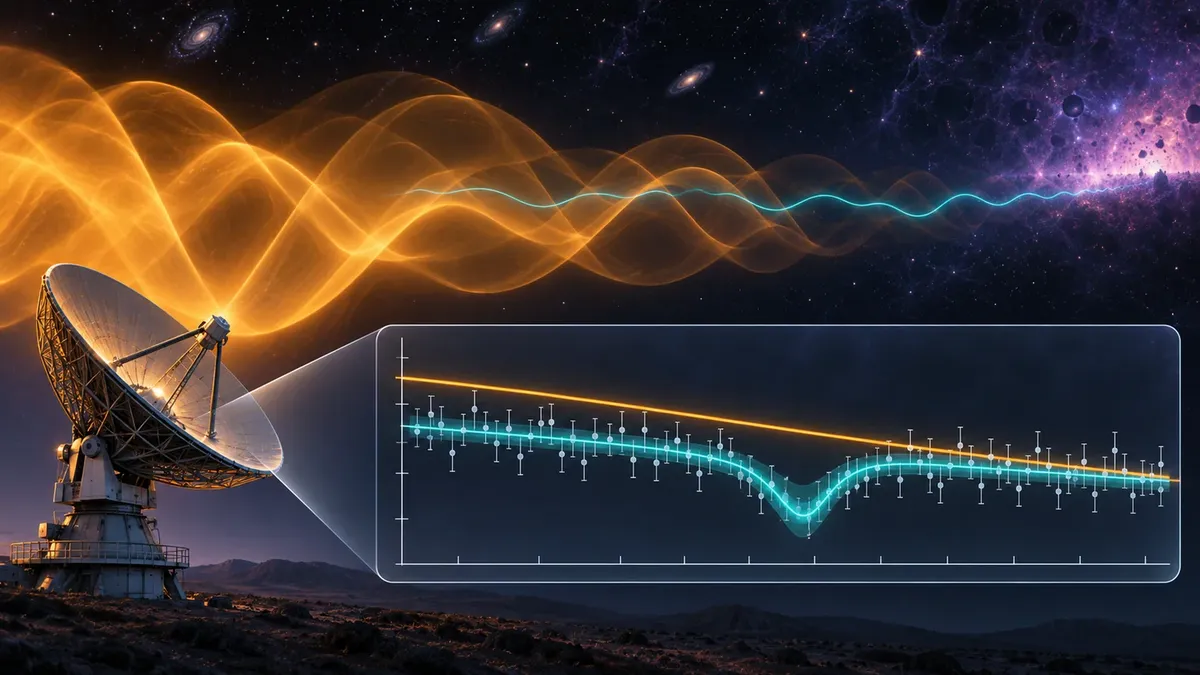
The faint radio signature of ancient hydrogen must be separated from much brighter radio foregrounds. Antenna response can also mix foreground structure into the measured spectrum. Researchers built a fast simulator and synthetic tests to check whether statistical methods can recover the signal while accounting for uncertainty.
A radio telescope searching for the universe’s early history faces a formidable separation problem. The sky-averaged 21-centimetre signal from neutral hydrogen is expected to be only a few hundred millikelvin, while radio foregrounds are about 10,000 times brighter. The antenna also responds differently across directions and frequencies, mixing foreground structure into the measured spectrum. If these effects are modelled imperfectly, an analysis might produce a narrow range of answers that is nevertheless biased.
Jacob Tutt and colleagues tackle two linked questions: can uncertainties across this observational chain be modelled without prohibitive computing costs, and can the resulting model recover known signals with appropriately calibrated uncertainty?
Modelling the measurement
The team combines three components. A neural network emulates the predicted 21-centimetre signal from astrophysical parameters. A physics-informed model represents the foreground sky using a reference brightness map and allows its spectral index—the way brightness changes with frequency—to vary across regions. In the benchmark, the map’s overall amplitude is fixed; regional spectral-index uncertainty is sampled. A compact, linear surrogate represents changes in the antenna beam caused by physical and environmental variations. Together, these components approximate the path from cosmic signal and radio sky through the antenna to a measured spectrum.
The model is differentiable and implemented for GPU computation. The authors report that one forward-model evaluation takes about 0.140 milliseconds on an NVIDIA H100 GPU, compared with roughly 2.8 hours for the full-fidelity simulations used as their reference. They describe this as a 72-million-fold speed-up. This comparison concerns evaluating the forward model, not completing an entire inference run.
The model includes 137 uncertain quantities, covering antenna, foreground, astrophysical and noise parameters. Because the antenna component is linear under the assumptions used, the researchers integrate out its 100 coefficients analytically. This reduces the number of parameters directly explored by the sampler to 37 while retaining antenna uncertainty in the likelihood.
Testing recovery on synthetic observations
The authors generated 100 test cases using injected signals drawn from the specified astrophysical model. For each, they created a synthetic observation using a full-resolution foreground, an antenna simulation held out from surrogate training, Gaussian noise and a three-hour observing window. They then used GPU-accelerated Nested Slice Sampling to estimate the posterior: the range of signal and nuisance-parameter values compatible with each observation under the model.
The main calibration test asked whether each injected signal profile fell entirely inside its corresponding 95% credible band across the observed frequencies. This happened in 94 of the 100 cases, which the authors describe as consistent with nominal 95% coverage. Separately, 75 posterior-mean profiles had a root-mean-square error below the assumed 25 millikelvin instrumental-noise level. This error measures the difference between the injected profile and the posterior-mean profile; it is distinct from the coverage test, which assesses uncertainty.
The benchmark is intended to test inference methods as well as provide a fast model. The authors release synthetic observations, reference sampler results and evidence estimates so other approaches—including simulation-based and variational inference—can be assessed on the same cases.
Scope and remaining uncertainty
These tests support the model’s performance for the specific synthetic setup studied. They do not establish that the same coverage will hold for real observations or every telescope configuration. The benchmark fixes the observing window and uses a particular foreground construction, antenna setup and noise model. It omits secondary observational effects, receiver-calibration uncertainty and noise that varies beyond the adopted homoskedastic Gaussian model. Real data may also depart from the assumptions used to generate the synthetic observations.
Inference remains computationally demanding. Although individual model evaluations are fast, the authors report that each 37-dimensional sampling run takes about 5 hours 34 minutes to 7 hours 16 minutes. They identify scalable posterior exploration and evidence-based model comparison as continuing challenges.
The work is available as an arXiv preprint and is identified in the paper as a NeurIPS 2026 workshop contribution. These results are best understood as a benchmark of a specified modelling setup—not proof that a cosmic signal has been detected. The benchmark code and inference products are publicly available; some upstream simulation assets are not publicly released.
- 21-cm cosmology
- uncertainty quantification
- Bayesian inference
- GPU simulation
- cosmic dawn
- radio astronomy
Reviewed cross-references
These connections were reviewed by a model, not independently fact-checked by a human. Similarity does not imply agreement; consult the original papers and the evidence below.
Can Gaussian processes recover the SKA’s 21-cm signal?
Shared method: Both studies use Bayesian methods to quantify uncertainty in 21-cm analyses: Tutt et al. benchmark global-signal recovery with Nested Slice Sampling, while the SKA1-Low study compares Bayesian Gaussian-process models for power-spectrum recovery. The shared approach is Bayesian uncertainty estimation, not a shared algorithm; the studies concern different observing modes, simulated data and signal products, so their recovery results are not directly comparable.
Model review: · openai-codex/gpt-6-luna
Evidence and provenance
Selected excerpts, not complete papers. PDF extraction can omit figures or damage equations, tables and reading order; sources may be preprints.
2611.30444v1 — Original paper
Excerpt reference:
static/papers/2611.30444v1.md:13-70
Basis: Paper text
Source SHA-256:3e155358f9fb39cd31ff2f4c49c4a6393719c4bc4ffa57a4c9717d480bfa47672605.10928v2 — Original paper
Excerpt reference:
static/papers/2605.10928v2.md:39-58
Basis: Paper text
Source SHA-256:f239d6a2039ef3df3e28bff4991dcb007b735df22e71c159017116406c445dfa
Related reading
Automatically matched by shared topic keywords. These links do not imply that the sources agree or establish a consensus.
A hybrid approach to calibrating radio arrays
Source published
Shared keywords: radio astronomy
Can Gaussian processes recover the SKA’s 21-cm signal?
Source published
Shared keywords: radio astronomy
A compact Bayesian model captures MeerKAT’s changing radio beam
Source published
Shared keywords: radio astronomy
Can 21-cm maps trace reionization’s changing pattern?
Source published
Shared keywords: 21 cm cosmology
A remarkably close quasar pair at cosmic dawn
Source published
Shared keywords: cosmic dawn