TRANSMISSION // 2611.30426v1
What squeezing can—and cannot—do for phase sensing
Source published
An analysis of squeezed-vacuum phase estimation finds that its ideal scaling can survive fair photon counting, but only with enough repetitions and within a narrow, branch-dependent phase range. Loss limits the per-photon advantage.
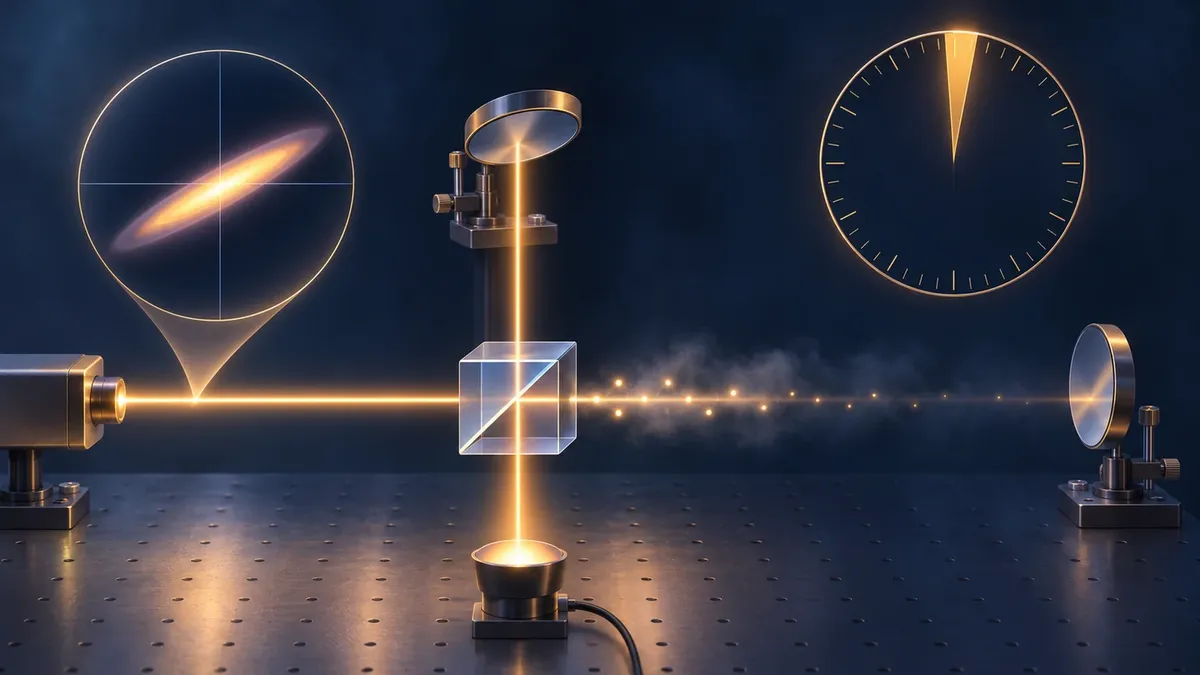
Squeezed light can make a phase easier to estimate in ideal conditions. But does that advantage remain when experiments use a finite number of measurements, count photons fairly and account for loss? A theoretical study calculates those limits for squeezed-vacuum probes and homodyne detection, and compares them with an optimal-measurement bound.
The promise, and the accounting problem
A phase sensor compares light before and after it passes through a system. In a squeezed-vacuum state, light’s fluctuations are redistributed between two measurement directions. This can make a measured signal unusually sensitive to a small phase shift. Experiments have reported strong sensitivity, while critics have questioned whether the advantage survives when measurement repetitions, phase uncertainty and losses are included.
Wangjun Lu and Qing Yu address those questions in a theoretical analysis. They model phase as changing the variance of a zero-mean Gaussian distribution of homodyne outcomes—measurements of one light-field quadrature. For repeated measurements, the data can be summarized by the sum of squared outcomes. The authors use this statistic to calculate Bayesian estimation errors without relying on approximate likelihoods. They also calculate how loss affects the measurement information and the quantum Fisher information, a bound on the information available to an optimal measurement. The paper reports checking some calculations independently, including comparisons with calculations in the photon-number, or Fock, basis.
Repetitions matter, but do not erase the ideal scaling
The paper’s finite-sample result is a useful qualification to claims based on Fisher information alone. Fisher information describes local sensitivity; it does not, by itself, guarantee that a practical estimate reaches the corresponding precision. In the authors’ Bayesian calculations, the gap between the estimated error and the Cramér–Rao bound becomes modest at around ten repetitions across the studied range of input photon numbers. With just one repetition, the excess error can be much larger.
The authors then compare strategies at a fixed total photon budget, rather than treating photons per trial as the only resource. Under that accounting, the repetition count cancels from their bound once there are enough repetitions to approach it. Their result is that the ideal, lossless Heisenberg scaling survives: precision can improve proportionally to the inverse of total photon number, rather than only to its inverse square root. Finite-sample overhead still affects the prefactor. This is a theoretical scaling result, not a claim that every experiment will achieve it.
A narrow window and an ambiguity
High local sensitivity comes with a restricted operating range. The calculations show that the phase interval with strong information narrows as the mean photon number per trial rises. The number of distinguishable phase points within that interval depends on the number of repetitions, not on the squeezing level. In this sense, better local precision does not mean that the sensor can identify an arbitrary phase over a wide range.
There is also a branch ambiguity: the measured variance is periodic and symmetric, so two phase values can produce indistinguishable outcomes. The paper says that one bit of prior information is needed to choose the correct branch. Experiments can provide this by design, but it is still part of the conditions for interpreting the estimate. The advantage is therefore conditional on a suitably narrow phase range and prior knowledge—not unconditional phase readout.
Loss sets a ceiling
Real optical systems lose photons. In the paper’s loss model, transmissivity, written η, is the fraction of light that gets through. At any fixed η below one, the per-photon advantage stops growing indefinitely with squeezing and approaches a ceiling determined by the loss. The ceiling is lower for homodyne detection than for an optimal measurement. Thus, the lossless scaling result should not be read as a prediction of unlimited gains in a lossy apparatus.
The authors compare their ceilings with two previously reported experimental records and conclude that the records are already close to the limits in their model. That interpretation depends on how loss and photon number are assigned in each experiment; the paper discusses alternative readings for one comparison. These are analyses of reported results, not new measurements.
What remains uncertain
The work is a theoretical preprint, not evidence that a particular sensor will attain the calculated precision. Its conclusions depend on the specified probe, measurement, phase prior and loss model. The provided source does not establish how robust the results are to every practical imperfection, and a search for related work cannot establish that the authors’ interpretation is uncontested. The paper offers a detailed accounting framework for the dispute; independent scrutiny and experimental tests remain important.
- quantum sensing
- squeezed vacuum
- phase estimation
- homodyne detection
- quantum metrology
- optical loss
Reviewed cross-references
These connections were reviewed by a model, not independently fact-checked by a human. Similarity does not imply agreement; consult the original papers and the evidence below.
A Bayesian way to tune quantum measurements when data are scarce
Shared method: Both papers use Bayesian mean-square-error methods for phase estimation with limited data: Lu and Yu evaluate an exact finite-sample posterior for squeezed-vacuum homodyne outcomes, while Rodríguez and Rubio apply Personick’s framework to optimize measurements and probes adaptively. This is a connection in estimation methodology, not evidence that the protocols or results are directly comparable; the cited material is from preprints and selected excerpts.
Model review: · openai-codex/gpt-6-luna
Evidence and provenance
Selected excerpts, not complete papers. PDF extraction can omit figures or damage equations, tables and reading order; sources may be preprints.
2611.30426v1 — Original paper
Excerpt reference:
static/papers/2611.30426v1.md:260-360
Basis: Paper text
Source SHA-256:2b26af5a8a0e16e02e69a13d0afb3acd0609e2f163a27ea72fb08246b0b7fe5b2611.31230v1 — Original paper
Excerpt reference:
static/papers/2611.31230v1.md:70-133
Basis: Paper text
Source SHA-256:932284a502ce4ba5d3c1cb39112bfb4bbb777758627768c076aa6101a49d3e342611.31230v1 — Original paper
Excerpt reference:
static/papers/2611.31230v1.md:134-196
Basis: Paper text
Source SHA-256:932284a502ce4ba5d3c1cb39112bfb4bbb777758627768c076aa6101a49d3e34
Related reading
Automatically matched by shared topic keywords. These links do not imply that the sources agree or establish a consensus.
A Bayesian way to tune quantum measurements when data are scarce
Source published
Shared keywords: phase estimation, quantum metrology
Quantum sensing proposal aims to stop gravitational-wave signals cancelling out
Source published
Shared keywords: quantum metrology
A Raman amplifier uses feedback to quiet its own quantum noise
Source published
Shared keywords: quantum sensing
Quantum limit cycles may help spins sense more precisely
Source published
Shared keywords: quantum metrology, quantum sensing
When a quantum sensing limit depends on the model
Source published
Shared keywords: quantum metrology, quantum sensing