TRANSMISSION // 2611.30421v1
A confidence score could speed up atom-array readout
Source published
In one ytterbium experiment, a four-feature classifier matched raw-image thresholding at half the exposure time. Its confidence scores also helped identify uncertain readings; assembly benefits were simulated.
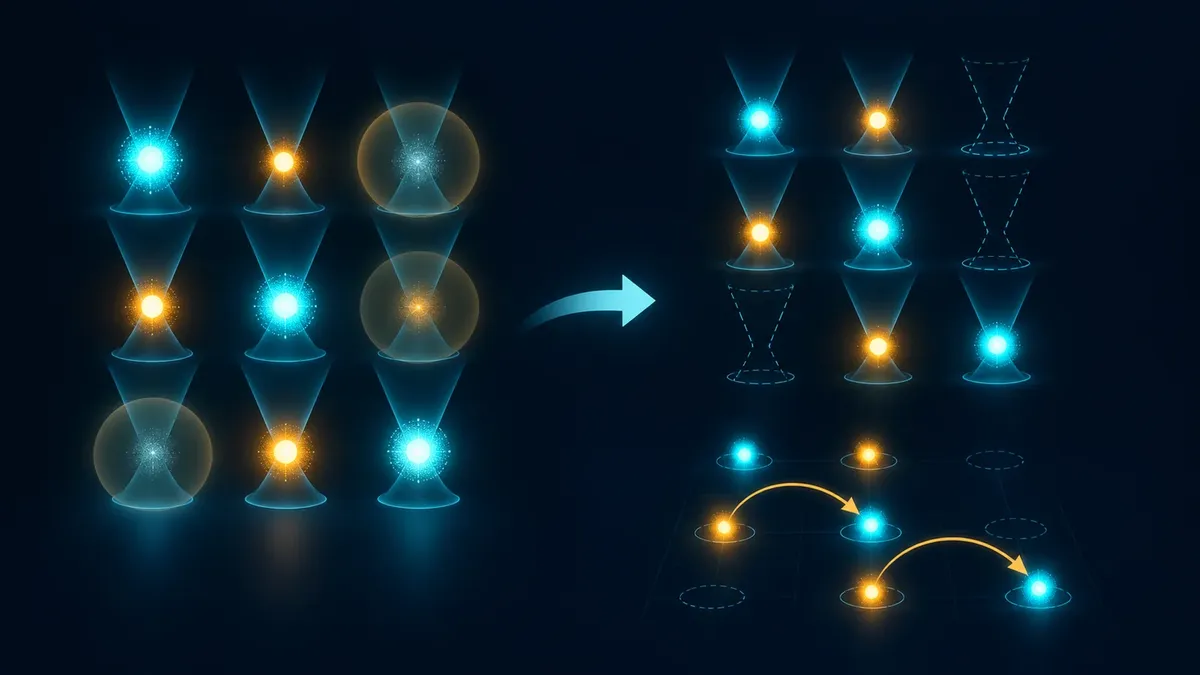
Neutral-atom computers must tell which traps contain atoms. In a 3×3 ytterbium array, researchers tested whether a classifier using photon counts, denoising, spatial-template matching and camera-noise information could read sites with shorter exposures—and flag uncertain decisions.
A faster answer, with a measure of uncertainty
Neutral-atom quantum computers hold atoms in arrays of tiny optical traps. Researchers need to determine which sites are occupied, often repeatedly. Fluorescence imaging makes atoms visible, but collecting more light takes time, and strong scattering can heat atoms or lead to their loss. Faster measurement could matter for processor operation, but a readout improvement in one experiment does not by itself show that an entire processor runs faster.
A common method adds up the light from each site and compares the total with a threshold. It gives a yes-or-no answer, even when the signal is close to the dividing line. Jaeick Bae and colleagues asked whether a classifier could use more information from each image, and whether its score could help identify readings that might be wrong.
What the researchers did
The team imaged individual ytterbium-171 atoms in optical tweezers arranged as a 3×3 array. An EMCCD camera recorded readout images at exposures from 4 to 20 milliseconds. A second camera simultaneously took longer reference images, used to label sites as occupied or empty.
Their four-feature logistic-regression classifier combined raw photon count, photon count after denoising, correlation with an empirical single-atom image template, and a likelihood feature based on a model of camera noise. The features capture different clues: signal strength, a denoised estimate, whether the light pattern resembles an atom, and whether the observed pixels fit expected detector noise. The classifier learned an occupied-versus-empty decision boundary from labeled experimental data.
The researchers compared it with thresholding the raw photon count and with a physics-based Bayesian baseline. They used five-fold cross-validation, keeping all nine sites from an acquisition frame in the same fold, and calculated results on held-out predictions. However, the paper says the denoiser was fixed across folds; it does not establish that denoiser training was isolated within each fold. This is relevant when interpreting how independent the evaluation was. Bootstrap resampling of frames was used to estimate uncertainty in performance metrics.
A specific exposure-time comparison
At 10 milliseconds, the four-feature classifier reached 99.83% readout fidelity. Thresholding raw images reached 99.82% at 20 milliseconds. In this dataset, the classifier therefore matched that particular thresholding result with half the exposure time. It exceeded 99.9% fidelity at exposures of 12 milliseconds and longer. These figures compare imaging exposures, not total measurement or processor-cycle times, and do not establish the same advantage with other cameras or systems.
The error balance also changed. At 10 milliseconds, the classifier’s false-positive rate—the chance of calling an empty site occupied—was 0.12%, compared with 1.52% for raw-image thresholding and 1.22% for the Bayesian baseline. Its false-negative rate was 0.21%, higher than the Bayesian method’s 0.05%. In the paper’s rearrangement context, false positives can lead to choosing an empty site as an atom source and creating a target defect; false negatives reduce the available atom pool. Thus, overall fidelity alone does not describe every consequence of a readout error.
Confidence, erasures and simulated assembly
The classifier’s score was also used to rank decisions by confidence: outcomes nearer the decision threshold were treated as less certain. The researchers tested flagging the least confident outcomes as measurement-level “erasures,” rather than accepting them as definite occupied-or-empty calls. Across the erasure budgets they evaluated, the classifier left fewer residual unflagged errors than the thresholding and Bayesian baselines at matched budgets. This is an experimental-readout analysis, not a guarantee for every setting; the score was defined by distance from the decision threshold, not shown to be a separately calibrated probability that a decision was correct.
The team then explored atom rearrangement using Monte Carlo simulations, not a live assembly demonstration. Simulations began with a 30×30 reservoir at 0.5 loading probability, used measured readout errors and modeled imaging-related atom loss. For the single-round case, the target was fixed at 20×20; the reported success criterion was checked against simulated ground truth, a simulation-oracle criterion. In this modeled setup, confidence filtering raised predicted defect-free success at 10 milliseconds from 59.87% to 96.37%. The simulation simplifies source assignment and excludes detailed transport trajectories, collision constraints and motion-control errors. Multi-round simulations allowed up to 20 cycles. Filtering too many candidates can also leave too few atoms, so the erasure budget involves a trade-off.
What remains to be tested
The study demonstrates readout performance on a particular 3×3 ytterbium setup and evaluates simulated assembly using its measured error rates. It does not demonstrate larger-array performance, live rearrangement gains, a quantum-error-correction experiment or reduced logical error rates. The classifier uses labeled training data, and whether it transfers to changed imaging conditions would need testing. Inference latency is also a deployment consideration; the authors identify faster inference and systematic studies of quantum-error-correction effects as future work.
This work is an arXiv preprint and has not necessarily undergone peer review. Its findings support further tests of confidence-aware readout, while the comparison remains specific to the experimental dataset and the assembly results remain simulation predictions.
- neutral-atom quantum computing
- fluorescence imaging
- atom-array readout
- logistic regression
- measurement erasures
- atom rearrangement simulations
Related reading
Automatically matched by shared topic keywords. These links do not imply that the sources agree or establish a consensus.