TRANSMISSION // 2611.30416v1
Using Gamma Rays to Constrain Pulsar Brightness
Source published
A study uses gamma-ray spectra from globular clusters to constrain a model of millisecond pulsar luminosities, with an inference approach suited to larger samples.
Millisecond pulsars (MSPs) are widely thought to power gamma-ray emission from globular clusters, but the distribution of their gamma-ray luminosities remains uncertain. A preprint reports a way to constrain that distribution from cluster spectra, rather than relying on external prescriptions for each cluster’s pulsar count.
Millisecond pulsars (MSPs) are widely believed to be responsible for gamma-ray emission from globular clusters. But the distribution of their gamma-ray luminosities—the luminosity function—remains uncertain. Some earlier cluster-based estimates relied on external prescriptions for how many MSPs each cluster contains. The researchers ask whether gamma-ray spectral data can instead constrain a shared luminosity function directly.
Modeling the combined spectra
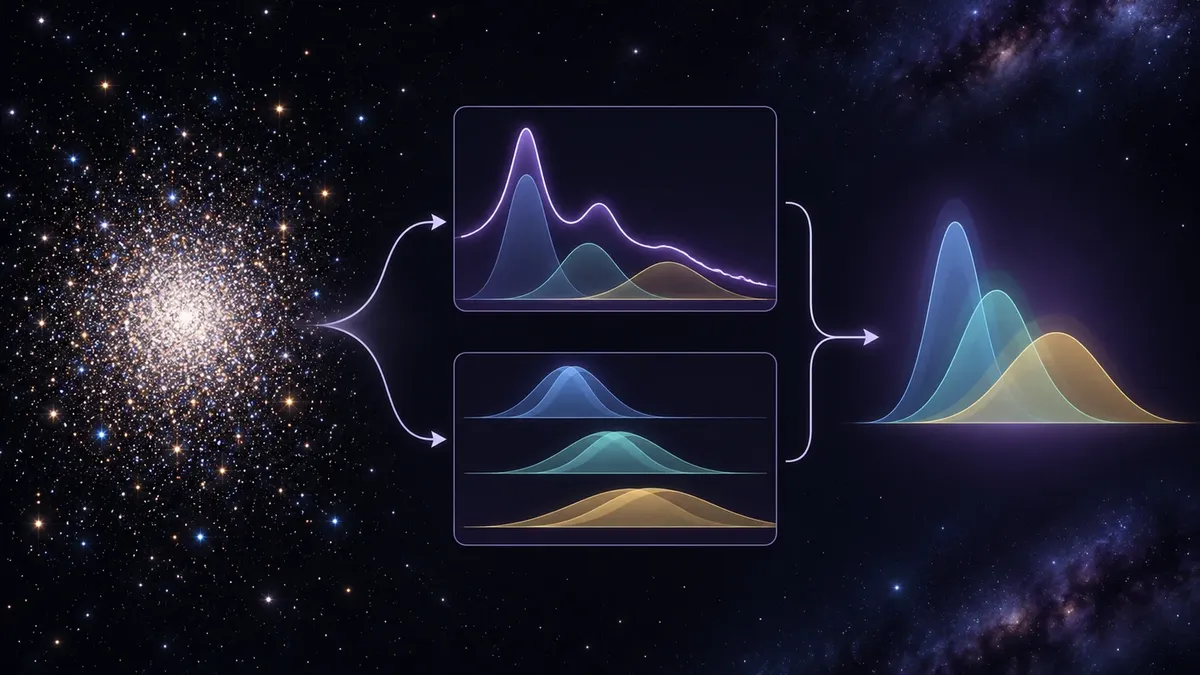
The team constructs a forward model in which each globular cluster hosts a population of MSPs. Each pulsar’s luminosity is drawn from a universal log-normal luminosity function. The model adds together the spectra of individual pulsars to generate a synthetic gamma-ray spectral energy distribution (SED) for each cluster. The researchers then infer probability distributions for the model parameters from the spectra.
They use two approaches: likelihood-based nested sampling and simulation-based inference (SBI). The abstract does not describe the SBI implementation in detail, but reports how its computational performance compares with the likelihood-based method.
As the number of jointly modeled clusters and cluster-specific latent parameters increases, likelihood-based sampling rapidly becomes impractical, the authors report. SBI scales more mildly with sample size. Where direct sampling is feasible, SBI reproduces the likelihood-based method’s posterior distributions—the ranges of parameter values supported by the analysis and their relative probabilities.
Applying the approach to observations
The researchers apply the SBI pipeline to Fermi-LAT SEDs from the 4FGL-DR4 catalog for 36 globular-cluster-associated sources. They also include dedicated phase-resolved ON/OFF SEDs for two clusters that host individually detected MSPs. The abstract names these data products but does not explain the details of their processing.
For the real-data sample, the study reports informative constraints on the luminosity-function parameters. The authors say the constraints are consistent with previous analyses that used complementary multi-wavelength information to constrain the number of MSPs in individual clusters. The abstract provides no parameter estimates or uncertainty intervals, so the numerical values and precision cannot be assessed from the available evidence.
What the findings do—and do not—show
The reported result is that gamma-ray SEDs from these cluster-associated sources can constrain luminosity-function parameters within the study’s model. The authors also report that SBI offers a more scalable route to joint analyses than direct likelihood-based sampling, while matching the latter where a comparison is possible. This supports the method’s use for larger samples; it does not establish that every modeling choice or data limitation has been resolved.
The inference depends on the assumed universal log-normal luminosity function and the broader forward model. The abstract does not provide enough information to evaluate alternative models, detailed data handling, or the full validation of the method. Those questions require the complete paper.
This account is based on the abstract, not a full-text assessment. The source is an arXiv preprint, and the supplied information does not establish whether it has been peer reviewed. Its results should be read as findings reported by the authors, not as a settled measurement. In particular, the abstract’s description of constraints as informative does not substitute for numerical estimates and uncertainty ranges.
The practical contribution is a strategy for jointly analyzing cluster spectra without first prescribing each cluster’s MSP count from other information. If supported by further evaluation, that computational approach could help researchers study pulsar luminosities across larger globular-cluster samples.
- millisecond pulsars
- globular clusters
- gamma-ray astronomy
- Fermi-LAT
- luminosity function
- simulation-based inference
Related reading
Automatically matched by shared topic keywords. These links do not imply that the sources agree or establish a consensus.
Gamma rays reveal differences in how galaxies retain cosmic rays
Source published
Shared keywords: fermi lat, gamma ray astronomy
BL Lac galaxies change with brightness and cosmic time
Source published
Shared keywords: gamma ray astronomy, luminosity function
Testing Pulsar Evolution Before Simulating a Whole Star Cluster
Source published
Shared keywords: globular clusters, millisecond pulsars
How much evidence makes a gamma-ray source stack stand out?
Source published
Shared keywords: fermi lat, gamma ray astronomy
One Gamma-Ray Glow, Two Possible Sources
Source published
Shared keywords: fermi lat, gamma ray astronomy