TRANSMISSION // 2611.30384v1
AMORE6: A Tiny Galaxy with an Unusually Pristine Past?
Source published
New VLT spectroscopy strengthens the case that distant galaxy AMORE6 has extremely metal-poor gas, but does not prove it contains the first stars.
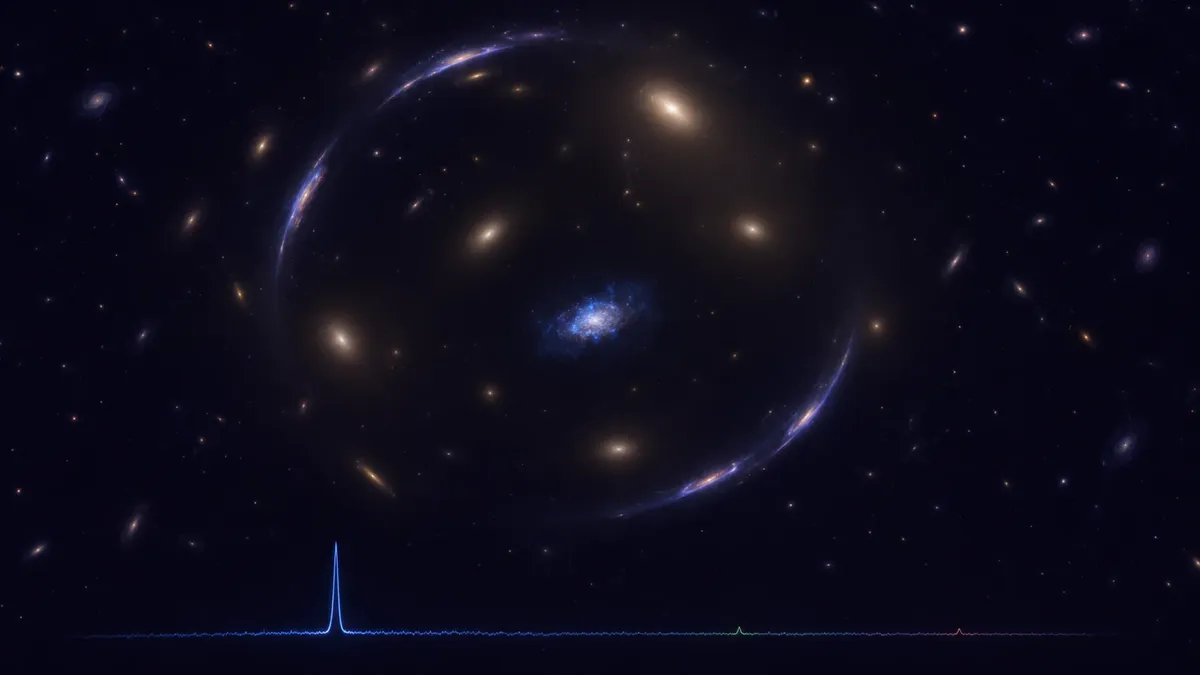
A faint galaxy seen when the universe was young offers clues to how stars form in nearly pristine gas. New spectroscopy rules out one explanation for its weak oxygen signal—but leaves its stellar population and even its nature uncertain.
AMORE6 is a compact, faint galaxy observed at a redshift of 5.725, when the universe was much younger than it is today. Astronomers are interested in it because its gas appears to contain very few heavy elements. Such elements—called “metals” in astronomy—are made by stars and scattered into space over time. A galaxy with little metal enrichment may therefore preserve clues about early star formation, including the possible formation of Population III stars: the first generation, born from gas with no heavy elements.
But a weak metal signal can have more than one explanation. Earlier observations found unusually faint oxygen emission. That could mean the gas contains very little oxygen, or that it is so dense that the oxygen line is suppressed. In a new study, Takahiro Morishita and colleagues use deeper spectroscopy to test whether the dense-gas explanation can account for AMORE6’s unusual spectrum.
Looking for lines that reveal the gas
The team observed AMORE6 with X-shooter, an instrument on the European Southern Observatory’s Very Large Telescope. The observations, taken in 2025, provided 7.7 hours of on-source exposure. The researchers combined spectra from the galaxy’s two gravitationally magnified images to improve the signal. Gravitational lensing makes distant objects appear brighter, although interpreting them still involves uncertainty in the lensing magnification.
The researchers searched the spectrum for ultraviolet emission lines from elements including carbon, nitrogen and oxygen. These lines form when gas absorbs energy and then emits light at particular wavelengths. Their strengths relative to hydrogen emission can help constrain the gas’s chemical composition and physical conditions. The team also modeled the galaxy’s light using stellar-population libraries representing both Population III and later, metal-poor Population II stars, alongside calculations of emission from surrounding gas.
A density explanation loses ground
The new spectrum shows no clear detection of the targeted ultraviolet metal lines. Instead, the researchers report upper limits on their strengths. The most useful constraint comes from carbon IV, or C IV, compared with hydrogen-beta emission. In models with moderately enriched gas, the observed limit is inconsistent with the very high gas densities that could otherwise suppress oxygen emission and make enriched gas look metal-poor.
That result strengthens the case that AMORE6 really does have an extremely metal-poor environment. The paper’s models indicate a gas metallicity below roughly one percent of the Sun’s, with the exact inference depending in part on assumptions about the gas’s ionization—the degree to which its atoms have lost electrons. The authors do not claim that the galaxy is chemically pristine. Nor does low gas metallicity by itself establish that its stars are Population III stars.
The spectrum also reveals a remarkably narrow Lyman-alpha line, emitted by hydrogen. Its peak is consistent with the systemic redshift measured from hydrogen-beta. The researchers estimate a dynamical mass by combining the line width with the galaxy’s measured size. Their reported range is about 10 million to 220 million solar masses, but this estimate depends on an important assumption: that the line width traces gravitational motion. Lyman-alpha photons can scatter through gas, and thermal motion can also broaden the line, so the measured width need not directly represent the galaxy’s gravity.
A mismatch models have not solved
The stellar-population models yield a stellar mass of about 100,000 to 500,000 Suns. Both Population III and Population II model sets can reproduce the blue ultraviolet light and are broadly consistent with the estimated hydrogen-alpha equivalent width. But none simultaneously matches the measured hydrogen-beta luminosity and equivalent width. The observed hydrogen-beta luminosity exceeds the model predictions by as much as 3.7 standard deviations.
That discrepancy may point to gas conditions or ionizing radiation not captured by the models. The authors discuss possibilities such as departures from standard recombination conditions—the usual assumptions about how ionized hydrogen produces light—or limitations in the stellar-population models. The hydrogen-beta measurement also needs confirmation with higher-signal-to-noise spectroscopy.
The team considers two broad interpretations: intense star formation in a halo where atomic hydrogen cooling is important, or a gravitationally bound young star cluster. The galaxy’s small size makes the cluster idea worth considering, while the absence of a detected surrounding host and other properties favor an isolated, low-mass galaxy in the authors’ assessment. Neither scenario is established by the data.
The study therefore sharpens one part of the picture—making high-density, enriched gas a less plausible explanation for the weak oxygen signal—without settling whether AMORE6 hosts the first stars. Its stellar mass, dynamical mass and gas conditions depend on modeling choices, and the mismatch in hydrogen-beta remains unresolved. This article is based on a preprint submitted to The Astrophysical Journal; a preprint is a public research manuscript, and its publication status can change. The findings should be read as the authors’ analysis, not as definitive proof of a primordial galaxy.
- AMORE6
- early galaxies
- metal-poor galaxy
- Population III stars
- X-shooter
- galaxy spectroscopy
Reviewed cross-references
These connections were reviewed by a model, not independently fact-checked by a human. Similarity does not imply agreement; consult the original papers and the evidence below.
Webb finds a nearly pristine pocket in an early galaxy
Supporting evidence: For the same galaxy, AMORE6, the X-shooter study reports UV metal-line non-detections and argues that the C IV limit disfavors a high-density, moderately enriched gas explanation; the JWST study infers very low oxygen abundance from weak [O III] lines and finds that combined metal-line constraints favor exceptionally low enrichment. These results are compatible evidence for a chemically poor environment, not a direct replication: they use different spectra and diagnostics, and the oxygen estimate depends on photoionization models.
Model review: · openai-codex/gpt-6-luna
Evidence and provenance
Selected excerpts, not complete papers. PDF extraction can omit figures or damage equations, tables and reading order; sources may be preprints.
2611.30384v1 — Original paper
Excerpt reference:
static/papers/2611.30384v1.md:397-471
Basis: Paper text
Source SHA-256:e81e075fe919ec181c0a3bf7be08a074fe8216e79cf5fb04a0f8f8e550104da02611.27979v1 — Original paper
Excerpt reference:
static/papers/2611.27979v1.md:170-211
Basis: Paper text
Source SHA-256:4dfd46f23cd2455894d2f8d2cfdac117fd3efd4a771c9c9d8975a4cb3db4cf312611.27979v1 — Original paper
Excerpt reference:
static/papers/2611.27979v1.md:87-125
Basis: Paper text
Source SHA-256:4dfd46f23cd2455894d2f8d2cfdac117fd3efd4a771c9c9d8975a4cb3db4cf31
Related reading
Automatically matched by shared topic keywords. These links do not imply that the sources agree or establish a consensus.
AMORE6 offers clues to possible primordial stars
Source published
Shared keywords: early galaxies, population iii stars
Webb finds a nearly pristine pocket in an early galaxy
Source published
Shared keywords: early galaxies, population iii stars
Little Red Dots at Cosmic Noon: What Spectra Reveal
Source published
Shared keywords: galaxy spectroscopy
Five observations that could sharpen our picture of early galaxies
Source published
Shared keywords: population iii stars
Little Red Dots may have unusually red UV light
Source published
Shared keywords: galaxy spectroscopy