TRANSMISSION // 2611.30365v1
How closely do LLM agents match human behavior in interactive tasks?
Source published
An abstract-only report describes interactive psychological tasks that compare agents’ behavioral trajectories with a learned human-policy model, and examines how setup and memory affect that compatibility.
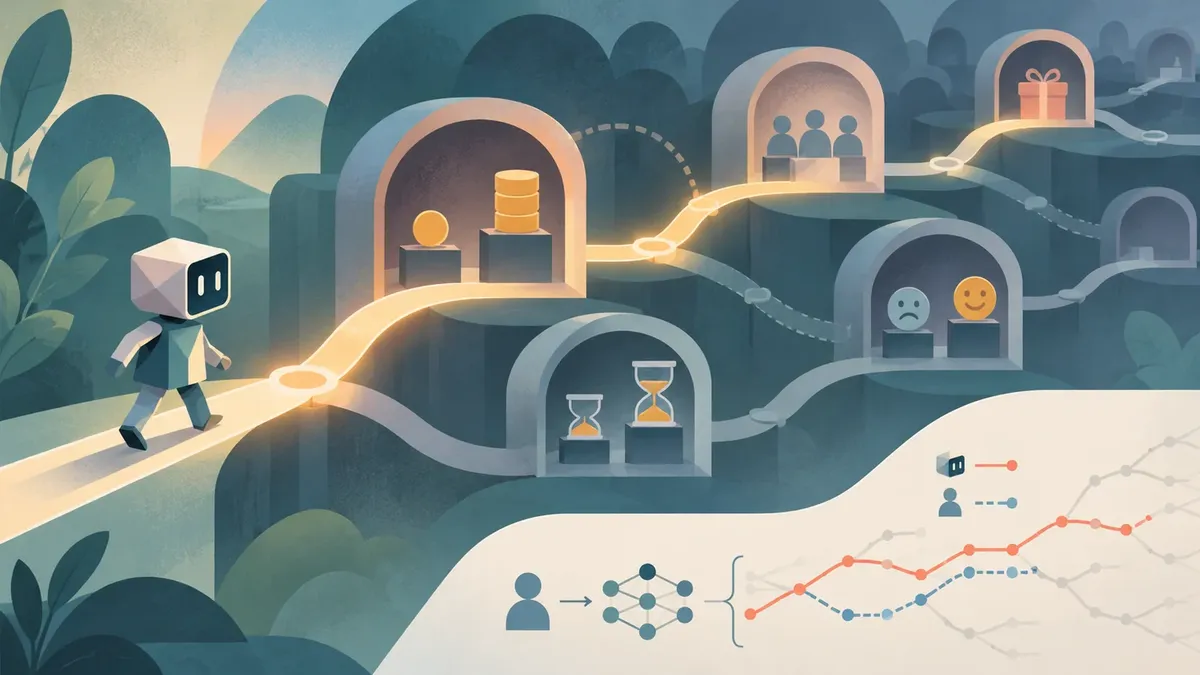
A language model’s behavior may vary with its agentic configuration and the computing budget available at test time. In *mini-psych-agent*, the authors adapt psychological tasks into interactive environments and assess how compatible agents’ behavior is with a learned human-policy model.
Psychological tasks that respond to actions
A person’s behavior can vary with incentives and how much they deliberate. Language-model agents can also behave differently depending on their configuration and the computing budget used at test time. That makes it useful to assess not only a model in isolation, but also the system in which it operates.
In mini-psych-agent, Yi-Fei Cao, Tianxin Huang, Hanbo Xie and Jian-Qiao Zhu describe adapting psychological tasks into interactive environments. In contrast to a fixed text prompt, these tasks allow an agent’s actions to affect later observations and task states. The authors evaluate the resulting behavioral trajectories using a learned human-policy model: a model of human choice patterns used to measure compatibility, not a complete or definitive account of human behavior.
Configuration and memory
According to the abstract, compatibility with the learned human-policy model varies with both the agent’s configuration and the psychological task. The reported measure therefore concerns an agent acting within a particular setup and task, rather than establishing a fixed quality of the underlying language model.
The authors also report that adding memory raises compatibility mainly by making choices more predictable, rather than more human-like. Predictability and compatibility are distinct: choices can become easier to anticipate without becoming more consistent with the human-policy model. The authors argue that evaluations should account for both the underlying model and its agentic scaffold—the surrounding system that shapes how it operates.
What the evidence does not establish
The available source is the paper’s abstract, not its full methods or results. It does not specify which psychological tasks, models or configurations were tested, how the human-policy model was trained or validated, or the size of the reported effects. Those details are needed to judge how the measure was constructed and how broadly the findings might apply.
The study evaluates compatibility with a learned model of human choices in its environments. That is narrower than showing that an agent thinks, feels or behaves like a person in general. The abstract reports findings within the described evaluation; it does not establish how agents would act in other settings.
The source is an arXiv version 1 preprint. Because this report is based on the abstract alone, important methodological details cannot be assessed here, and the supplied evidence does not establish the preprint’s review status. The findings should be read as the authors’ reported results, with those limits in mind.
- LLM agents
- psychological environments
- human behavior
- AI evaluation
- agent memory
Reviewed cross-references
These connections were reviewed by a model, not independently fact-checked by a human. Similarity does not imply agreement; consult the original papers and the evidence below.
AI moral choices shift when models take a role in a video game
Supporting evidence: Both studies indicate that agent behavior can depend on evaluation context: Cao et al. report that human-policy compatibility varies with agent configuration and task, while Li et al. report significant shifts between text-only and matched multimodal dilemmas for 75% of their 12 models. These are complementary, not directly comparable results: the studies use different tasks, context manipulations, models, and outcome measures, so neither validates the other’s metric.
Model review: · openai-codex/gpt-6-luna
Evidence and provenance
Selected excerpts, not complete papers. PDF extraction can omit figures or damage equations, tables and reading order; sources may be preprints.
2611.30365v1 — Original paper
Excerpt reference:
static/papers/2611.30365v1.md:13-100
Basis: Paper text
Source SHA-256:ca31ec560ee35d15727998399791d1b1f2a4b4431c094387ddf3cb5e73d40ad02611.09326v1 — Original paper
Excerpt reference:
static/papers/2611.09326v1.md:13-117
Basis: Paper text
Source SHA-256:2e5b9bf31de011ba3502a9addb7adb058f82c5291148053f250a4b26bd48cbf7
Related reading
Automatically matched by shared topic keywords. These links do not imply that the sources agree or establish a consensus.
When an AI remembers the details but loses sight of the plan
Source published
Shared keywords: ai evaluation
The same AI persona can make different decisions on a new model
Source published
Shared keywords: agent memory
SkillBuffBench: A proposed test of AI-agent skills
Source published
Shared keywords: agent memory, ai evaluation
When AI Agents Change Without Getting Better
Source published
Shared keywords: agent memory, ai evaluation
How AI tuning agents can learn from past experiments
Source published
Shared keywords: agent memory