TRANSMISSION // 2611.30357v1
MeerKAT Finds a Radio Tracer of the Milky Way’s Diffuse Molecular Gas
Source published
A search of thousands of radio sight lines finds hydroxyl absorption linked to molecular gas, while highlighting the limits of faint-line detections.
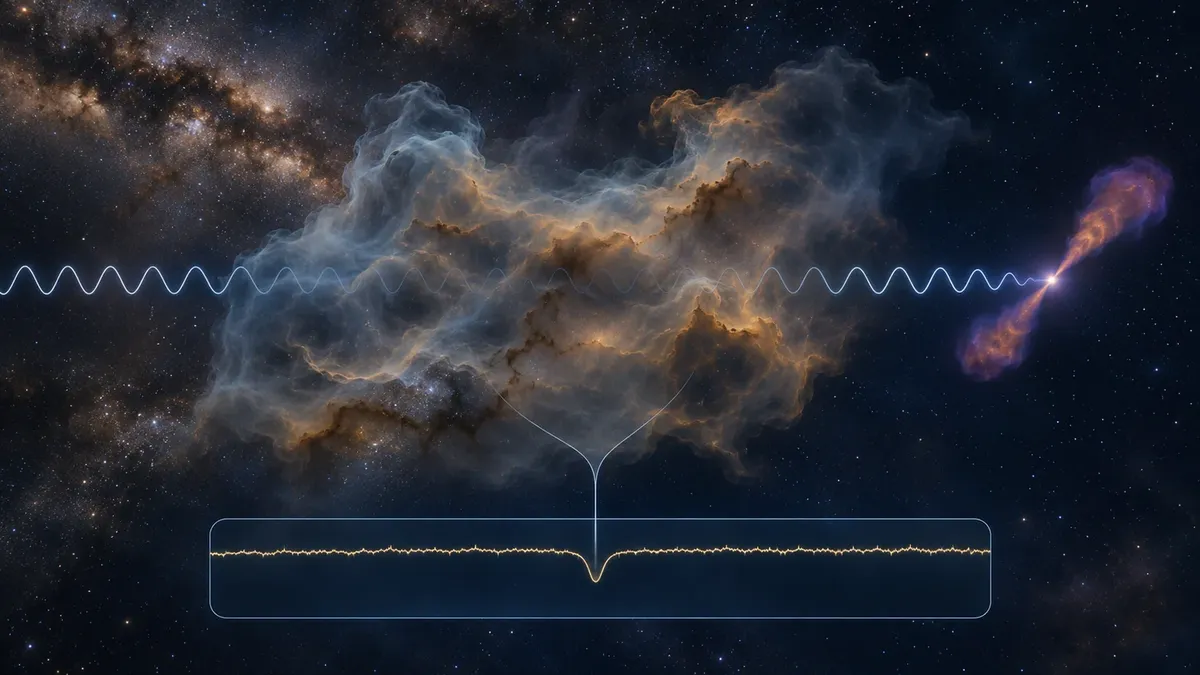
Molecular hydrogen is difficult to observe directly, so astronomers look for other clues to where it gathers in the Milky Way. A MeerKAT survey uses radio absorption from hydroxyl (OH) to trace this diffuse, often hard-to-map gas—and estimates how often OH-bearing material lies along a line of sight.
A faint radio shadow can reveal hidden gas
Molecular hydrogen, H₂, is the most abundant molecule in interstellar clouds, but it is difficult to detect directly under many conditions. Astronomers therefore use other signals to find molecular gas. One candidate is hydroxyl, or OH, a molecule that produces radio lines near 18 centimetres in wavelength. If gas lies between Earth and a bright radio source, it can absorb some of that source’s radio waves, leaving a dip in its spectrum.
A new analysis of the MeerKAT Absorption Line Survey (MALS) asks whether OH absorption can help map the Milky Way’s diffuse molecular material, including gas that is difficult to trace with carbon monoxide (CO). The work focuses on absorption in our own Galaxy, not on OH in distant galaxies.
Searching thousands of background sources
The researchers examined spectra toward 19,130 radio sources brighter than 1 millijansky at 1.4 gigahertz, observed in 390 MALS telescope pointings. These distant radio sources act like backlights: their signals pass through Galactic gas on the way to Earth. The team searched for OH absorption at 1667 and 1665 megahertz (the “main” lines) and at 1612 megahertz (a weaker satellite line).
Finding a shallow dip is not enough to establish that a molecule is present. Noise and radio-frequency interference can create apparent features, and an initial automated search returned many candidates. The researchers therefore compared models with and without absorption using Bayesian nested sampling. For the main-line search, they used information from neutral hydrogen (H I) emission and absorption to guide the likely velocity and width of OH features. They also checked candidate detections against shifted velocity ranges where real OH absorption was not expected.
What the survey found
The analysis identified 15 confident sight-line detections of 1667 MHz OH absorption. Most were associated with excess visual extinction—a measure of how much dust dims background light—and occurred in MALS pointings with detected CO emission and relatively frequent H I absorption. These links are consistent with OH tracing gas that contains H₂. They are not a perfect match: CO maps have limited resolution, and the molecular material is patchy. A CO detection in a pointing does not guarantee OH absorption along every individual sight line.
The team also reported nine candidates for absorption in the 1612 MHz satellite line. Two coincide with main-line detections and have line-strength ratios well above the ratio expected under local thermodynamic equilibrium (LTE). This may indicate unusual excitation conditions, but the authors caution that the satellite-line sample is tentative: its evidence is weaker, and the data are not sensitive enough to find ordinary, weaker satellite lines reliably.
After accounting for the differing sensitivity from one sight line to another, the researchers estimate that about 5.1% of sight lines have OH column densities above 10¹² per square centimetre, with a quoted uncertainty of 0.8 percentage points. This is a covering fraction: an estimate of how often gas above that threshold lies in front of a background source. It is not the fraction of the Milky Way’s total gas that is molecular. Stacking many spectra also revealed an OH signal that stood out more clearly when spectra were weighted by excess extinction, supporting the proposed link to molecular gas.
Useful clues, with important caveats
The study reports no significant relationship between OH and H I column density. That is consistent with OH tracing the H₂-bearing parts of clouds while H I also comes from more diffuse surrounding gas. A model of the detected sight lines suggests hydrogen densities of roughly 10–100 particles per cubic centimetre and typical H₂ columns above 10²¹ per square centimetre. These are model-dependent estimates: the analysis uses a simplified, single-layer cloud geometry, and the authors note that some inferred conditions are degenerate with one another.
The results also have detection uncertainties. A test using shifted velocity priors produced a few strong-looking false detections, so the authors say the confident sample may still include false positives. Their estimate of how often OH-bearing gas occurs depends on assumptions about the distribution of OH column densities and on corrections for uneven sensitivity. They find a qualitative decline in covering fraction with increasing Galactic latitude, but sparse coverage and limited statistics prevent a firm measurement of that trend.
The source is a preprint whose text lists the journal acceptance details as placeholders. This account is based on the supplied preprint text and abstract; it should not be read as independent confirmation of the analysis or as a final journal version. The authors say MALS images, spectra and catalogues are publicly available, allowing other researchers to examine the measurements and refine the estimates.
- MeerKAT
- OH absorption
- Milky Way
- diffuse molecular gas
- radio astronomy
- interstellar medium
Reviewed cross-references
These connections were reviewed by a model, not independently fact-checked by a human. Similarity does not imply agreement; consult the original papers and the evidence below.
Layered cloud model traces hydrogen’s transition toward star-forming gas
Supporting evidence: Both studies connect OH-related absorption to molecular material: the MALS survey reports OH detections associated with indicators of H₂-bearing gas, while Xing et al. describe HINSA as cold atomic gas mixed with molecular material and note its association with OH. This is a compatible, bounded comparison—not a direct test of the same gas or sight lines; the studies examine different environments and use different analyses.
Model review: · openai-codex/gpt-6-luna
Evidence and provenance
Selected excerpts, not complete papers. PDF extraction can omit figures or damage equations, tables and reading order; sources may be preprints.
2611.30357v1 — Original paper
Excerpt reference:
static/papers/2611.30357v1.md:1536-1608
Basis: Paper text
Source SHA-256:0e9c7907b11bc632cce795d7180c84f9f2f15af3aeae21f881afed94fac1a1ed2611.10456v1 — Original paper
Excerpt reference:
static/papers/2611.10456v1.md:71-129
Basis: Paper text
Source SHA-256:4d35174f471cd26605c28e875ccedb2749a7ed8d29a0b10c4617888b48de0fb6
Related reading
Automatically matched by shared topic keywords. These links do not imply that the sources agree or establish a consensus.
A compact Bayesian model captures MeerKAT’s changing radio beam
Source published
Shared keywords: radio astronomy
A black-hole system reaches record radio lows after decades of activity
Source published
Shared keywords: radio astronomy
Can faint radio galaxies clarify cosmic star formation?
Source published
Shared keywords: radio astronomy
FAST Reveals Filaments in a Magellanic Stream Field
Source published
Shared keywords: radio astronomy
Ammonia Maps Offer a Closer Look at Gas Near the Milky Way’s Centre
Source published
Shared keywords: radio astronomy