TRANSMISSION // 2611.30335v1
A tougher test for conversational search systems
Source published
MH-RAG-DIVE simulates conversations that require evidence from multiple documents, aiming to test retrieval systems more realistically while reducing the cost of generating test dialogues.
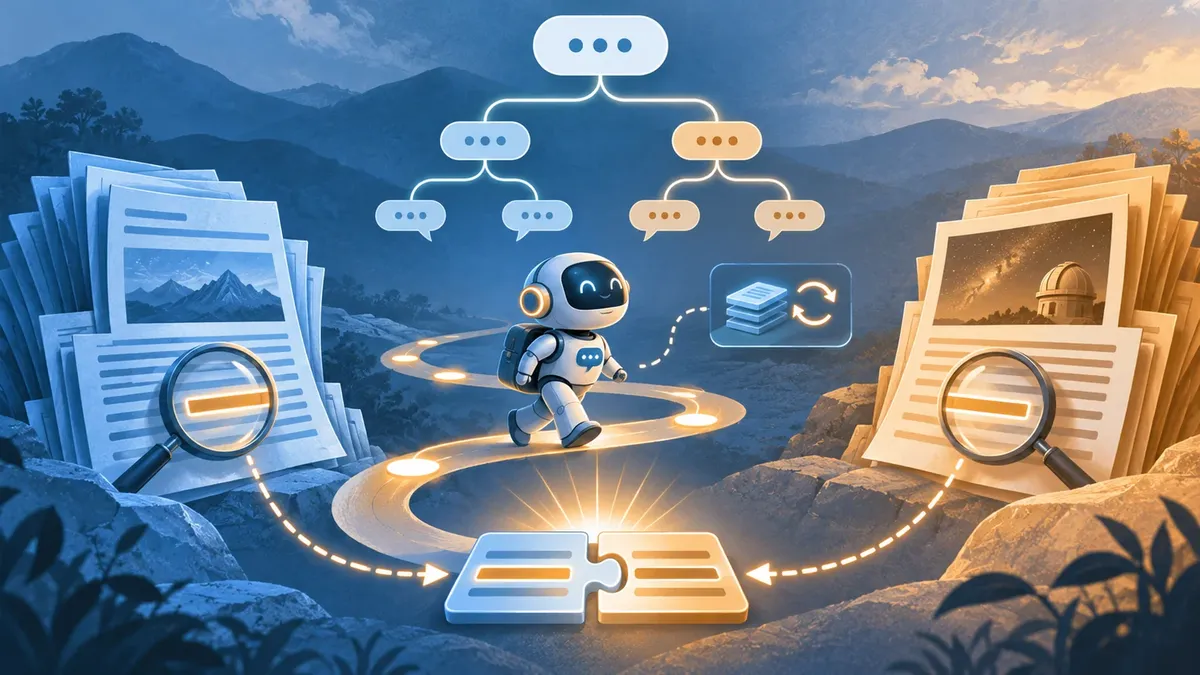
A retrieval-augmented generation (RAG) system can give answers using documents it finds outside a language model. But can it still perform when a conversation depends on connecting information across documents—and can researchers test that without generating every simulated exchange from scratch?
Why test RAG in conversation?
A RAG system retrieves information from documents and gives it to a language model to help answer a question. Evaluating one answer at a time can miss problems that emerge when a user asks follow-up questions or when the answer depends on combining evidence from different sources. The researchers behind MH-RAG-DIVE set out to bring both challenges—multi-turn conversation and multi-document reasoning—into one evaluation framework.
Their system builds on RAG-DIVE, which simulates conversations dynamically. MH-RAG-DIVE adds a Context Discoverer to find chunks from different documents that can support a multi-hop question. “Multi-hop” means that an answer requires connecting more than one piece of information. A Conversation Generator creates questions and follow-ups, while a Conversation Validator checks whether the generated exchanges meet quality criteria. A Conversation Evaluator scores the RAG system’s responses.
The framework also adds a Conversation Cacher. It stores generated dialogue turns in a branching tree. When a later evaluation produces a sufficiently similar system response, the framework can reuse a stored turn; if the conversation has diverged, it can generate a new branch. The aim is to avoid rebuilding entire conversations while keeping the simulation responsive to the system being tested.
How the researchers tested it
The team evaluated six RAG configurations using Wikipedia material from the CLAPNQ dataset. They varied factors including the embedding model, the number of retrieved document chunks, and whether retrieval was agentic—that is, whether the system could take multiple retrieval steps. The researchers ran 100 simulated conversations of five turns each, giving 500 question-and-answer pairs, and repeated the baseline evaluation ten times to examine consistency.
They compared results with the original RAG-DIVE evaluation and with questions from the static, human-created CLAPNQ dataset. They also asked two people to assess a sample of 100 generated turns and their conversations. Separately, they applied the framework to a municipal-software company’s RAG system and documentation.
What emerged—and what it does not show
In the human review, 93% of sampled questions were judged correct and 93% answerable from the supplied document chunks. Reviewers judged 95% of the initial multi-hop questions to genuinely require information from both chunks. At the conversation level, 90% were rated coherent and diverse.
The cacher reduced the tokens used by the Conversation Generator by 45%. Validation used about 11% more tokens, but total token consumption fell by around 28% compared with running MH-RAG-DIVE without caching. In this experiment, the original RAG-DIVE used more than twice as many total tokens as cached MH-RAG-DIVE. These figures describe token use, not a direct measurement of money, time, or energy.
Across the tested configurations, performance patterns were broadly similar between evaluation approaches, but the multi-hop, multi-turn setup exposed additional challenges. The paper reports that systems generally scored lower on the initial multi-hop questions than on easier evaluation questions, with especially clear drops for some configurations. This suggests that a more demanding test can reveal weaknesses that simpler questions may not surface; it does not establish that any one configuration is best in general. The industrial example likewise shows an application of the method, not proof that results will transfer to every company or domain.
There are important caveats. The main experiment used 100 conversations, and only the initial turn was classified as multi-hop; later turns expanded context within the same source documents. The authors also flag possible retriever bias: because the Context Discoverer finds related chunks using semantic search, its question selection could favor systems with similar retrieval methods. And an LLM validates questions created by another LLM, which may introduce evaluation bias, despite the use of different models and a human review.
The paper describes the work as accepted for presentation at ICAART 2027 and makes its code and experimental data publicly available. This account is based on the supplied preprint text; the reported experiments are limited in scale, and further testing—including with human users—would help establish how well the framework reflects real-world evaluation needs.
- retrieval-augmented generation
- RAG evaluation
- multi-hop questions
- conversational AI
- user simulation
- LLM evaluation
Related reading
Automatically matched by shared topic keywords. These links do not imply that the sources agree or establish a consensus.
When an AI remembers the details but loses sight of the plan
Source published
Shared keywords: conversational ai, user simulation
A More Connected Memory for AI Agents
Source published
Shared keywords: conversational ai, retrieval augmented generation
When graphs help AI agents—and why better retrieval is not enough
Source published
Shared keywords: retrieval augmented generation
COGENT models the path from screen to action
Source published
Shared keywords: user simulation
Virtual shopping benchmark tests whether AI can recommend, listen and guide
Source published
Shared keywords: user simulation