TRANSMISSION // 2611.30331v1
Moon flashes reveal centimetre-sized Geminid meteoroids
Source published
Lunar impact flashes recorded during the 2018 and 2025 Geminids offer a rare way to study centimetre-scale debris linked to asteroid Phaethon. The campaigns found similar impact fluxes, while particle-size estimates depend on assumptions about how impacts produce light.
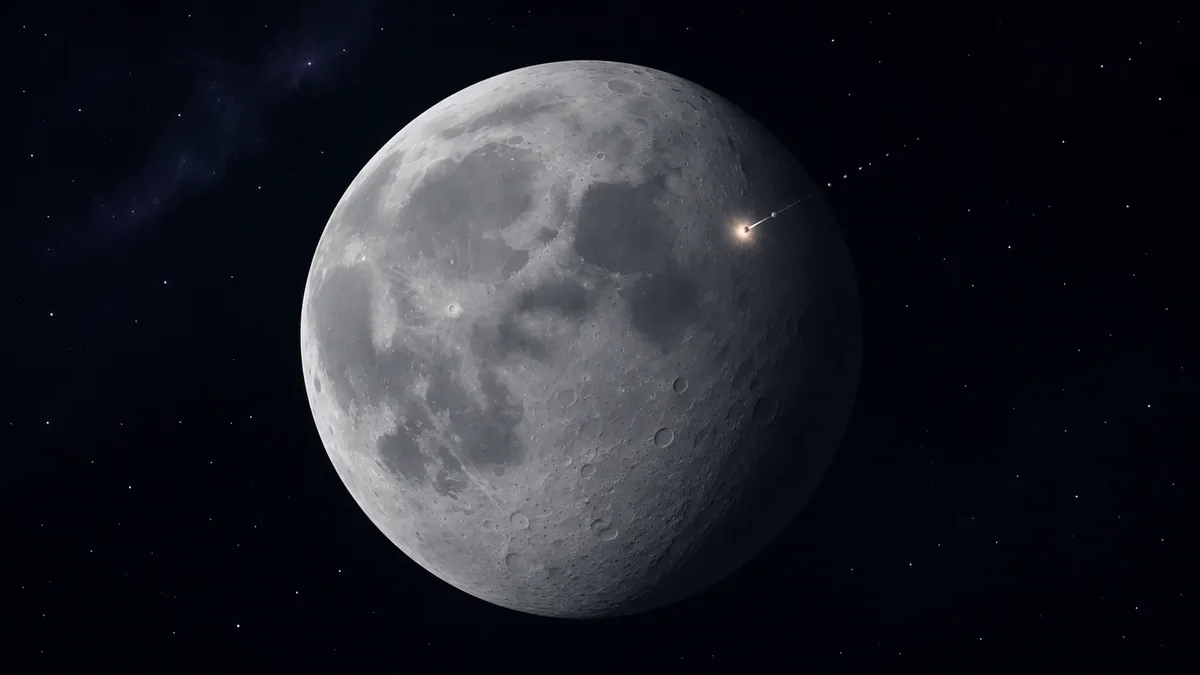
A meteor shower is easy to notice in Earth’s sky, but its larger, centimetre-scale particles are harder to count. Researchers used brief flashes from impacts on the Moon to estimate how many Geminid particles arrive there—and whether the measured population was similar in 2018 and 2025.
When a meteoroid hits the Moon, it can produce a brief flash of light. Lunar impact flashes provide a way to study centimetre-scale particles that are difficult to sample with ordinary meteor observations. A team led by Shinsuke Abe analysed flashes recorded during the 2018 and 2025 Geminid meteor showers, whose parent body is asteroid (3200) Phaethon.
The researchers asked whether the centimetre-sized population appeared similar at two observing dates seven years apart. They also estimated the particles’ masses and size distribution, and the craters they might make. These measurements can help constrain models of how the Geminid stream formed and evolved.
Recording flashes on the Moon
Both campaigns used the 0.40-metre GUNDAM telescope at Nihon University, with video cameras recording at about 60 frames per second. The team searched the recordings for brief flashes and checked candidates against observations from independent stations, helping distinguish lunar events from artifacts such as satellite glints or electronic noise.
The researchers analysed both datasets with a common photometry pipeline—a method for measuring brightness—and calibrated the flashes against standard stars. They used the measured brightness to estimate emitted light, then inferred impact energies and meteoroid masses. To calculate how often impacts occurred, they also measured the area of the Moon’s night side covered by the observations and the duration of each campaign.
The surveys found 11 flashes during 3.3 hours in 2018 and nine during about 2.2 hours in 2025. Under the paper’s primary method, each flash had an estimated 0.87–0.96 probability of being a Geminid. A separate mass-based prescription, which extrapolates shower and sporadic populations using assumed indices, gave lower probabilities of 0.34–0.66. The independent station detections support the events’ authenticity, while the different estimates show that shower association depends partly on the method used.
Similar flux, uncertain particle sizes
After accounting for monitored area and observing time, estimated impact fluxes were 4.2 × 10⁻⁷ and 5.2 × 10⁻⁷ impacts per square kilometre per hour in 2018 and 2025, respectively. The authors regard the results as consistent within the statistical uncertainty associated with the small number of flashes. They interpret them as evidence that the measured population was similar at those two sampled points in the stream—not proof that its density stayed constant everywhere or throughout the years between observations.
Turning flash brightness into mass requires an assumption about luminous efficiency: the fraction of an impactor’s energy that emerges as visible light. With the paper’s nominal value, the estimated masses are about 10–320 grams, and the corresponding diameters are 1.8–5.9 centimetres. A crater model predicts rim diameters of roughly 2–5 metres. These are inferred values, not direct measurements of the meteoroids or of new craters.
The combined sample gives a mass-distribution index of 1.76 ± 0.17 and a population index of 2.0 ± 0.3. In broad terms, the relatively shallow distribution implies a greater share of large particles than a steeper distribution would. The authors interpret the Geminid stream’s excess of large particles relative to the sporadic background as consistent with an asteroidal origin. They also report that a single power law can connect their centimetre-scale estimates with published measurements of smaller Geminids. That connection compares separate datasets and extrapolates across sizes; it is not a direct measurement of every size in between.
What the observations cannot settle
The sample consists of 20 flashes from two short observing windows. Both campaigns sampled the stream after its visual peak, and the Moon’s phase limited when its night side could be observed. The observations therefore cannot establish when the centimetre-sized population itself peaks. The authors say monitoring on both sides of the visual maximum would be needed to test whether its timing differs from that of smaller meteors.
Mass and crater estimates also rely on assumptions about luminous efficiency and crater formation. The manuscript identifies luminous efficiency as a major systematic uncertainty: changing it shifts the inferred mass scale, even though the fitted distribution slopes are less affected. The reported stability is best understood as consistency between two limited surveys under the adopted analysis, not a precise long-term record of the whole stream.
The supplied source is an Astronomy & Astrophysics manuscript dated November 24, 2026, marked “proofs,” with received and accepted dates still shown as placeholders. This status does not establish whether the work has completed peer review, so the findings should be treated as the authors’ reported analysis rather than settled consensus. The manuscript says reduced video clips, calibrated light curves, event tables and analysis scripts are publicly available; that availability is not independently verified here.
- Geminid meteor shower
- asteroid Phaethon
- lunar impact flashes
- meteoroids
- Moon craters
- planetary science
Related reading
Automatically matched by shared topic keywords. These links do not imply that the sources agree or establish a consensus.