TRANSMISSION // 2611.30303v1
When Structured Noise Reshapes Photon-Loss Errors
Source published
An experiment in a superconducting microwave cavity finds that frequency-shaped noise can make photon loss depend on photon number, challenging assumptions used in bosonic quantum error correction.
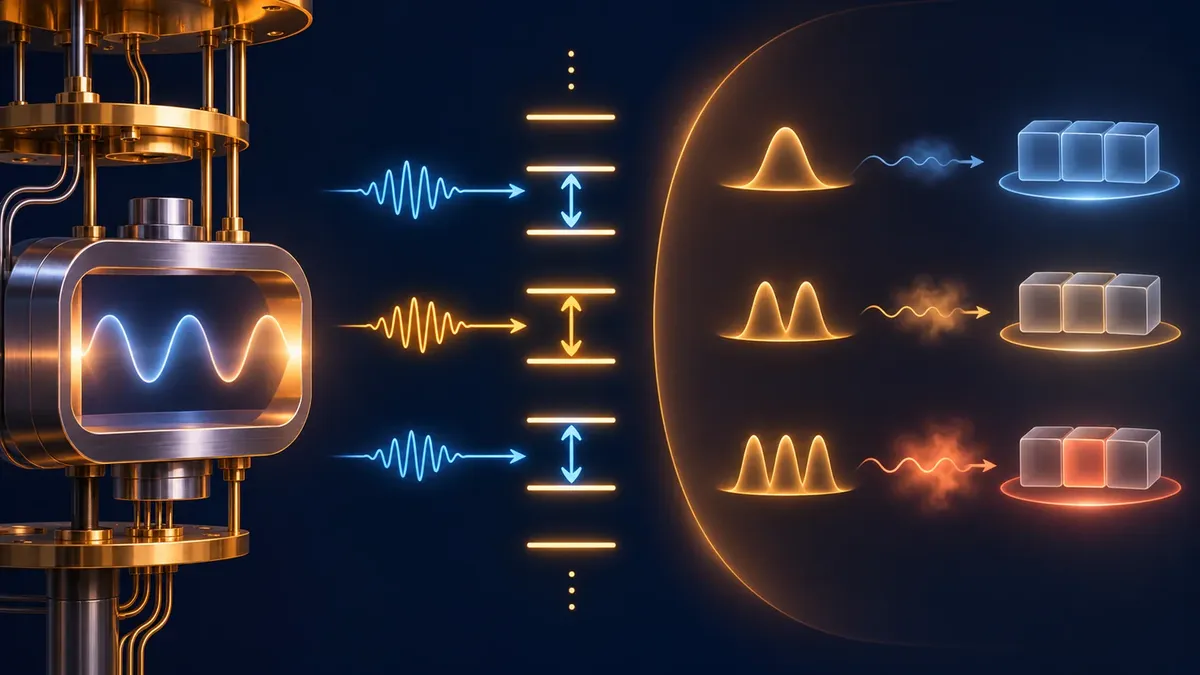
Bosonic quantum error-correcting codes store information in oscillator states, but their protection depends on how photon loss behaves. In a superconducting-cavity experiment, researchers engineered narrowband noise and measured its effects on transitions between photon-number states. The results show how an environment’s frequency structure can alter errors that a code is designed to correct.
Quantum error correction arranges information so that errors can be detected and corrected. In bosonic codes, information is stored in an oscillator, such as a microwave cavity, and the code is designed to handle photon loss. A common model describes loss using one ideal operation, the oscillator’s annihilation operator. Under that assumption, loss fits a shared error-correction scheme for different logical states.
Real cavities are not perfectly harmonic: their energy levels are slightly uneven. As a result, transitions between neighboring photon-number states occur at different frequencies. Noise concentrated in a narrow frequency range may therefore affect some transitions more than others. The researchers asked whether this structured noise could change photon-loss dynamics enough to alter the errors a bosonic code is meant to correct.
Engineering and measuring the noise
The team tested the idea in a three-dimensional superconducting microwave cavity coupled to a transmon ancilla. The cavity acts as the bosonic mode; the transmon helps prepare and measure cavity states with particular photon numbers. The cavity’s weak Kerr nonlinearity makes neighboring transitions slightly different in frequency, allowing the team to target transitions with engineered noise.
They injected tunable, narrowband classical noise and varied its center frequency and pulse duration. By measuring the populations of Fock states—states with definite photon number—they tracked changes in the cavity’s levels. They also prepared a logical qubit encoded using a binomial code, which distributes information across selected photon-number states.
To interpret the measurements, the researchers compared a standard Markovian model, which assumes constant transition rates, with a second-order time-convolutionless (TCL2) model. TCL2 allows rates to vary while the noise retains memory of its recent history. The paper also reports direct numerical simulations of the noisy dynamics.
What the experiment found
The engineered noise was frequency selective: transitions near its center frequency were affected more strongly than those farther away. Early in the evolution, measured dynamics showed transient behavior that a constant-rate Markovian description did not capture as well. Under the main experimental conditions, the TCL2 calculation was in quantitative agreement with the reported dynamics. At longer times, transition rates approached the Markovian limit, in which the rate depends on the noise spectrum at the transition frequency.
The effect also appeared in the encoded qubit. The researchers prepared a superposition of the binomial code’s logical states and centered the narrowband noise at the cavity transition frequency ω4. They observed that the population dynamics of the Fock state |3⟩ changed substantially, while those of |1⟩ remained nearly unchanged. The authors interpret this difference as state-dependent dissipation that deforms the nominally correctable error space. Detuning the noise from ω4 reduced the effect, consistent with its frequency selectivity.
The experiment demonstrates that a deliberately structured environment can deform photon-loss errors in a weakly nonlinear bosonic system. It does not show that every bosonic code will fail under realistic noise, or measure a general loss of performance across quantum computers. The study isolates a controlled mechanism; how much it matters in other devices depends on their nonlinearities, noise spectra, encoded states and correction procedures.
What remains uncertain
The work studies one cavity-based platform and engineered noise, rather than identifying and measuring every naturally occurring noise source in a quantum processor. Its logical-qubit demonstration tracks state populations and changes to the nominally correctable error space. It does not report a full error-corrected computation or a quantified change in a code’s operational performance.
The theoretical model also has limits. In supplementary tests with narrower-band, stronger noise, TCL2 captured early-time behavior but departed from measurements at longer times, while direct stochastic simulations remained consistent. This illustrates that the approximation’s agreement under the main conditions does not guarantee accuracy in every noise regime.
The source is an arXiv preprint, and its claims should be treated as research findings that have not necessarily undergone peer review. The broader implication is a motivation rather than a demonstrated prescription: characterizing state-dependent dissipation may help researchers evaluate and design bosonic error-correction schemes for the environments they actually face.
- bosonic quantum error correction
- structured noise
- photon loss
- superconducting cavity
- non-Markovian dynamics
- binomial code
Related reading
Automatically matched by shared topic keywords. These links do not imply that the sources agree or establish a consensus.
A quantum environment that remembers—and carries control between spins
Source published
Shared keywords: non markovian dynamics
Higher-Order Equations for Quantum Systems With Memory
Source published
Shared keywords: non markovian dynamics
When three-time tests reveal quantum memory
Source published
Shared keywords: non markovian dynamics
A Symmetry-Aware Approach to Quantum Memory
Source published
Shared keywords: non markovian dynamics
An atom’s returning radiation could reveal a comb of frequencies
Source published
Shared keywords: non markovian dynamics