TRANSMISSION // 2611.30287v1
How MMMem teaches AI agents to remember tasks
Source published
MMMem combines multimodal retrieval, task-specific experience notes and model training. Tests on three benchmarks show gains over the compared memory systems, with important limits to consider.
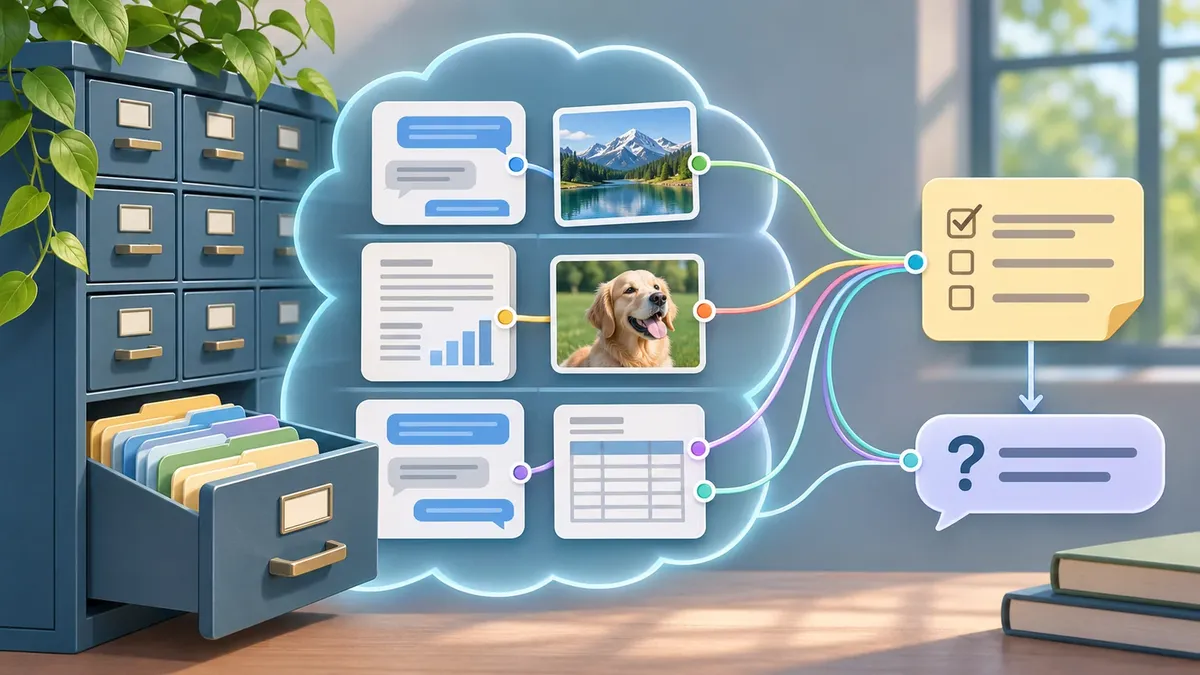
A memory system can save an AI agent’s records without helping it learn what those records mean. MMMem aims to retain task conclusions alongside their evidence—and use both in later answers.
An AI assistant may need to connect a photograph with a name mentioned in an earlier conversation, or combine details scattered across a long document. Saving the original records is not always enough: the system may have to reconstruct those connections each time, and can repeat mistakes. MMMem, a proposed memory framework, asks whether an agent can preserve useful conclusions from completed tasks while keeping links to the evidence behind them.
The idea is to make a task—not just a conversation or document—the unit of memory. When the system answers a question, it also writes an “experience” containing the task context, its conclusion and links to supporting source records. Later, a relevant experience can guide another answer, while the source material remains available for checking.
Keeping records, views and experience connected
MMMem organizes source material into linked memory units, including conversation segments, sessions, recurring named entities and timelines. It can expose each unit through original text and images, images of rendered pages with OCR text, and generated “scene” images. Those generated views are intended to bring together clues from multiple records so visual search can find them more easily. The system retains source identifiers so a retrieved view can lead back to the original records.
The framework also combines two kinds of learning. Before evaluation questions are asked, a warm-up process generates tasks from source material and writes initial experiences into external memory. Separately, self-training adapts a reader model using generated questions, answers and supporting source IDs. The researchers update LoRA adapters while keeping the underlying model weights fixed. During use, the model retrieves source evidence and a relevant experience, answers, then makes another call to write a new experience.
New experiences are initially staged and can be retrieved right away. They are promoted into longer-term memory when later answers reuse them and cite supporting source records. Entries that are not reused eventually expire from the staging area. The experience store is reset between each evaluated dialogue, scenario or document, so this setup tests reuse within a unit rather than an indefinitely growing personal memory.
What the tests found
The team evaluated MMMem on three benchmarks: LoCoMo, for questions about multi-session conversations; Mem-Gallery, for image-and-dialogue associations; and LooGLE v2, for questions requiring evidence from long documents. They compared it with eight baselines using two vision-language readers, Qwen3.5-9B and MiniCPM-V 4.5. The tests used held-out subsets, and the systems were scored on answer quality; the paper says failed or malformed outputs remained in the evaluation denominator.
MMMem had the highest reported results among the compared methods in all six benchmark-and-reader combinations. With Qwen3.5-9B, its scores were 65.84 F1 on LoCoMo, 77.21 F1 on Mem-Gallery and 29.97 on LooGLE v2’s aggregate measure. The authors report relative gains over the best-performing baselines of 36.9%, 17.6% and 15.2%, respectively. These figures describe performance in the authors’ particular benchmark setup, not a general measure of how well an AI remembers in everyday use.
Ablations—tests that remove parts of the system—suggest that both model training and warm-up contribute to the results. Removing training lowered scores in all six settings, as did removing warm-up. Experience memory and generated scene views also helped, though their measured contribution varied by benchmark and reader. In one example, a generated view helped retrieval combine bird descriptions scattered across records; in another, a recalled experience helped connect a bird’s common and scientific names.
What remains uncertain
The evaluation is limited to three benchmark datasets and selected held-out subsets. The authors note that experiences may become outdated when tasks or source information change, and identify revising or retiring old experiences as future work. They also point to the computing and storage costs of training and writing experiences. Although their procedure keeps links to supporting records, that does not guarantee every generated conclusion will be correct or remain applicable later.
The evidence here comes from an arXiv preprint, not an independent assessment of real-world deployment. Benchmark comparisons can show how systems perform under specified conditions; they cannot establish that MMMem will improve every assistant or user’s long-term experience. The paper offers a promising design and reported test results, but broader evaluation would be needed to judge its reliability in sustained, changing interactions.
- AI memory
- multimodal AI
- AI agents
- vision-language models
- retrieval-augmented generation
Related reading
Automatically matched by shared topic keywords. These links do not imply that the sources agree or establish a consensus.
MemVerse gives AI agents a two-speed memory
Source published
Shared keywords: ai agents, ai memory, multimodal ai, retrieval augmented generation
An AI memory proposal asks what should matter now—not just what matches
Source published
Shared keywords: ai agents, retrieval augmented generation
MMGraph-Agent: helping AI search documents and the web without overflowing its working context
Source published
Shared keywords: ai agents, multimodal ai, retrieval augmented generation
BRAG helps AI memory adapt as facts change
Source published
Shared keywords: ai memory, retrieval augmented generation
How AI Memory Can Forget Without Losing Its Index
Source published
Shared keywords: ai memory, multimodal ai