TRANSMISSION // 2611.30179v1
A safety gate for AI-planned lunar repairs
Source published
A simulated lunar rover system lets an AI planner adapt to unexpected faults while requiring physical checks before actions that cannot be undone.
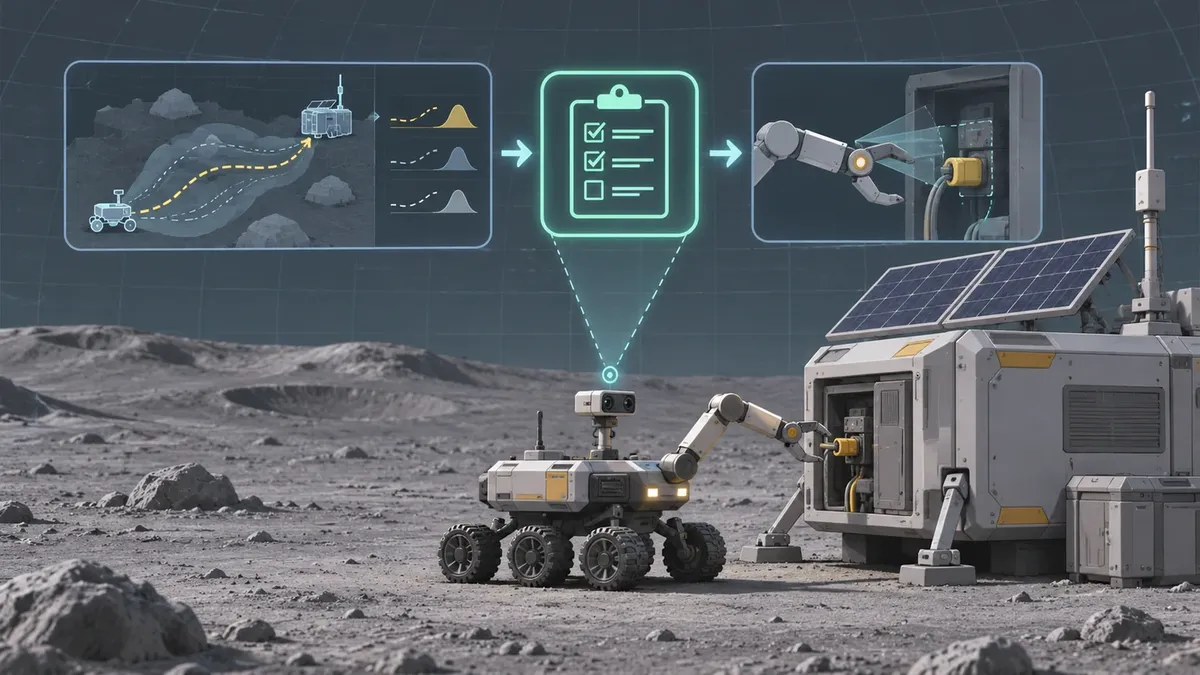
Lunar robots may need to fix faults that were not anticipated before launch, but an AI-generated repair plan can rely on incorrect records or assumptions. A new planning method distinguishes actions that can be retried from those that could permanently damage equipment—and requires evidence before the riskier steps.
A rover at a lunar outpost might have to respond to a broken power unit without waiting for instructions from Earth. But if it acts on a false assumption, it could cause damage it cannot undo. How can a robot adapt to unexpected problems without allowing an AI planner to trigger an irreversible mistake?
In an arXiv preprint, Bingqi Huang and colleagues propose asymmetric knowledge-level replanning, or AKR. The method treats the planner as a source of suggestions, not the final authority on safety. Its key distinction is between reversible actions, where a mistaken attempt can be limited to wasted time, and irreversible actions, where a mistake could cause lasting damage.
Different rules for different risks
The researchers model maintenance and cargo delivery when inventory records may be wrong, actions may fail, and sensors may not provide a clear answer. They also account for the time required to gather information and deadlines, such as requesting authorization from Earth before the communication window closes.
The rover represents what it knows about a fact as true, false, or undecided. An inconclusive camera reading, for example, does not count as proof. The planner can use uncertain records as working assumptions, but those assumptions do not become verified facts in the safety system.
For a reversible action—such as trying to pick up an item at a recorded location—AKR permits an attempt if no precondition is known to be false. If the action’s effects are not verified, the system updates its knowledge from the available evidence and replans. A fact may remain undecided, in which case further sensing or stopping may be necessary; another attempt is not guaranteed to be possible or useful.
For an irreversible action—such as removing a module from an energized unit or handing cargo to a destination where it cannot be retrieved—the system requires every precondition to be verified first. When some are undecided, AKR computes a minimum-cost, deadline-feasible sensing cover: a set of checks that can resolve those uncertainties in time. If no safe verification schedule remains, it can stop in a “certified hold,” meaning the paper’s conditions support the conclusion that the blocked action cannot safely be carried out for the rest of the mission.
The authors prove that, under their stated assumptions, no irreversible action is dispatched with a false precondition, regardless of the planner or inventory record. This guarantee relies on sound measurements and sound rules for how knowledge is updated—including assumptions about which facts actions can change and when environmental changes are observed. Actions may fail; the proof does not require every action to produce its intended effects. The authors also prove a lower bound on the information-gathering cost for any sound knowledge-based policy. AKR’s sensing cover meets that bound in specified cases, not universally. A separate completion guarantee requires a complete planner and additional conditions; it promises a verified goal or certified hold, not successful repair in every case.
Tests in a simulated outpost
The team evaluated AKR in Monte Carlo trials with a sampled-world search planner and in full-stack runs pairing a foundation-model planner with a simulated rover and lunar outpost. The mission suite included repairs and deliveries, including contingency cases. Across all methods, the study reports 254,000 Monte Carlo trials and 165 full-stack runs. These totals should not be confused with the narrower safety result: AKR recorded no hazardous actions in 21,000 Monte Carlo trials with sound observations, or in 58 full-stack runs.
The FF-Replan acting rule allowed an action whenever its preconditions were not known to be false. In the main Monte Carlo grid, it produced a hazardous action in 7.4% to 8.3% of trials. In full-stack tests, it produced eight hazardous actions across 36 runs: six handovers onto an occupied destination and two removals from an energized unit. The paper does not specify how many distinct runs contained those actions.
AKR was not fastest in every setting. Across nine non-reference missions, its median run time was 1.10 times the fastest successful run on the same mission; the corresponding ratio for the more conservative K-replanner rule was 1.50. These ratios do not compare every method on every mission. For contingency and sequential-fault missions, AKR completed 20 of 21 full-stack runs without changing the task model. Original PLEXIL and EUROPA-to-PLEXIL procedures completed none of the seven relevant missions. After engineers revised them, PLEXIL completed four of six contingency missions and EUROPA-to-PLEXIL completed all six. The comparisons illustrate different approaches to adapting to unexpected faults, not universal superiority.
What remains uncertain
These results come from simulation, not a lunar deployment. Full-stack testing used one foundation model, fixed lighting conditions, and a specific set of equipment and missions. Some fault causes were outside the formal task model, making recovery depend on whether the planner could diagnose them. Wrong records were explicitly sampled in Monte Carlo trials; the full-stack evaluation also included two wrong-record missions, rather than testing record corruption across every mission.
In the simulated full-stack evaluation, 40 of 5,537 sensed values disagreed with simulator truth. Monte Carlo trials with higher observation error did produce hazardous actions, underscoring that the safety guarantee depends on reliable evidence. The authors identify further work, including testing other planning models and correlated visual occlusions. This is an arXiv preprint, and its results do not establish performance on the Moon; independent scrutiny and testing beyond simulation would be needed to assess how well the method transfers.
- lunar robotics
- robot safety
- AI planning
- contingent planning
- foundation models
- simulation
Related reading
Automatically matched by shared topic keywords. These links do not imply that the sources agree or establish a consensus.
A Debate-Based Safety Check for Home Robots
Source published
Shared keywords: ai planning, robot safety
Editing a Robot Model’s Hidden Goal Without Changing Its Instructions
Source published
Shared keywords: robot safety
HomeLoop tests whether home robots investigate before intervening
Source published
Shared keywords: robot safety
Robot safety looks different outside the chat window
Source published
Shared keywords: robot safety
A safety shield for image-based robot parking
Source published
Shared keywords: robot safety