TRANSMISSION // 2611.30171v1
Can a Robot Hear a Request, Find an Object and Deliver It?
Source published
Audio-Visual Rearrangement tests whether a simulated robot can combine spoken intent and spatial hearing to fetch and deliver an object. The system outperformed tested baselines in overall success, but performance remained limited, especially with distracting sounds.
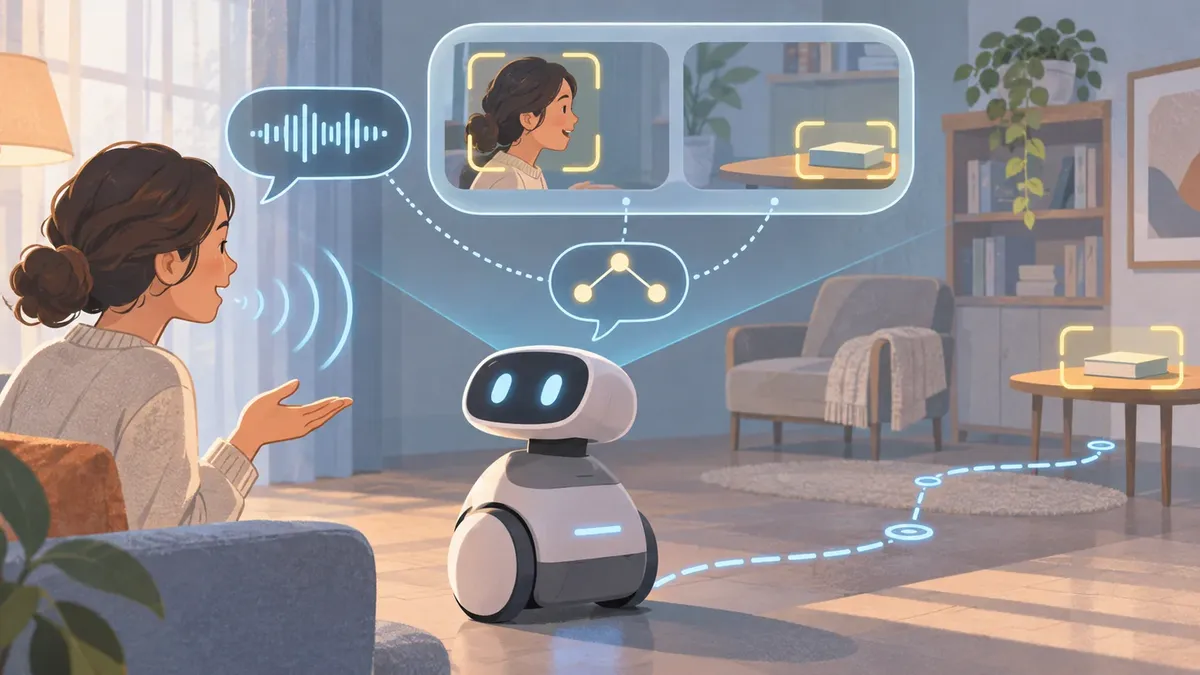
A household request can carry two kinds of information at once: what someone needs and where they are. Audio-Visual Rearrangement is a simulated benchmark that tests whether a robot can use both to retrieve an appropriate object and deliver it to the intended person or place.
One request, several challenges
If someone says, “I’m thirsty,” a helpful robot has to infer that a drink might be useful, identify a suitable object in its surroundings, and bring it to the person who spoke. A different request might name an object directly or ask for one near the speaker. That means the robot must interpret speech, make sense of the scene, locate the speaker by sound and carry out a physical task.
The paper introduces Audio-Visual Rearrangement (AVR) as a benchmark for studying this combination. Its authors note that object-rearrangement tasks and audio-navigation tasks often examine related abilities separately. AVR brings them together: speech conveys the request and provides acoustic clues about the requester’s location, while vision helps the agent find objects and move through the environment.
A simulated household test
The researchers built the benchmark in Habitat 3.0, using furnished indoor scenes, simulated people and a Fetch mobile manipulator. They generated spoken requests and rendered them as binaural audio—sound represented for two ears—so the audio contains spatial information. One simulated person is the requester; others act as distractors.
The benchmark includes three broad request types: explicit object targets, spatial references such as “the cup closest to me,” and implicit intentions such as “I’m thirsty.” Together these cover eight subtypes. Success depends on the particular request: the agent must retrieve an acceptable object and meet its specified delivery goal. For delivery to the requester, it must hand the object to the correct person. In the Spatial Reference Destination subtype, it must place the object on the eligible support nearest to the requester.
The proposed system builds on an audio-visual language model. A dedicated spatial-audio component extracts cues about the speaker’s direction and distance from the initial utterance. As the agent moves, a motion adapter uses its relative pose to update those initial spatial features, assuming the speaker stays in place. The model combines the adapted features with speech content and visual observations to choose navigation and manipulation actions. The team trained it in stages, including spatial localization, motion adaptation and instruction tuning with auxiliary tasks such as speech transcription and visual grounding.
The evaluation used 400 episodes: 200 in scenes from the development pool and 200 in 11 scenes outside it. The paper calls these “seen” and “unseen” scenes. The method’s overall success rates were 20.5% in seen scenes and 17.0% in unseen scenes. It achieved higher overall success than the four evaluated baselines under this protocol. This is a benchmark-specific comparison, not evidence that the system is generally better than other robots.
What worked—and what did not
Ablation tests, which remove or add components to examine their contribution, suggest that spatial audio and motion adaptation helped task success in the tested configurations. On the unseen split, the full system reached 17.0% overall success, compared with 11.0% for the motion-adapted configuration before adding the full combination of auxiliary supervision and response-loss weighting. This supports the usefulness of those components in this setup, but does not show they will help in other environments or on physical robots.
Performance varied by request. Placing an object on the support nearest to the speaker succeeded in just 3.3% of episodes on both splits. Acoustic interference was another weakness: adding a concurrent environmental sound reduced unseen-scene success from 17.0% to 6.5%. The paper reports declines in both target selection and delivery after a correct object had been acquired. The difficulty was not only choosing what to fetch; completing the delivery was challenging too.
A benchmark, not a household-ready robot
These experiments took place in simulation, with synthesized speech and acoustics rendered by a simulator. The paper does not test real homes, real microphones, varied voices or moving people, so performance under those conditions remains unknown. The evaluation also covers a defined set of scenes, instructions and baselines. Its success rates indicate substantial room for improvement, not reliable general-purpose assistance.
This is an arXiv preprint, and its claims should be considered provisional rather than treated as independently validated conclusions. The authors present AVR as a baseline for future study and point to multi-source sound understanding and transfer to real-world mobile manipulators as future directions. The work offers a concrete way to test whether robots can connect what a person says with where they are—and then act on both.
- embodied AI
- robotics
- audio-visual learning
- spatial audio
- human-robot interaction
- object retrieval
Reviewed cross-references
These connections were reviewed by a model, not independently fact-checked by a human. Similarity does not imply agreement; consult the original papers and the evidence below.
Using two-channel hearing to identify which object is making a sound
Supporting evidence: Both studies report benefits from spatial audio cues for grounding sound sources: the AVR study reports improved task success with spatial-audio encoding in simulated object retrieval and delivery, while BiSID-AVS reports better same-class instance segmentation on benchmark subsets using binaural cues. These results support the bounded point that spatial audio can aid source grounding, but the tasks, systems, and outcome measures differ, so they do not establish a shared method or directly comparable performance.
Model review: · openai-codex/gpt-6-luna
Evidence and provenance
Selected excerpts, not complete papers. PDF extraction can omit figures or damage equations, tables and reading order; sources may be preprints.
2611.30171v1 — Original paper
Excerpt reference:
static/papers/2611.30171v1.md:138-205
Basis: Paper text
Source SHA-256:55f40b7006904fb2fbaf5107788c7bdeafa1bcd5af9867497a5efa7528c3f9d02611.06074v1 — Original paper
Excerpt reference:
static/papers/2611.06074v1.md:1001-1106
Basis: Paper text
Source SHA-256:b19e085187e61087f9c1a44fdda51959082bff9cfc02154a35402421f9837197
Related reading
Automatically matched by shared topic keywords. These links do not imply that the sources agree or establish a consensus.
Teaching rescue robots to share a plan, not just follow orders
Source published
Shared keywords: human robot interaction
AI coding agents build a robotics simulation benchmark
Source published
Shared keywords: embodied ai
When Reflections Challenge Robot Policies
Source published
Shared keywords: embodied ai
Robots Learn From Teachers, Then From Failure
Source published
Shared keywords: embodied ai
Robot Memory Fails When the World Keeps Moving
Source published
Shared keywords: embodied ai