TRANSMISSION // 2611.30139v1
Can AI solver skills transfer between optimization problems?
Source published
AutoSECO evolves natural-language guidance for LLM agents building optimization solvers. Guidance refined on the traveling salesperson problem also helped on three other benchmarks, though the evidence has important limits.
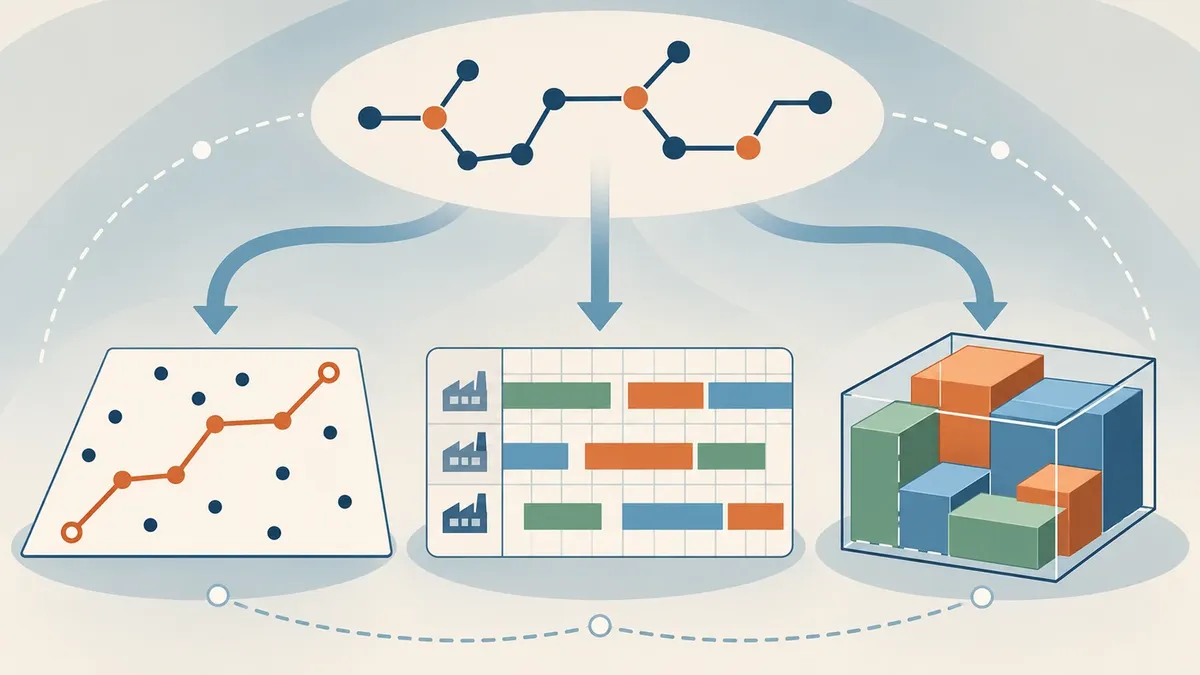
A solver-building agent must do more than write code: it has to diagnose weak results, choose what to change and test whether those changes help. AutoSECO asks whether experience from that process can become guidance useful on different optimization problems.
The challenge: turning scores into useful advice
Combinatorial optimization involves finding good solutions among many possible choices. Examples include planning delivery routes, scheduling jobs across machines and packing items into bins. Large language model (LLM) agents can write and revise solvers for these tasks, but experience gained on one problem is not automatically useful on another.
The difficulty is that a benchmark score evaluates the finished solver, while a skill—a set of natural-language instructions—guides decisions during its development. A poor score does not by itself reveal whether the agent chose a weak search strategy, made a coding error or lacked useful guidance. AutoSECO, introduced in a preprint by Zirui Zhu and colleagues, is designed to connect these pieces of evidence.
How AutoSECO revises a skill
The method starts with a skill that guides an agent through solver development. After a solver is evaluated, a separate skill-evolving process examines the results alongside the solver code and the agent’s recorded development decisions. It uses that evidence to identify a possible weakness in the guidance, then proposes a general instruction intended to help future development—not simply a copy of the original solver’s algorithm.
A fresh agent then builds a new solver from scratch using the revised skill. The revision is kept only if that solver’s mean evaluation gap is lower than the previous recorded gap. A gap measures how far a solution is from a reference value; lower is better in the gap-based tasks. Each candidate revision is assessed in one development run, and the solver associated with the current skill is not rebuilt for the comparison.
The researchers evolved the skill on the study’s Euclidean traveling salesperson problem (TSP), in which the solver returns a permutation of node IDs and the evaluator measures the closed-tour length using rounded Euclidean distances. They then held the resulting skill fixed and tested fresh solver development on capacitated vehicle routing, job-shop scheduling and three-dimensional bin packing. These tests used each target problem’s own task definition and training instances. The study also tried the frozen skill with alternative combinations of language model and agent software, or “harness.”
What the study reports
On TSP, the final AutoSECO skill produced a mean benchmark gap of 0.52%, compared with 0.98% for the SkillOpt skill-evolution baseline. In the reported aggregate results across all four problems, AutoSECO outperformed the no-skill condition, the initial skill and SkillOpt. The authors also report better aggregate results with the frozen skill under two alternative model–harness configurations than with the Initial Skill evaluated using GPT-5.6 Sol and Codex. That is not a matched initial-skill comparison within each alternative configuration.
The evolved guidance includes practical development checks: distinguish slow evaluation from limited search reach, test whether a new mechanism explores genuinely different moves, and allocate computing time with attention to both recent and longer-term improvement. These examples illustrate the kind of reusable advice the method seeks to capture. They do not show that any single instruction caused the reported gains; each candidate skill was tested as a package.
What remains uncertain
The results are evidence of transfer in this study, not proof that one skill will generalize broadly across optimization. The skill was evolved on just one source problem, using fixed training sets. For TSP, the same benchmark instances informed revisions and candidate selection and were also used for the final reported scores, so performance on new TSP instances remains untested in this setup.
There is also run-to-run uncertainty. Solver development is stochastic, yet each candidate revision was judged in a single run; final results were averaged over three fresh runs. The authors note that this can affect both which revisions are retained and the results reported. The alternative-configuration comparisons also lack matched initial-skill baselines for each configuration, limiting conclusions about gains within those setups. Further controlled tests would be needed to isolate the role of the tracing method or individual instructions.
The work is an arXiv preprint, and the supplied source does not establish that it has undergone peer review. Its findings should therefore be treated as preliminary. Overall, AutoSECO offers a specific test of a promising idea: solver-development experience may be reusable as guidance, but the breadth and reliability of that transfer still need to be established.
- large language models
- AI agents
- combinatorial optimization
- solver development
- skill evolution
- generalization
Related reading
Automatically matched by shared topic keywords. These links do not imply that the sources agree or establish a consensus.
How AI agents turn successes and failures into reusable skills
Source published
Shared keywords: ai agents, large language models, skill evolution
Teaching AI agents to patch their skills with code
Source published
Shared keywords: ai agents, large language models
Can simpler AI frameworks design better heuristics?
Source published
Shared keywords: ai agents, combinatorial optimization, large language models
When AI Skills Learn from the Tools They Use
Source published
Shared keywords: ai agents, skill evolution
QuASAR tests whether AI agents can turn scientific ideas into quantum prototypes
Source published
Shared keywords: ai agents, large language models