TRANSMISSION // 2611.30134v1
WASP aims to help language models keep up with changing preferences
Source published
A recurrent system turns each new batch of interactions into a compact user state and personalized adapter. Tests suggest useful personalization with bounded update costs, but leave real-world privacy and preference challenges open.
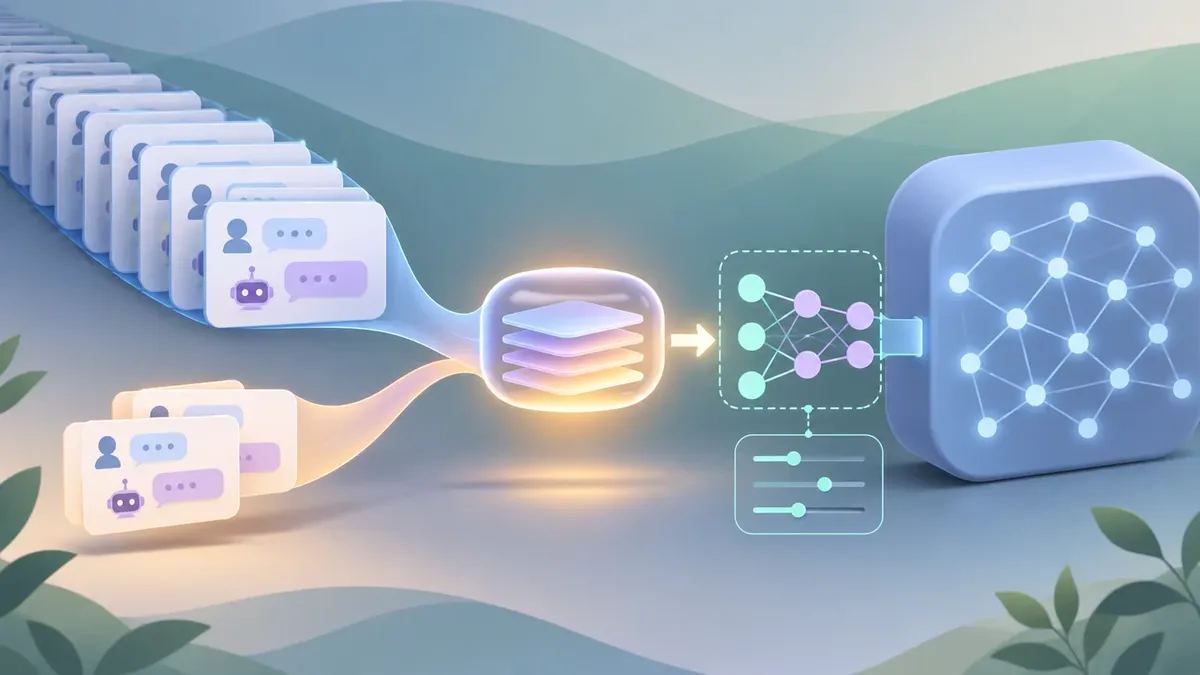
A personal AI assistant might learn that you prefer short answers, then need to adjust when your habits change. WASP is a research framework designed to update a language model’s personalization from new interactions without repeatedly processing everything a user has said. In benchmark tests, it performed well on several tasks and kept its per-user state and update costs bounded as histories grew.
The challenge: learning without rereading everything
A language model can tailor responses using a person’s past interactions. But preferences may be expressed indirectly, scattered across conversations, or change over time. Systems that include a long history in each prompt must handle more context as that history grows. Other approaches train a separate set of model parameters for each user, which can require repeated optimization and additional storage.
WASP—short for Weight Adaptation for Streaming Personalization—takes a different route. The paper’s central question is whether a model can update a compact representation of a user as new interactions arrive, and use that representation to generate personalized model weights without reprocessing the full history.
A compact state that generates an adapter
The researchers use a shared neural network called a hypernetwork. It maintains a fixed-size set of learned representations, or latent tokens, for each user. When a new chunk of interactions arrives, the system encodes its text and uses the hypernetwork to update those tokens. It then generates a personalized LoRA adapter in a single forward pass. LoRA is a way to modify a model’s behavior using a relatively small set of additional parameters, while leaving its main, or “backbone,” model fixed.
The updated tokens become the starting state for the next step. In principle, this means the system only needs to process new interactions and retain the compact state, rather than repeatedly revisiting all past interactions. WASP also includes a “surprise” rule: it can wait to update until incoming examples indicate that the current personalized model is performing differently from the shared task-adapted model. The threshold controls how often updates occur, trading update frequency against personalization quality.
The evaluation covered two settings. For static personalization, the authors tested benchmark tasks from LaMP and LongLaMP, including classification, rating prediction, and text generation. They assessed performance on both randomly selected test users and an out-of-distribution split intended to challenge generalization to users unlike those in training. For continual personalization, they used chronological streams for review writing and abstract generation, plus a semi-synthetic MovieLens test in which genre preferences could be explicitly changed. Comparisons included methods that retrieve or summarize histories, methods that use user-specific adapters, and other hypernetwork approaches.
What the tests found
In the static tests, WASP had the strongest average classification performance reported by the authors across the two user splits. Its results on long-form generation were generally competitive rather than uniformly best. The paper also reports that WASP’s continual version outperformed methods that repeatedly reprocessed accumulated history on the reported ROUGE measures for both chronological text-generation tasks. It beat static representations on seven of eight metrics in that comparison.
The controlled MovieLens experiment suggests the system could respond to a changed genre preference while retaining preferences not mentioned in the update. That is a useful test of revision, but it is semi-synthetic: it does not establish how reliably WASP would interpret messy, real conversations or conflicting preferences.
The efficiency results support the paper’s core design claim. With a fixed-size user state, WASP’s update computation and per-user storage do not grow with the accumulated history length, assuming the amount of newly arriving data is fixed. The reported per-user storage was 8.7 MB in the tested setup. This is a benchmark measurement, not a guarantee that deployment on any phone or other device will be practical; the paper’s experiments used substantial GPU resources for training and inference.
What remains uncertain
The authors say their evaluation focuses mainly on implicit preferences, with only a preliminary test of explicit preference revision. They identify preference-following when relevant clues are sparse among unrelated dialogue as a direction for future work. They also test fixed-rank LoRA adapters; whether other adaptation methods would work as well remains untested.
The paper argues that keeping interaction histories local could support privacy-preserving use. That is a design possibility, not evidence that a deployed system is secure or that personal data cannot be exposed through other parts of an implementation. The study does not establish performance with real users changing their minds in everyday settings.
This account is based on the paper text supplied for this article. The source is an arXiv preprint, and the available evidence does not establish peer review. Results should therefore be read as the authors’ reported experiments, not as settled evidence of real-world effectiveness.
- large language models
- AI personalization
- continual learning
- LoRA
- hypernetworks
- on-device AI
Related reading
Automatically matched by shared topic keywords. These links do not imply that the sources agree or establish a consensus.
Why AI Can Ignore a Document That Updates Its Knowledge
Source published
Shared keywords: large language models
Can AI Personas Preserve Their Quirks?
Source published
Shared keywords: ai personalization, large language models
Why Multimodal AI Can Forget in Two Places
Source published
Shared keywords: continual learning
Getting language models onto small devices takes more than shrinking them
Source published
Shared keywords: large language models, on device ai
Can an optimizer help AI learn new tasks without forgetting old ones?
Source published
Shared keywords: continual learning