TRANSMISSION // 2611.30116v1
Grokking as a Search for the Right Internal Representation
Source published
A preprint argues that, in small neural networks learning group operations, delayed generalization involves finding a task-defined subspace. Its evidence is limited to structured mathematical tasks.
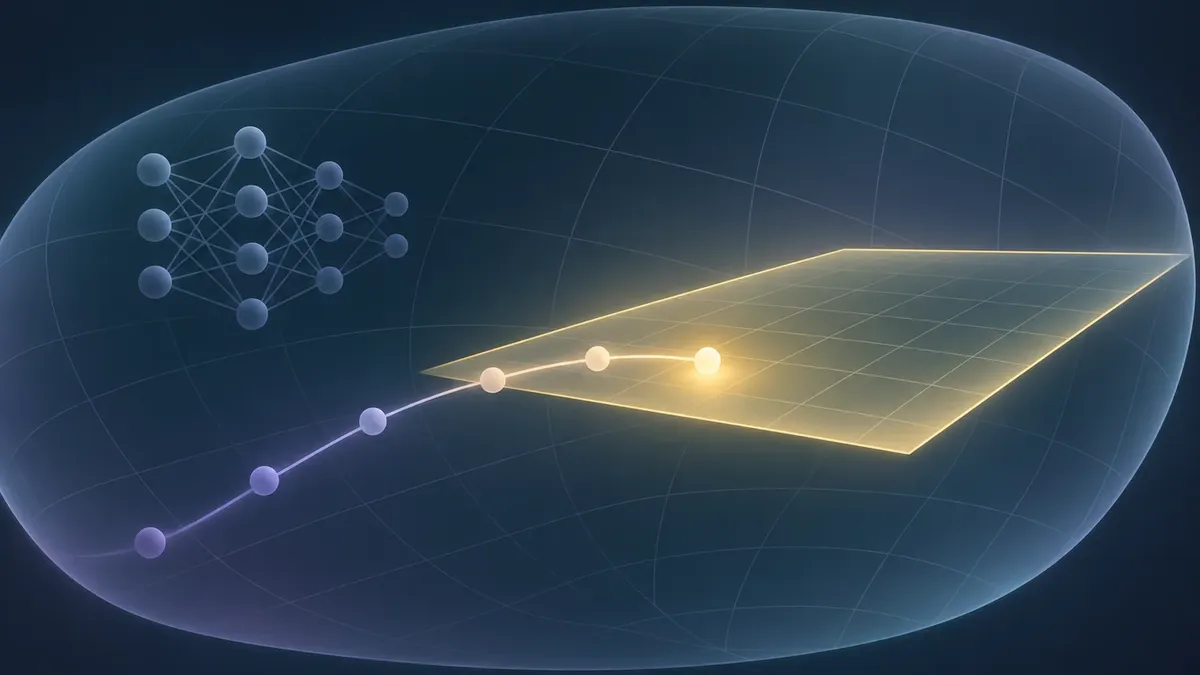
Why can a neural network memorize examples yet take much longer to answer new ones correctly? A preprint proposes a testable account for this delay in a family of mathematical tasks: during training, the network’s embeddings move toward a subspace defined by the task, and that movement is associated with the eventual rise in test accuracy.
Grokking describes a striking training pattern: a neural network learns its training examples, while accuracy on new examples remains low for a long time before rising. In Grokking as a Subspace Search: Computing the Destination Before Training, Sunjae Jeong, Jaeseung Kim and Hyoseok Hwang ask what happens during that delay. Their proposal is that, on certain group-operation tasks, the network searches for a particular subspace in its embeddings.
A subspace is a set of directions within a larger mathematical space. Here, the “right subspace” is not just any smaller part of the representation: the paper defines it using complete blocks of a group’s mathematical representations, with the selected blocks required to distinguish all elements of the group. The authors derive symmetry-compatible projectors from the task, then use these conditions to identify the right subspaces. The choice is not always unique: for the group S5, two minimal candidates remain.
A destination specified in advance
The experiments involve finite groups: mathematical systems whose elements can be combined according to a rule. In the main example, a network receives two permutations and must predict their product. The paper also studies conjugation, commutators and another operation built from group elements. Because these tasks have explicit algebraic structure, the authors can calculate relevant subspaces and accuracy limits before training.
The main setup uses a one-hidden-layer network, with further tests across groups, architectures and training procedures. The paper defines memorization as the first step at which training accuracy reaches 1.0, and grokking as the first step at which test accuracy reaches 0.95; the delay is the gap between those steps. The authors also measure embedding alignment with the defined subspace. They intervene by restricting embeddings to selected subspaces or rotating them toward a subspace during training. When embeddings are restricted to an unfaithful set of blocks—one that cannot distinguish some group elements—the task’s structure lets the authors calculate an accuracy ceiling.
In the main multiplication experiment, training accuracy reached 100% well before test accuracy rose. Restricting embeddings to the right subspace removed the long delay in the reported runs. Starting closer to that subspace was associated with a shorter delay; rotating toward a random subspace did not produce the same effect. In untouched runs, embeddings became more aligned with the right subspace before test accuracy increased. Alignment was not a universal threshold for generalization: runs generalized at different measured alignments, and the authors caution that alignment is not a distance from the destination.
When embeddings were instead restricted to a subspace built from unfaithful blocks, networks did not achieve full generalization. Across 163 restricted configurations, the reported plateaus tracked the calculated ceilings. This supports the predicted limits on accuracy, but does not by itself establish that the delay is a search; the authors say that claim rests on timing and intervention results. In one intervention, rotating embeddings toward the right subspace partway through training shortened the remaining delay in the tested runs.
The paper also examines optimization noise and weight decay. A hundredfold increase in gradient-noise power changed the delay by only a factor of 1.10, and a finite delay remained with exact gradients. But the authors report that weight decay accounted for most of the delay range across their sweeps. Their interpretation is not that training conditions are irrelevant: these factors can change how quickly the network searches, while the subspace proposal identifies what it is searching toward.
What the evidence can—and cannot—show
The proposed destination makes the account experimentally testable: it is derived from the task rather than inferred only after a network has generalized. The interventions provide evidence for the search interpretation in the tested settings. Still, the paper’s claim is limited to tasks with a visible group structure. It says that behind an ordinary encoder the projector becomes indistinguishable from a random subspace of the same size, and that on tasks without algebraic structure the right subspace is undefined.
Important details remain unresolved even within this scope. The paper’s alignment-delay formula predicts when generalization occurs from initial alignment, but does not explain the full path of alignment during training; its fitted exponent also differs between seed sets. The authors further note that pushing alignment below its usual level is quickly undone, without explaining why, and that why one of two tied candidate blocks tends to win remains open.
The study offers a specific account of delayed generalization in small mathematical systems, not a general explanation for all neural networks. It is an arXiv preprint; the supplied source does not establish whether it has undergone peer review.
- grokking
- neural networks
- machine learning
- generalization
- representation learning
- group theory
Reviewed cross-references
These connections were reviewed by a model, not independently fact-checked by a human. Similarity does not imply agreement; consult the original papers and the evidence below.
Why telling a quantum image model to ignore rotation can help
Supporting evidence: A bounded parallel is that task-structured constraints can improve a model’s outcome in the settings studied: Jeong et al. report that providing the computed right subspace removes the delay on tested group tasks, while D’Ambruoso et al. report better generalization for invariant quantum models on four D4-invariant image tasks trained with few tens of images. These are different models, constraints and outcomes; the image results do not support the proposed subspace-search mechanism. Jeong et al. limit their claim to visible group actions, and both papers are supplied as v1 preprints, so this is not independent confirmation.
Model review: · openai-codex/gpt-6-luna
Evidence and provenance
Selected excerpts, not complete papers. PDF extraction can omit figures or damage equations, tables and reading order; sources may be preprints.
2611.30116v1 — Original paper
Excerpt reference:
static/papers/2611.30116v1.md:81-155
Basis: Paper text
Source SHA-256:443d9325db0a8f90c5765c2cec12705a22466aff8680114f35fb7a6af529cfbb2611.30116v1 — Original paper
Excerpt reference:
static/papers/2611.30116v1.md:739-808
Basis: Paper text
Source SHA-256:443d9325db0a8f90c5765c2cec12705a22466aff8680114f35fb7a6af529cfbb2611.14368v1 — Original paper
Excerpt reference:
static/papers/2611.14368v1.md:12-71
Basis: Paper text
Source SHA-256:a0ce6fd2e9c9a69150e69df7721c53dd6204bfe3280fda3683c999fdf6f90105
Related reading
Automatically matched by shared topic keywords. These links do not imply that the sources agree or establish a consensus.
Can a model’s future features be spotted early?
Source published
Shared keywords: machine learning, neural networks, representation learning
A Mathematical Case for Neural Flow Matching
Source published
Shared keywords: neural networks
A GAN-based route to learning from full 3D brain MRI
Source published
Shared keywords: representation learning
Teaching Neural Networks to Mimic Voting Rules
Source published
Shared keywords: machine learning, neural networks
Can large learning rates help noisy SGD learn faster?
Source published
Shared keywords: neural networks