TRANSMISSION // 2611.30047v1
Robot Memory Fails When the World Keeps Moving
Source published
RoboLiveMem tests whether robot agents can keep information current as simulated people and machines change scenes during deliberation.
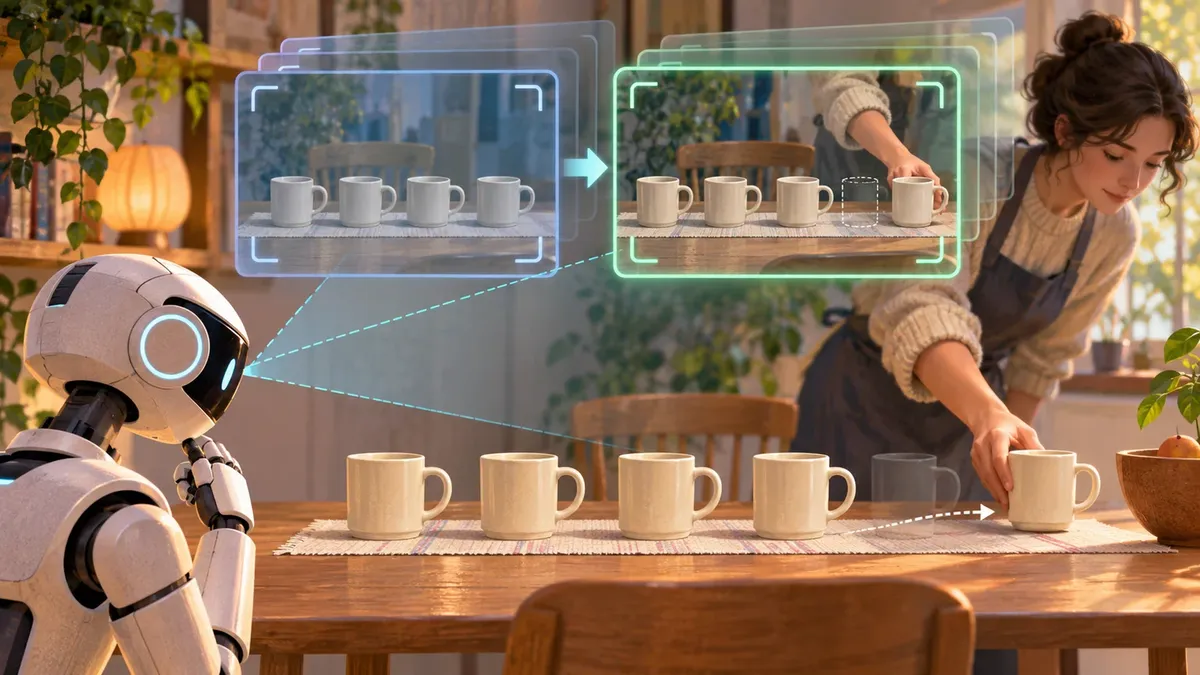
A robot may remember where an object was and still pick the wrong one. RoboLiveMem tests what happens when the world changes while an AI model is deciding. Its results suggest that looking again just before acting can help in some scenes, while repeated swaps remain challenging.
Many robot memory benchmarks pause the simulated world while an AI model thinks. That tests whether a robot can recall something it no longer sees, but it sidesteps a practical complication: in a shared space, people and machines may move things before the robot acts. A mug can be swapped while the robot is deciding which one to pick up.
A preprint introduces RoboLiveMem, a benchmark designed to ask whether robot agents can keep remembered information useful when the world changes during deliberation. The question is not just whether a model recalls an earlier observation, but whether it acts on information that is still accurate when its command takes effect.
The same task under two clocks
Researchers ran tasks under two conditions. In the “paused” condition, the world stopped while the model thought. In the “live” condition, other actors could continue moving objects during that time. The robot’s camera kept recording, but frames from the interval reached the model with its next decision. So a model might have evidence of a change and still act based on an earlier view.
The benchmark covers 29 task families across three simulated tiers: 16 scenes from BEHAVIOR-1K, kitchen tasks in MuJoCo, and controlled tasks in ManiSkill. Some tasks involve tracking a changed state, such as which identical mug is the target. Others require remembering a one-time event, such as whether soup has been salted. Decoy movements and episodes with no meaningful change make it harder to succeed by simply assuming that something happened. For most tasks, a “visible twin” adds a cue that follows the important state. Comparing the twin with the version where that state is hidden helps researchers separate memory demands from other difficulties.
The team tested 16 models across 34,176 episodes. In realistic scenes where a remembered object changed, eight Claude and GPT models succeeded in 97% of episodes on average when the world was paused, versus 50% when it kept running. Their relative performance also shifted: Claude Opus 5.5, which succeeded in every paused episode in that comparison, succeeded in about 44% in the live condition. On episodes without a change to the important state, live success was high. This is a comparison within the benchmark; it does not by itself establish that changes alone explain every performance difference.
Seeing a change is not the same as acting on it
The researchers tested whether the live-condition gap was mainly about speed. Across the models, slower decision-making did not consistently predict worse results. In controlled swap tasks, giving each decision a fixed two seconds still left every tested model at least 36 percentage points below its paused success. Speed could matter under a tight deadline: in one controlled setup with a 65-second limit, Gemini 4 Carbon timed out in most live episodes.
The study also examined when the robot made its decisive choice. A decision counted as “stale” if it relied on camera frames from before another actor had finished changing the scene. In the realistic tier, stale decisions succeeded in 38–57% of episodes across the five models reported in this analysis; fresh decisions succeeded in 49–96%. In an offline probe, some models correctly identified the important state from the frames they had received in failed episodes. That shows they could identify it in those cases, but does not establish why all failures occurred.
To test whether a newer view could help, the team added a “commit check.” Just before a command ran, the robot looked at the target again. If the view had changed, it cancelled the command and made a new decision. In the 13 realistic scenes where this check applied, success rose for all five tested models. The measured memory gap—the difference between performance with the state hidden and with its visible twin—ranged from −1.8 to 3.6 percentage points. That narrow result applies to those scenes and models; it does not show that memory difficulties have been eliminated generally.
The check was less conclusive in controlled tasks where identical objects swapped places several times. Even after rechecking, the models performed worse when the state was hidden than when a cue followed it. The authors say the robot must have followed every swap; the benchmark does not establish one general mechanism behind the remaining failures.
Scope and uncertainty
RoboLiveMem separates several possible challenges: time passing during a decision, acting on an outdated view, and keeping track of changes that are not visible at action time. The results suggest that rechecking can address some outdated-view problems, while repeated swaps remain difficult in the tested tasks. They do not establish how robots would perform in every home or on physical hardware.
All scenes were simulated, and other actors followed scripts. The authors note that people in the realistic tier did not have articulated arms and that latency depended on the load of public model services. They also caution that results on the realistic tier should be compared carefully across different agent setups. The preprint reports paired bootstrap intervals for measured differences, but conclusions remain specific to the tasks, models and procedures tested.
RoboLiveMem is described in an arXiv preprint, which may not have undergone peer review. The findings are best read as evidence about a particular evaluation gap: success when a simulated world waits does not establish that a robot can keep information current when that world keeps moving. Read the preprint.
- robotics
- AI memory
- vision-language models
- robot benchmarks
- embodied AI
- real-time robotics
Related reading
Automatically matched by shared topic keywords. These links do not imply that the sources agree or establish a consensus.
Why a robot’s interface can matter as much as its AI
Source published
Shared keywords: embodied ai, robot benchmarks
Can a large vision model use a smaller model’s visual memory?
Source published
Shared keywords: embodied ai, vision language models
A Simulated World for Robots That Learn From Doing
Source published
Shared keywords: embodied ai, robot benchmarks
Robots Need to Know Not Just What to Do, but When
Source published
Shared keywords: robot benchmarks
A robot can finish the task—and still ignore the instructions
Source published
Shared keywords: robot benchmarks