TRANSMISSION // 2611.30042v1
Keeping game characters consistent when they leave the screen
Source published
SWAM separates character movement from video generation so off-screen game characters can keep evolving. Tests in one custom shooter show better consistency, with important limits.
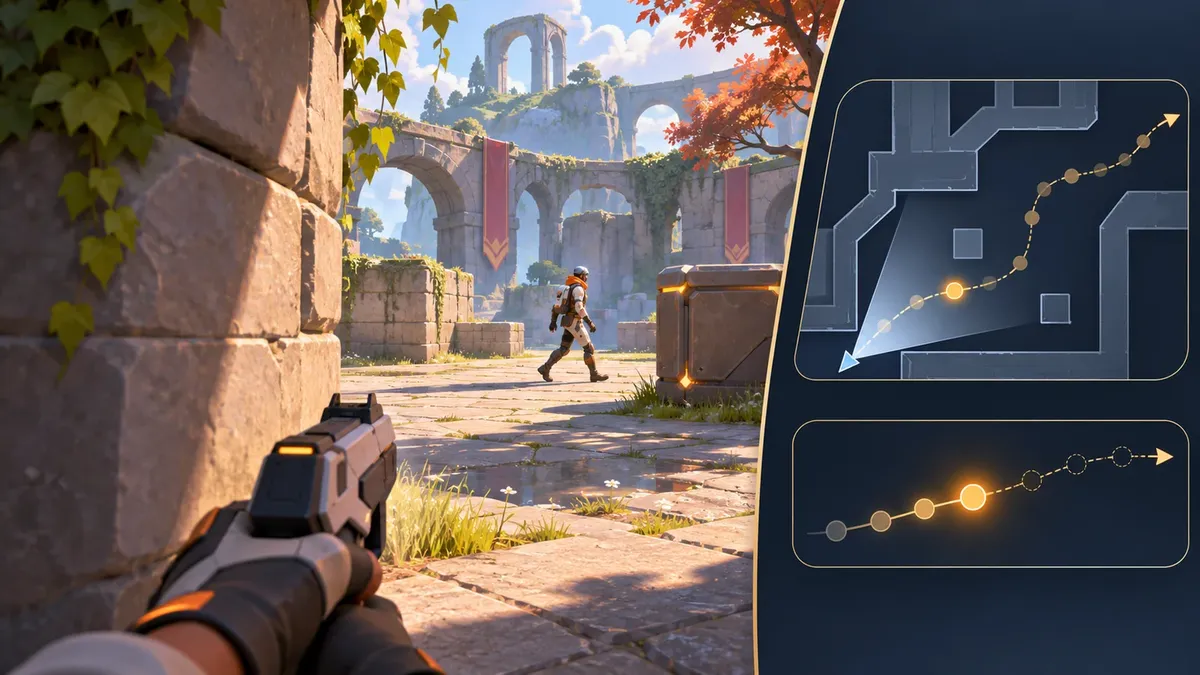
A game world can look convincing frame by frame yet lose track of characters when they move out of view. SWAM, a research system tested in a custom first-person shooter, tackles that problem by predicting character states separately from the video it generates.
In an interactive game, the camera shows only part of the world. A character who walks behind a wall or out of view does not stop moving—but a video-generating model may have little visual evidence about what happens next. When the character reappears, it might be in the wrong place, look different, or be missing altogether.
That is the challenge addressed by SWAM, short for State-aware World Action Model. The researchers ask whether a system can keep track of independently acting players and non-player characters (NPCs) without generating separate videos for them or relying on a detailed map of the scene.
Track the state, then generate the view
SWAM splits the task into two parts. A lightweight state model predicts each character’s position, movement, orientation and other game-state information from recent states and actions. It combines basic motion rules—such as how movement and gravity work—with learned adjustments for situations where those rules are not enough, including collisions and landings. Crucially, this model does not need to inspect newly generated video frames to keep updating characters.
A separate video model uses those predicted states, along with visual history and the camera player’s actions, to generate the next view. SWAM projects character locations into rough indicators of where they might appear on screen. The indicators do not say whether a wall blocks a character. Instead, the video model learns from examples when and how characters should be visible or occluded.
The team trained and tested the system in a custom 3D first-person shooter built with Godot. Its main dataset contained 40 hours of four-player gameplay, with recorded actions and ground-truth game states. The researchers compared SWAM with a video model without explicit state conditioning and with Solaris, a system that generates multiple player views. The evaluation included short clips and long, autoregressive rollouts—sequences in which each generated frame helps condition the next.
Better character tracking in this testbed
In the reported comparisons, SWAM scored better on the study’s visual-quality measures and achieved higher character recall than the two comparison methods. These character figures come from a study-specific detector-based evaluation: the researchers filtered ground-truth character boxes by camera field of view and matched generated detections to eligible characters using set overlap thresholds. They are not a general measure of a system’s ability to detect characters.
In 30-second rollouts, recall was 71.1% for SWAM, compared with 28.3% for the model without state conditioning and 22.6% for Solaris. Here, recall means the share of eligible characters rendered in the correct location under that evaluation procedure.
In ten-minute rollouts, SWAM’s recall was 57.2%; the two comparison methods fell to 2.0% and 1.1%. SWAM’s precision—the share of generated character detections that matched eligible characters—was 55.0% in that setting. The researchers also report that the model generally avoided drawing characters judged to be outside the camera’s view, despite the spatial indicators not explicitly encoding wall occlusion.
These results suggest that separating character-state prediction from image generation can help a generated game world remain coherent as characters disappear and return. But the visual-quality results require an important qualification: the headline Table 1 metrics use ground-truth character states. Results using predicted states are analyzed separately in supplementary material, so those headline metrics should not be treated as a complete assessment of end-to-end performance with predicted states alone.
What remains uncertain
The evaluation covers one custom shooter with relatively simple graphics and a particular set of character behaviors. The researchers say training requires synchronized video, actions and ground-truth states for every character—a demanding kind of data to obtain from ordinary gameplay footage. Their state model can also accumulate position and orientation errors over time, affecting what the video model draws. Uncertainty-aware predictions or occasional visual feedback are proposed as possible future directions, not solutions demonstrated in the study.
SWAM is described in an arXiv preprint, a research manuscript whose peer-review status is not established by the available source. Its findings are evidence from a controlled game test, not proof of reliable performance across commercial games or real-world environments. The work offers a specific design idea: maintain a compact simulation of who is where, then let a separate model decide how that state should look from the current viewpoint.
- world models
- video generation
- NPCs
- multi-agent AI
- 3D games
- artificial intelligence
Reviewed cross-references
These connections were reviewed by a model, not independently fact-checked by a human. Similarity does not imply agreement; consult the original papers and the evidence below.
A robot's-eye view, generated from outside video
Supporting evidence: Both papers report gains when structured information conditions video generation: SWAM’s ablations show improved visual and player-detection metrics with fuller character state and FOV conditioning in a custom FPS, while AuroraWorld’s ablations show its combined spatial, temporal, and motion components outperforming an unconditioned baseline on video metrics for robot-view synthesis. These results support the bounded point that structured conditioning helped in each evaluated setting; the tasks, inputs, and metrics differ, so they do not establish a direct comparison or a general guarantee.
Model review: · openai-codex/gpt-6-luna
Evidence and provenance
Selected excerpts, not complete papers. PDF extraction can omit figures or damage equations, tables and reading order; sources may be preprints.
2611.30042v1 — Original paper
Excerpt reference:
static/papers/2611.30042v1.md:889-967
Basis: Paper text
Source SHA-256:77746958ecea921dfe37c666f3a74776ac4528105ea163bb99269e1fd8d710f52611.00177v1 — Original paper
Excerpt reference:
static/papers/2611.00177v1.md:902-1021
Basis: Paper text
Source SHA-256:51fa1c602592723ce01037eb0349bc8a528b48be281a4916ec37096c8fc249ae
Related reading
Automatically matched by shared topic keywords. These links do not imply that the sources agree or establish a consensus.
Could AI Think by Watching Its Own Imagined Scenes?
Source published
Shared keywords: artificial intelligence, video generation
Eight tokens to help a world model plan
Source published
Shared keywords: artificial intelligence, world models
Teaching robot video models to focus on what moves
Source published
Shared keywords: video generation, world models
When AI’s imagined drives miss the odds
Source published
Shared keywords: video generation, world models
A robot's-eye view, generated from outside video
Source published
Shared keywords: world models