TRANSMISSION // 2611.30001v1
How cluster gas may carry the Flying Fox radio source
Source published
XRISM measurements in Abell 1060 reveal gas motions aligned with the compact Flying Fox radio source. The results favor transported fossil plasma over electron acceleration by present-day turbulence, but the interpretation has important uncertainties.
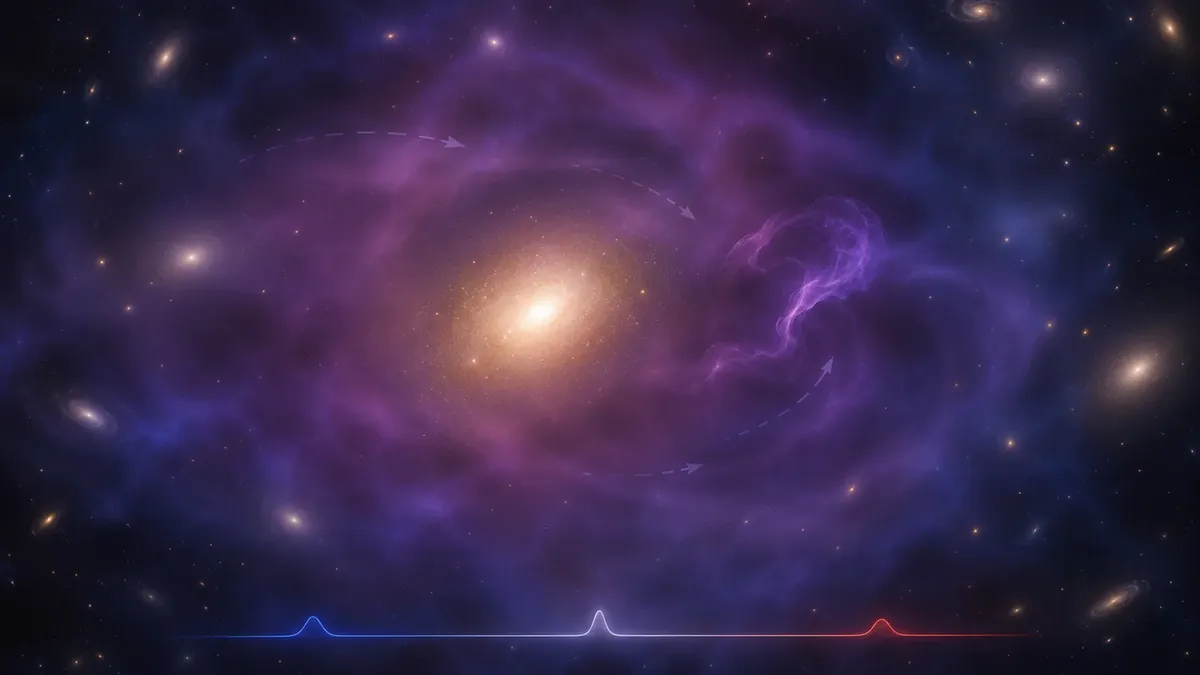
A diffuse radio structure near the center of galaxy cluster Abell 1060 may consist of old material from an active galaxy, carried through the cluster by moving hot gas. XRISM’s X-ray measurements support that picture, while suggesting that the gas’s present turbulence is too weak to produce the radio-emitting electrons on its own.
Galaxy clusters are filled with extremely hot gas, called the intracluster medium, or ICM. Some also contain diffuse radio emission produced by energetic electrons spiraling through magnetic fields. A key question is how those electrons got there: were they accelerated in place by turbulent gas, or did they come from an earlier outburst by a central galaxy and later get transported?
A study of Abell 1060 examines this question using XRISM’s Resolve instrument, which measures the X-ray lines emitted by hot gas. Changes in a line’s energy reveal gas moving toward or away from us; line broadening provides an estimate of unresolved motion. The target is the cluster’s central radio structure, nicknamed the Flying Fox (FF), near the brightest cluster galaxy, NGC 3311.
The researchers analyzed the central region observed by Resolve. They first fitted the X-ray spectrum across the field, then divided it into smaller regions to map gas properties. Because XRISM’s telescope can mix photons from neighboring regions, they also performed a spatial-spectral-mixing analysis, using Chandra images to help account for that effect. The Resolve field covers only a small part of the cluster, so these measurements describe the center, not the cluster as a whole.
The spatial analysis found a line-of-sight velocity difference of about 100 kilometers per second across the field, with the change running along the same general direction as the Flying Fox’s extended shape. This is evidence for organized gas motion, although it does not reveal its full three-dimensional direction or prove that the gas is carrying the radio source. The authors discuss several possible origins for the motion, including sloshing, rotation, or a past gravitational disturbance. They identify no uniquely established cause.
The overall measured velocity dispersion—the spread of gas velocities—is about 97 kilometers per second, with a reported 90% confidence interval of roughly 72 to 121 kilometers per second. In the three-region analysis, the central region containing NGC 3311 has a marginally larger dispersion than the neighboring regions. The authors suggest that interactions between the galaxy and surrounding gas could stir the ICM, but the result does not establish that explanation as certain.
The Flying Fox is compact, around 30 by 50 kiloparsecs in projected size, and lies close to the central galaxy. Those features lead the authors to favor a scenario in which past activity of NGC 3311 supplied aged, or “fossil,” radio-emitting plasma, which was later displaced by gas motions. The observed alignment is consistent with this idea, but XRISM measures line-of-sight motion—not the transverse speed or the plasma’s journey from its source.
To test whether current turbulence could instead generate or sustain the radio emission, the researchers estimated its energy supply and compared an estimated particle-acceleration time with the time over which electrons lose energy through radiation. These calculations require assumptions, including a turbulence scale of 50 kiloparsecs and a magnetic-field estimate based on equipartition. Under the adopted parameters, the acceleration time is about 2.5 billion years, while the estimated radiative cooling time is about 210 million years. That mismatch suggests the measured turbulence is insufficient to accelerate electrons to the energies needed for the radio emission. It could, however, weakly reenergize electrons that already exist.
These are model-dependent estimates, not direct measurements of the acceleration process. The assumed turbulence scale and magnetic field are uncertain, and the paper notes that XRISM measurements may underestimate the true turbulence under some conditions. The authors also estimate a transport time of about 300 million years by adopting a transverse speed of 100 kilometers per second. That speed is illustrative, motivated by the measured line-of-sight difference; it is not measured directly, so the timescale does not show that transport finishes within the electrons’ cooling time.
Overall, the observations favor a history in which past activity of the central galaxy supplied the plasma, cluster gas motions transported it, and weaker turbulence may have modified it. They do not establish that history conclusively. This article summarizes the arXiv version identified as 2611.30001v1; the supplied source text includes journal-style formatting, but the available material does not clarify the publication history or review status.
- Abell 1060
- XRISM
- Flying Fox
- galaxy clusters
- intracluster medium
- turbulence
- radio astronomy
Reviewed cross-references
These connections were reviewed by a model, not independently fact-checked by a human. Similarity does not imply agreement; consult the original papers and the evidence below.
A Quiet Core in Abell 2199, Seen in X-rays
Shared method: Both studies use XRISM/Resolve spectroscopy to measure intracluster-medium velocities and velocity dispersion. The Abell 1060 study reports spatially resolved velocity mapping; the Abell 2199 study divides the field into regions for spatially resolved spectral analysis. Their different targets and analyses limit the comparison to a shared observational method.
Model review: · openai-codex/gpt-6-luna
Evidence and provenance
Selected excerpts, not complete papers. PDF extraction can omit figures or damage equations, tables and reading order; sources may be preprints.
2611.30001v1 — Original paper
Excerpt reference:
static/papers/2611.30001v1.md:112-171
Basis: Paper text
Source SHA-256:9235518bda8c5ca40f489f3ec3ac02812cdbe66524be718803c01ac71a0969892607.06977v3 — Original paper
Excerpt reference:
static/papers/2607.06977v3.md:302-393
Basis: Paper text
Source SHA-256:a119dcc93afae6733835025888333db0b8220a153fcdf6fc4cc4a31ea7688b6a
Related reading
Automatically matched by shared topic keywords. These links do not imply that the sources agree or establish a consensus.
A Quiet Core in Abell 2199, Seen in X-rays
Source published
Shared keywords: galaxy clusters, intracluster medium
What stirs a galaxy cluster: black-hole bubbles or a passing neighbor?
Source published
Shared keywords: galaxy clusters
Modified gravity still leaves galaxy clusters with missing mass
Source published
Shared keywords: galaxy clusters, intracluster medium
One Simulated Cluster Reveals How Black-Hole Feedback Shapes Cool Gas
Source published
Shared keywords: galaxy clusters, intracluster medium
Simulated galaxy clusters match X-ray outskirts—but their cores look too faint
Source published
Shared keywords: galaxy clusters, intracluster medium