TRANSMISSION // 2611.29998v1
What Does Category Theory Say About AI Agents?
Source published
Yong Wang’s abstract outlines a categorical treatment of transformers, agents and multi-agent coordination. The available evidence does not show how the formalism works.
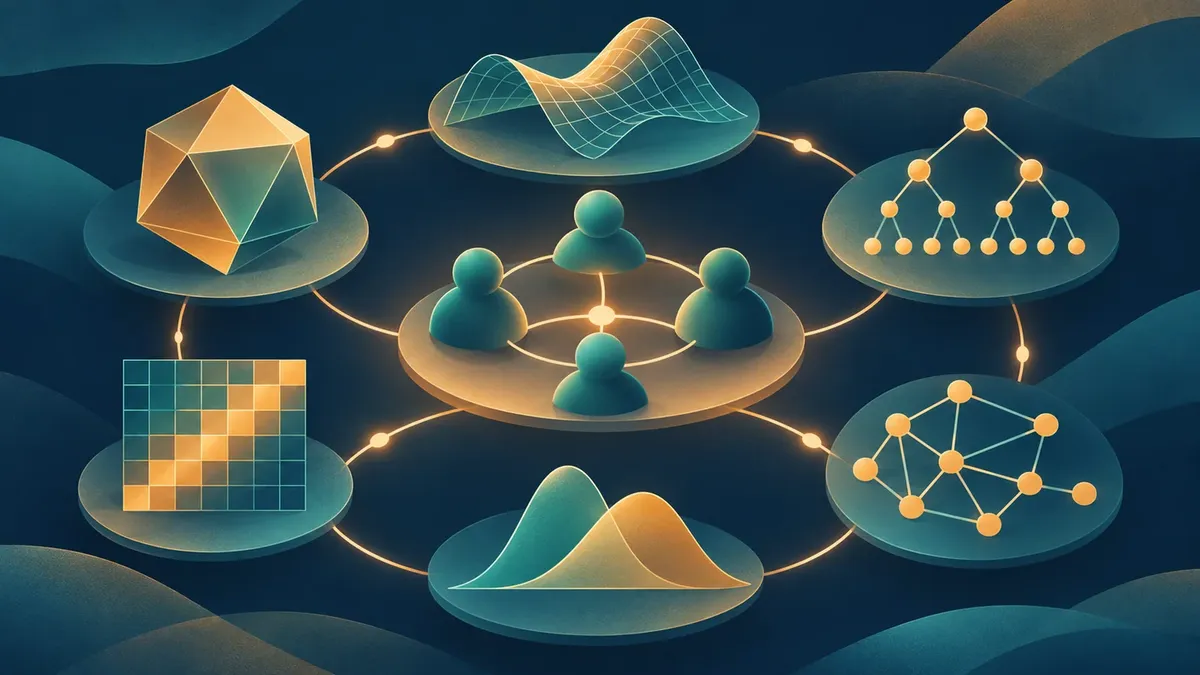
How might AI agents and the systems that coordinate them be described mathematically? Yong Wang’s preprint says it develops categorical foundations for transformers, agents, and agent orchestration and choreography. Its abstract gives the scope, but not enough detail to assess the definitions or results.
A mathematical framing of AI agents
Yong Wang’s preprint, “Categorical Foundations of AI Agents,” takes up a broad question: how can AI agents and arrangements of agents be treated within a mathematical framework? The abstract says the work follows the idea of separating intelligence from execution, then gives categorical foundations for several related subjects.
Specifically, it says the paper categorizes transformers, agents, and the orchestration and choreography of AI agents. It also says the treatment includes coalgebras and algebras. These are the topics named in the abstract; it does not explain how the paper defines them or relates them to one another.
What can be said from the abstract
The abstract identifies the work as a mathematical account of AI agents, rather than describing an experiment or reporting agent-performance results. It does not provide the definitions, arguments, examples or conclusions needed to explain the framework in detail. That is a limit of the available source material here: because the evidence is abstract-only, it cannot establish what details appear in the full paper.
The stated separation of intelligence from execution is also not defined in the abstract. It would therefore be premature to assign it a more specific meaning or to infer how the distinction is used in the paper. Likewise, the abstract names orchestration and choreography but does not say how it distinguishes them.
What remains uncertain
The abstract does not give enough information to evaluate the mathematical contribution, the precise role of algebras and coalgebras, or the framework’s possible applications. It also does not report empirical findings or claim that the approach improves an agent’s performance. Those questions require the full paper and examination of its definitions and arguments.
The source is an arXiv preprint. Based on the supplied abstract, the careful takeaway is limited: Wang says the work applies categorical foundations to transformers, agents and multi-agent arrangements, while following an idea of separating intelligence from execution. The abstract alone does not let readers assess the technical details or broader significance.
- AI agents
- category theory
- transformers
- multi-agent coordination
- algebras and coalgebras
Related reading
Automatically matched by shared topic keywords. These links do not imply that the sources agree or establish a consensus.
Why AI agents still struggle to work as a team
Source published
Shared keywords: ai agents, multi agent coordination
A publish-subscribe network for coordinating AI agents
Source published
Shared keywords: ai agents, multi agent coordination
A shared task board for AI agents that need to wait
Source published
Shared keywords: ai agents, multi agent coordination
Why AI Agents Still Stumble on Complex Tasks
Source published
Shared keywords: ai agents
When Coding Agents Work Alone, Their Changes Can Clash
Source published
Shared keywords: multi agent coordination