TRANSMISSION // 2611.29982v1
Can GPU Current Reveal Hidden AI Training?
Source published
A preprint tests whether an external current sensor can flag GPU activity that differs from an operator’s declared workloads. Results on one H200 are promising, but depend on a carefully built reference and do not establish a ready-made verification system.
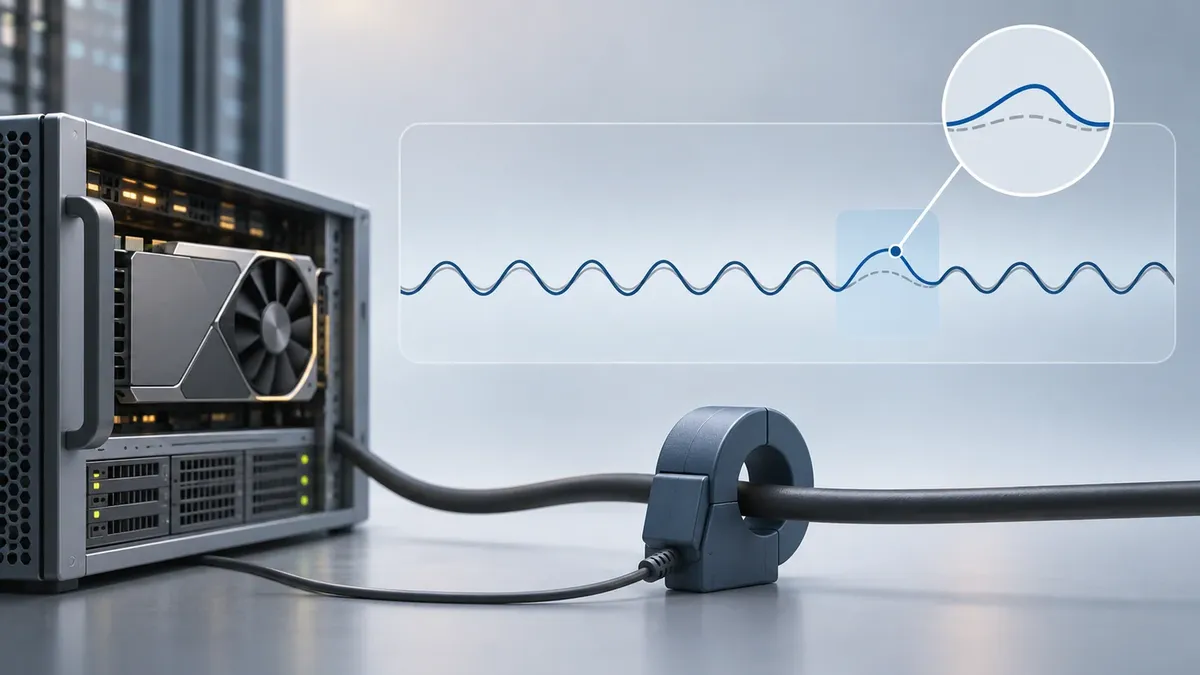
AI compute agreements are difficult to enforce if an operator’s word is the only evidence of how a GPU is being used. Tom Kimpson’s preprint explores a physical clue: the electrical current drawn by a GPU. Can an external sensor spot activity that does not match declared uses such as inference or idle time?
A physical signal, not a view inside the software
An outside verifier may not have access to a GPU operator’s software or logs. But a GPU draws electrical current, and its current patterns can reflect its activity. This study asks whether those patterns can help check an operator’s declaration of permitted workloads—without collecting examples of every kind of prohibited training or attempted disguise.
The approach is a “signature check.” A detector learns the current patterns of declared work, then flags later signals that differ from that reference. An alarm means “this does not match the declaration,” not necessarily “this is AI training.” Unexpected activity could have another explanation and would need investigation.
How the test worked
The author measured current on one NVIDIA H200 NVL, using a Rogowski coil clamped to the GPU’s auxiliary power supply. Across 62 workload runs, the dataset contained 23.4 hours of recordings. Activities included idle, inference prompt processing (“prefill”) and token generation (“decode”), ordinary training, non-AI computing, and five evasion groups: time-sharing, co-location, jitter, padding, and power cap.
The current signal was divided into five-second windows. An isolation-forest model was fitted to development recordings of declared work—idle, prefill and decode—but not to training or evasion examples. Separate calibration recordings of declared work set the alarm threshold. The study also tested a continuous monitor, which combined flagged windows into alarms rather than reacting to each window individually.
Promising results, with important conditions
With a complete reference containing all three declared activities, the signature check flagged at least 99.9% of windows in each tested evasion group. In a continuous test-day monitor, it detected all 188 scored episodes of training hidden by time-sharing with inference. The median delay from the first training step to an alarm was 3.0 seconds.
The monitor raised no alarm on test-day decode, but that exposure was short. It raised one alarm during the 8.35 hours of declared idle; across the paper’s reported 8.8 hours of declared work, that is the single alarm. These results describe this experiment, not a general guarantee. The test day included only 0.475 hours of decode and no prefill, limiting what it can show about false alarms on held-out inference. Some detection results were measured on development data; the test-day monitor results were held out, but not every evaluation was.
The reference can make or break the check
A signature check depends on both components of its reference: the recordings used to fit the detector and the separate recordings used to set its threshold. If a declared activity is missing from both, the detector can flag that legitimate activity repeatedly. In the study, a decode-only reference—missing idle from both components—left the monitor in alarm for 99.97% of declared idle, a conspicuous failure.
A different omission caused a silent failure. When idle was omitted from the fit but included in the threshold-setting recordings, the threshold rose enough that the monitor missed all 188 tested hidden-training episodes while raising no alarm on declared work. Including training in the reference could also blunt detection. A quiet monitor, therefore, is not proof that the check is working. The paper recommends that verifiers witness reference recordings, cover multiple sessions and use positive controls to test the monitor.
What the study does—and does not—show
The evasion strategies did not adapt to the detector. The study also did not test diluted low-rank adaptation, an approach that has reduced detection in earlier work. The probe measured current on the auxiliary supply, not through the GPU’s PCIe slot, and the recording setup lacked an anti-alias filter. Under idle, aliased variance may exceed in-band variance by up to 13 times; the author did not test how filtering or a different digitiser would change the results.
The detector’s threshold depended on a small number of calibration recordings. The study did not establish how the method would perform across many GPUs, varied models or a broad catalogue of declared workloads. It is a preprint, not a peer-reviewed publication. Its findings suggest that external current sensing could help check declared GPU activity under controlled conditions. They do not establish that the method can identify training from an alarm, or that results from one GPU extend reliably to large systems or determined, adaptive operators. Broader testing and independent replication would be needed before treating it as a dependable governance tool.
- GPU current sensing
- AI compute verification
- AI governance
- hardware monitoring
- machine learning security
Related reading
Automatically matched by shared topic keywords. These links do not imply that the sources agree or establish a consensus.
AI Should Not Act Beyond Its Permission: A Governance Framework
Source published
Shared keywords: ai governance
AI safety may depend more on access than intelligence, preprint argues
Source published
Shared keywords: ai governance
A financial AI that knows when not to guess
Source published
Shared keywords: ai governance
Generative AI in information systems: promise meets governance
Source published
Shared keywords: ai governance
How should frontier open-weight AI be governed?
Source published
Shared keywords: ai governance