TRANSMISSION // 2611.29969v1
Teaching 3D AI to Check the Evidence It Uses
Source published
CARE-3D trains an AI agent to choose among 3D scene-grounding tools. Its evidence reward measures whether returned information raises the likelihood of the correct answer; tests report gains on two benchmarks.
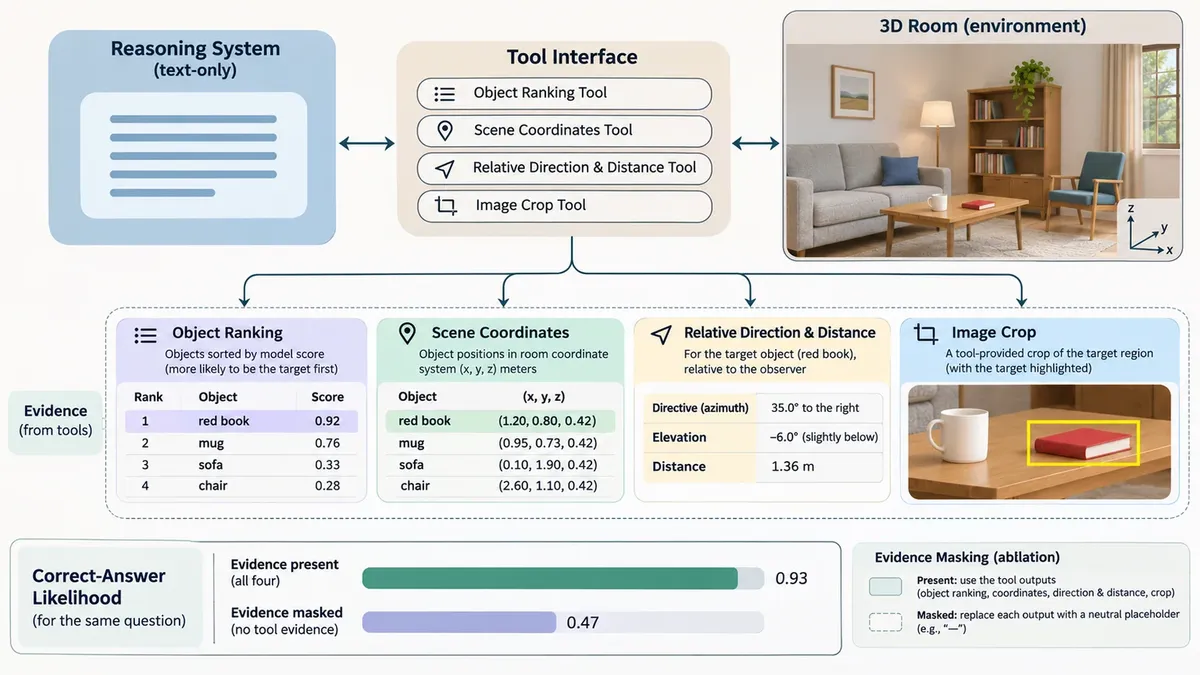
When an AI answers a question about a room, is it using information from the scene—or relying on familiar patterns? CARE-3D is a training framework designed to help 3D-reasoning agents choose scene evidence and assess how that evidence relates to the correct answer.
A question such as “What is at my two o’clock?” cannot be answered from object labels alone. An agent must account for the observer’s viewpoint and identify what lies in that direction. But even a correct answer may come from a familiar pattern rather than information retrieved from the scene. CARE-3D, a research preprint by Xiaoqian Hu and colleagues, asks whether reinforcement learning can help agents choose useful evidence and make their answers more responsive to it.
The framework gives an agent four ways to request information from a 3D scene. One tool ranks objects by how well they match a description. Another returns their positions and sizes in scene coordinates. A third reports direction and distance relative to the observer. A fourth returns a highlighted image crop, which can show an object’s appearance and nearby surroundings. Different questions call for different evidence: a viewer-relative direction is not the same kind of information as an object’s color or shape.
The team first uses supervised fine-tuning (SFT) to teach the model to make valid grounding requests and answer using returned evidence. CARE-3D then applies Group Relative Policy Optimization (GRPO), a reinforcement-learning method, while keeping the 3D grounding module and vision-language backbone frozen. It updates the agent’s LoRA adapters, a smaller set of model parameters.
Two additions change how training evaluates interactions. Counterfactual Attribution of Returned Evidence (CARE) compares the likelihood of the ground-truth answer when returned evidence is available with its likelihood when that evidence is replaced by a fixed placeholder. The difference estimates how much the evidence changes the model’s likelihood for the correct answer; it does not directly check whether the evidence supports the agent’s own generated answer. This signal is combined with rewards for answer correctness and valid interaction format.
Group Coverage Sampling (GCS) addresses the possibility that some tools may be sampled too rarely during training. For each prompt, it adds two coverage rollouts using the least-used tools among six freely sampled attempts. The added rollouts let those tools’ returned evidence enter training comparisons. GCS is disabled during evaluation, when the agent selects its tool without this coverage procedure.
The researchers report benchmark results on MSQA and Beacon3D. MSQA tests situated 3D questions, including counting, attributes, spatial relations and navigation. Beacon3D reports answer scores per question and an object-level score that requires all questions associated with a target object to be answered correctly. The team used MSQA for reinforcement training and reserved Beacon3D for evaluation. Across four model backbones, CARE-3D improved on the corresponding SFT baselines for MSQA’s overall score and both Beacon3D measures. In an ablation using Qwen3-VL-4B, CARE-3D scored 65.7 on MSQA overall, compared with 62.6 for GRPO using answer and format rewards alone. Among the tested GRPO variants in that comparison, the version combining CARE and GCS scored highest on the reported measures.
The paper also reports analyses beyond those benchmark scores. Among 103 MSQA errors where the SFT model’s answer stayed unchanged when evidence was masked, CARE-3D corrected 47 on that fixed subset. In a separate analysis of 1,369 validation samples, reported answer accuracy was 56.8% for CARE-3D and 49.7% for SFT; the authors also reported lower rates of incorrect grounding and misinterpretation of returned evidence. These findings are consistent with greater sensitivity to scene evidence, but they do not establish that every answer is properly grounded or that the method will work in physical environments.
Important limits remain. The agent makes one grounding request per question, so it cannot refine a failed query or combine evidence through multiple calls. CARE’s evidence-masking comparison may create an unfamiliar input, and likelihood scores can depend on how the correct answer is phrased. The method also requires extra computation during training. Benchmark performance was evaluated on MSQA and Beacon3D; the paper additionally reports validation and evidence-intervention analyses. The results do not establish broad transfer beyond the evaluated data or safe performance in real-world settings. The authors caution against safety-critical use without human oversight and further validation.
The source is an arXiv preprint: the supplied material does not establish peer-review status. Its results should be treated as preliminary. The paper reports experiments on two benchmarks and releases code, but does not show that CARE-3D is ready for deployment or establish how well it would perform beyond the settings evaluated.
- 3D reasoning
- artificial intelligence
- reinforcement learning
- grounded AI
- spatial reasoning
- vision-language models
Reviewed cross-references
These connections were reviewed by a model, not independently fact-checked by a human. Similarity does not imply agreement; consult the original papers and the evidence below.
Can visual AI learn to work without its tools?
Shared method: Both papers use GRPO in reinforcement-learning training: CARE-3D applies it to optimize situated 3D grounding decisions, while Tool-to-Self includes a GRPO objective in its RL stage. This is a shared optimization method, not evidence that their reward designs, training setups, or results are equivalent.
Model review: · openai-codex/gpt-6-luna
Evidence and provenance
Selected excerpts, not complete papers. PDF extraction can omit figures or damage equations, tables and reading order; sources may be preprints.
2611.29969v1 — Original paper
Excerpt reference:
static/papers/2611.29969v1.md:13-94
Basis: Paper text
Source SHA-256:94db5f03b5165e205a34ef43a3571b517c9a6f95f2e0f1f4b6657a453a8debe72611.29969v1 — Original paper
Excerpt reference:
static/papers/2611.29969v1.md:507-581
Basis: Paper text
Source SHA-256:94db5f03b5165e205a34ef43a3571b517c9a6f95f2e0f1f4b6657a453a8debe72611.28564v1 — Original paper
Excerpt reference:
static/papers/2611.28564v1.md:1100-1177
Basis: Paper text
Source SHA-256:89152de20c57bce4f4da155a9efdd3b4040a33d00fe357013d1eb14e8bd7904e
Related reading
Automatically matched by shared topic keywords. These links do not imply that the sources agree or establish a consensus.
StereoVLM: Teaching AI to See in 3D with Two Cameras
Source published
Shared keywords: vision language models
WorldMind tests spatial reasoning without turning every imagined view into an image
Source published
Shared keywords: reinforcement learning, spatial reasoning, vision language models
Can AI agents share a scene through words?
Source published
Shared keywords: reinforcement learning, spatial reasoning, vision language models
Can visual AI learn to work without its tools?
Source published
Shared keywords: artificial intelligence, reinforcement learning, vision language models
Why visual features help AI reason about camera movement
Source published
Shared keywords: spatial reasoning, vision language models